The views expressed herein are solely mine.
Mali: Al-Qaeda’s Next Fallen State
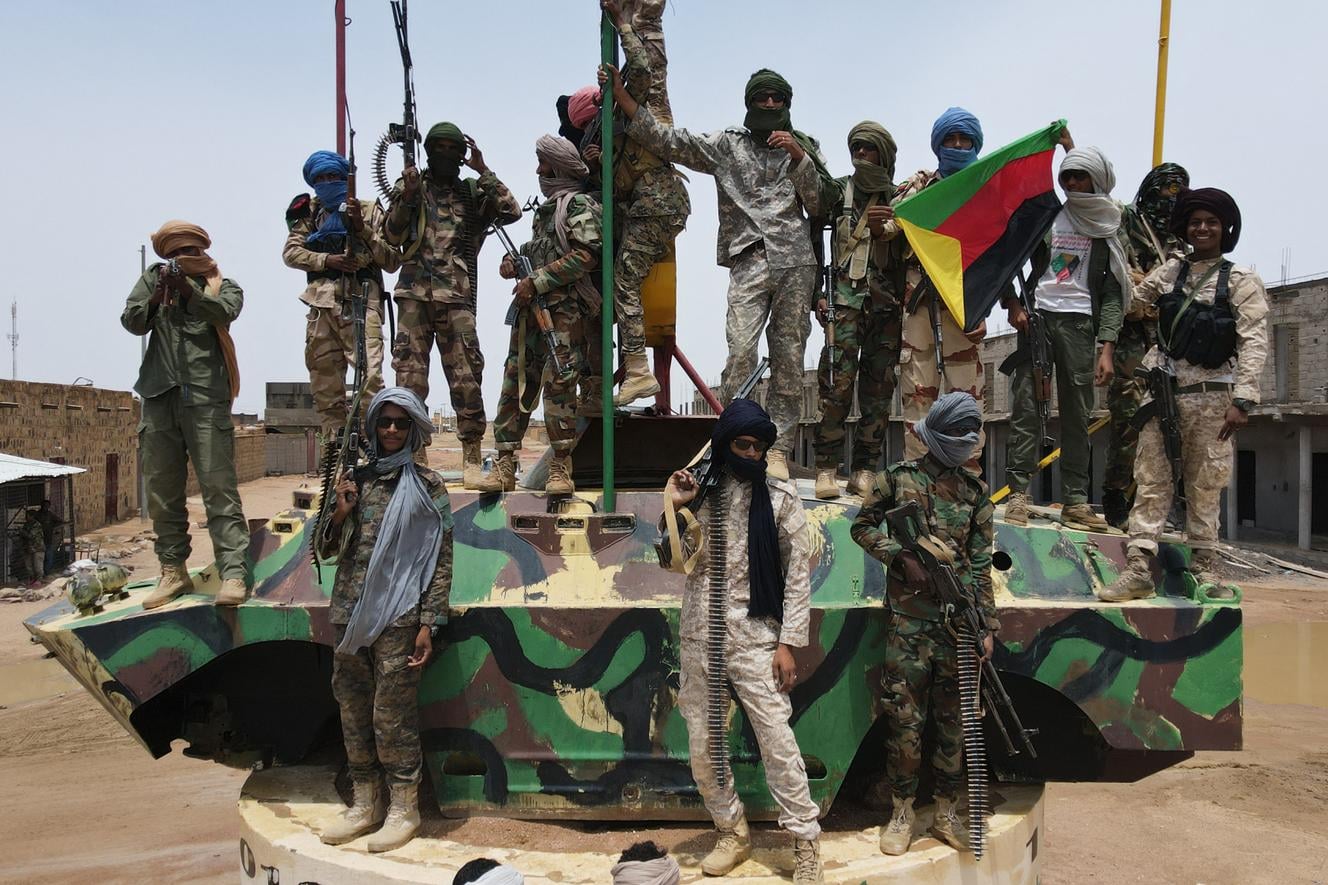
Tuareg rebels of the MNLA in Kidal, in northern Mali, on August 28, 2022. In 2024, the MNLA joined with other Tuareg groups under the FLA (Azawad Liberation Front). SOULEYMANE AG ANARA / AFP.
Al-Qaeda was never defeated—it simply repositioned itself.
This terrorist organization simply shifted from Afghanistan’s mountains to Africa’s vast, ungoverned belt, and today Mali stands on the brink of becoming the terror network’s most consequential comeback in a generation.
What we are witnessing is not a sudden collapse but the slow, methodical construction of a jihadist proto-state.
Once France pulled out in 2022 and the UN withdrew in 2023, Al-Qaeda’s local franchise—JNIM—did exactly what jihadist organizations do when Western power retreats: they filled the vacuum.
Towns, transit routes, judicial systems, and state authority disappeared overnight.
By 2025 they were encircling Bamako, taxing populations, enforcing sharia, and dismantling Mali’s armed forces in battle after battle.
Thus, if Mali falls, it will become the third country in a generation to be swallowed by Islamist rule—after the Taliban retook Afghanistan and Al-Sharaa’s HTS entrenched its Islamist order in Syria.
This is not a localized insurgency; it is a strategic warning shot aimed directly at the international system. And Mali is only one theater.
Across Africa, Al-Qaeda has reconstituted a transcontinental architecture stronger than anything it ever sustained in the Middle East.
In Burkina Faso and Niger, its fighters are grinding down the juntas.
In Nigeria, its operatives collaborate with Boko Haram offshoots.
In Somalia, Al-Shabaab effectively governs its own polity while Mozambique’s Cabo Delgado remains engulfed.
Add Libya, Algeria, Sudan, and Chad, and the landscape is unmistakable: Al-Qaeda did not die—it metastasized into a pan-African insurgent ecosystem.
Meanwhile, the Middle Eastern front never went dormant.
Yemen’s AQAP still holds villages, smuggling corridors, and training areas.
Lamentably, the American drone campaign constrained it—never eliminated it.
A jihadist-run Mali would therefore detonate the entire African security architecture. Borders would disintegrate. Foreign fighters would surge in. Smuggling networks—from gold to arms to human trafficking—would expand dramatically.
Simultaneously, Burkina Faso and Niger could topple next, forging an uninterrupted jihadist corridor from Mauritania to Somalia.
The shockwaves would not end on the continent.
Synchronously, AQAP in Yemen would gain a parallel sanctuary beyond Western strike reach, enabling Al-Qaeda to reassemble the kind of long-range operational hub the world once vowed never to permit again.
And unlike ISIS’s erratic brutality, Al-Qaeda offers militants something more strategic: discipline, patience, and organizational hierarchy.
Naturally, Israel would feel the geopolitical tremor. A jihadist emirate in Mali would destabilize the Maghreb—Morocco, Algeria, Tunisia—three states central to Israel’s emerging intelligence and counterterrorism corridors.
In parallel, a weakened North Africa means easier weapons movement, faster recruitment pipelines, and deeper strategic space for Iran’s proxy constellation.
For the West, the implication is brutally simple: the reemergence of a pre-9/11 sanctuary.
The entire post-9/11 doctrine was designed to prevent exactly this—territory large enough for jihadists to train, recruit, and plan mass-casualty attacks.
If Mali collapses, that doctrine collapses with it—and Europe, sitting one short sea crossing away, will confront a new migration shockwave carrying not only desperate civilians but embedded jihadists exploiting the flow north.
A continent already strained by uncontrolled migration would see its borders, domestic politics, and security posture pushed to the brink.
Meanwhile, the United States would lose its final strategic foothold in the Sahel, and its fall would not be “another African crisis.”
Unquestionably, this would mark the opening phase of a new jihadist era—engineered not in Kabul or Raqqa, but in Africa’s flat, forgotten expanses where Al-Qaeda has quietly prepared its most dangerous resurrection.
Related Topics
Related Posts