Mamdani Won: What Now?
1) A Tale of Two Cities
When past New York City mayor Bill de Blasio visited my former shul in New York a decade ago, he joked of how he was once at an international mayoral conference with Tel Aviv mayor Ron Huldai, and that he had teased Huldai saying: I have more Jews than you do! De Blasio was referring to the fact that New York City has more Jews than any city in the world, including even Tel Aviv. In responding to De Blasio from the pulpit, I politely needled him by pointing out that he might be technically correct if you stick within official city limits. But the greater Tel Aviv metropolitan area actually has far more Jews than the entire New York City metropolitan area – an amazing close to four million Jews for greater Tel Aviv vs. an also impressive roughly 2 million for metro New York (more than half of Israel’s Jews live in and around Tel Aviv, which is not good for Israel’s more peripheral areas, or for the holy city of Yerushalayim, but that’s a different matter).
Metropolitan areas include all the suburbs of a major city, which for Tel Aviv means large towns like Ramat Gan and Holon, and which, for New York City, includes all the tri-state suburbs in Long Island, Westchester, New Jersey, and Connecticut.
In any case, what’s the real difference between the two cities? All those Jews in New York are only 15 percent of the total population. The Jews of Tel Aviv, of course, constitute a strong majority in their own sovereign nation. To make an obvious and almost comical point: Could a Zohran Mamdani or anyone like him ever be elected mayor of Tel Aviv?? (My more right-wing friends would likely reply in jest that Tel Aviv is so liberal, that maybe the answer is yes! And yet, we all know that’s not actually true: Liberal Zionists and Antizionists are quite fundamentally different, as we’ve all seen play out since October 7th).
That in itself is probably the best possible illustration of what Zionism is about. A Tel Aviv with slightly fewer Jews than New York has exponentially more Jewish power than a New York City; or a Minsk for that matter.
In my multiple visits to Minsk while in college volunteering to help Belarusian Jews, we were often told of how before World War Two, Minsk was 51% Jewish! A slight majority of the entire city. And yet, we can all easily recognize that that they were still a vulnerable minority in their country at large, and tragically so.
Consider the following analogy from the Muslim world: Ten percent of the world’s Muslims live in India, a staggering 200 million Muslims. But they’re still an embattled minority in India, since there are over a billion Hindus there! A Muslim majority country like Kazakhstan, which has far fewer Muslims than India, still has far more collective Muslim power than an India does. The Jews of New York City are like the Muslims in India. And that’s what Zionism is all about.
2) What Now?
The Jews of New York, as numerous as they are, remain a minority, and they could not prevent the election of an anti-Jewish mayor in Zohran Mamdani. What should the Jews of New York do now? Some will make Aliyah, which is a wonderful thing. Although I tend to think that it’s best to make Aliyah out of principle and not fear. For many, I suppose, the fear combined with the preexisting principle might be at play together. Some will move to the suburbs in Long Island, Westchester, New Jersey. Some will move to Florida, or to other areas of America. Most will stay put and make do.
Hasidic Jews in places like Williamsburg and Crown Heights never leave, no matter how much the city might change. They’ve internalized centuries of exilic thinking that whoever the “Tsar” is, we’ll make do as best we can. That’s admirable on a certain level. To be able to not catastrophize, and to keep the faith even through difficult circumstances. It’s important to note that those Hasidic areas voted overwhelmingly for Cuomo, and against Mamdani. As I’ve often pointed out, even Hasidic Jews who are ideologically anti-Zionist in thought are still overwhelmingly pro-Israel on the pragmatic and political level.
How can we balance the confident faith of the Hasidim with the entirely reasonable dread of many of New York’s Jews?
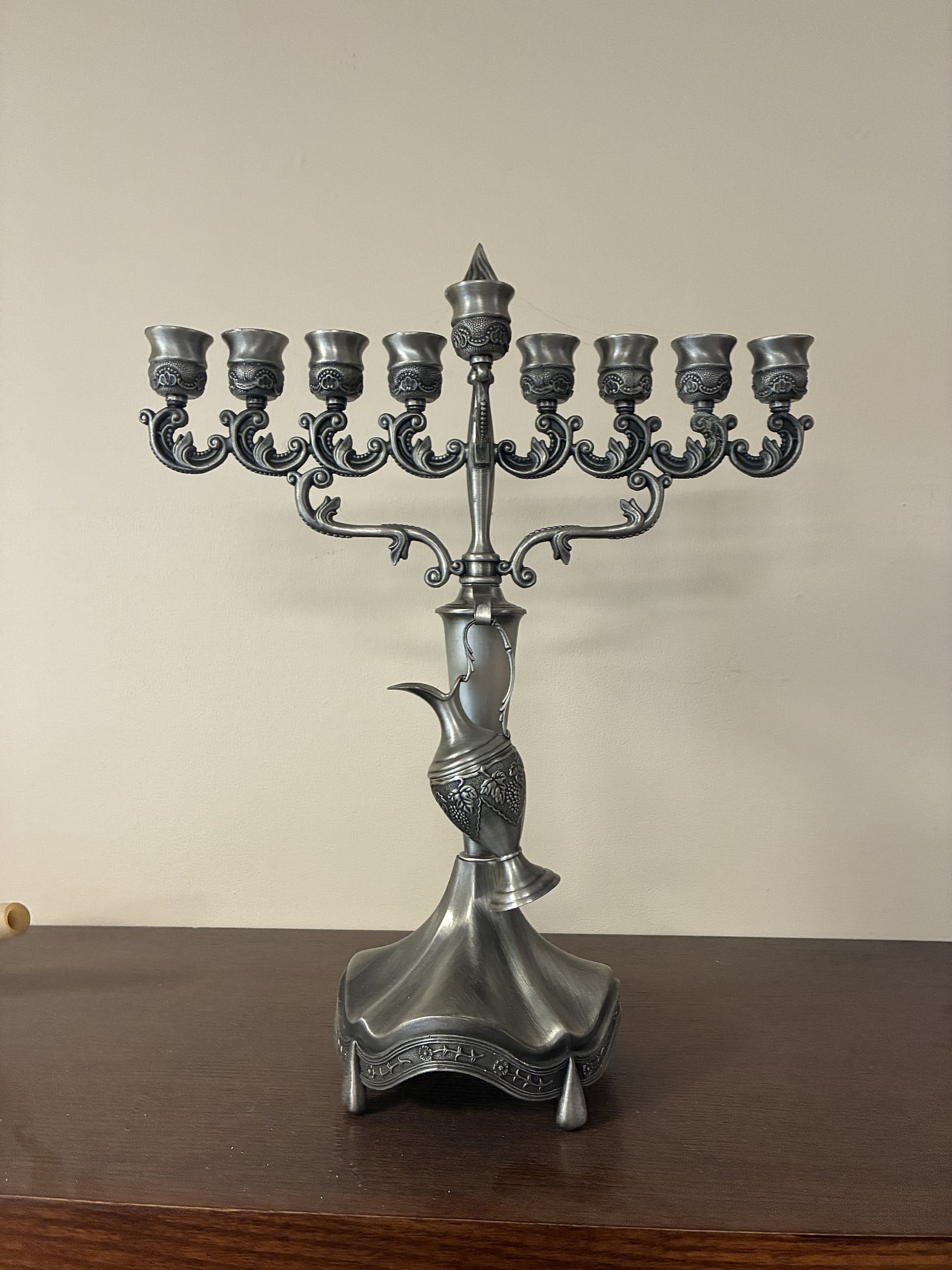
This Friday begins the Jewish month of Kislev, at the end of which is the holiday of Hannukah. R. Mordechai Yaffe of 16th Century Prague (popularly known by the title of his main work, The Levush) points to a well-known distinction between the two holidays which were added to the calendar after the Torah: Purim and Hanukkah. On Purim, we are required to have a festive meal. On Hannukah, many people do hold festive meals, which is good and fitting, but there is no technical requirement to do so. The only major requirement is to light the menorah and to reflect on the meaning of the lights. What accounts for this distinction?
The Levush answers that on Purim, our enemies tried to destroy us physically. Haman didn’t care if we’d convert to his religion or not. It was a racial hatred, like that of the Nazis. And so, our celebration on Purim manifests more physically. The Hellenist Greeks, on the other hand, tried to destroy us spiritually. Like the Medieval Catholic Church, there was no racial aspect: a Jew could escape being Jewish by becoming Christian at that time, or by becoming a Hellenist in the days of Hannukah. And so, our celebration of Hannukah manifests more spiritually, by just reflecting on the meaning of the lights.
3) Today’s Faithful and Hellenized Jews
Where do Mamdani’s allies on the far-left fall along this spectrum? Some of them do endorse killing us physically. But the major thrust of their ideology is to destroy our spirit. A Jew can escape the nefarious category of “Zionist” by simply renouncing Israel, to show that you are one of the token, enlightened “good Jews”.
These are Jews like the sheltered and privileged Jonathan Glazer, and Hannah Einbeinder. (Ironically, the Biblical Jonathan was the son of the first sovereign king of Israel, Saul; the Biblical Hannah was the mother of the prophet who anointed that same king! I doubt that Glazer or Einbeinder have ever reflected on that). Glazer won an award for making yet another Hollywood movie about how the Nazis were evil. There’s no moral courage in denouncing Nazism. It’s the lowest hanging fruit that there is. Glazer opposes the threat that the Jews faced 80 years ago, without even recognizing the threats that we face today, and without any sense of what antisemitism has morphed into for the past 80 years – a more fashionable antisemitism in which he himself shares token complicity.
These are the modern-day Hellenized Jews, like New York City’s Mandy Patinkin and Wallace Shawn, who each enthusiastically supported Mamdani. Why were Patinkin and Shawn cast, respectively, as a Spaniard and an Italian in the movie The Princess Bride? Because so many Ashkenazi Jews still retain that swarthy Mediterranean look, which testifies to our Mediterranean/Middle Eastern origins. I feel uncomfortable bringing this up, since Judaism is not inherently connected to race, which is why converts are fully Jewish. I actually don’t like emphasizing the connection of Zionism with technical genetic lineage overly much, since our history is far more complex than that.
But there is a historically ethnic element to our identity which seems relevant to bring up in the racially focused discourse of our time, only since our enemies tend to view the world through that same shallow lens. Part of the Othering of Jews in Europe was that we looked Oriental, and Patinkin and Shawn each retain that look.
And Patinkin and Shawn have made money from this ethnic connection. Shawn played the grossly antisemitic stereotype of Grand Nagus Zek on Star Trek, the leader of a race called the Ferengi, who are a clear metaphor for the exotic and Oriental Jews in Western thought. Almost all the male Ferengi were played by short, Jewish actors. (To the credit of Star Trek, I think the Ferengi were actually meant as a comical critique of this stereotype rather than an endorsement of it, but people debate that point).
Jews like Patinkin, Shawn, Einbeinder, and Glazer are actually, themselves, the greatest living examples of the failure of diaspora Jewry, in contrast to the success of Zionism. Even the most secular Israeli Jews tend to have a markedly higher level of Jewish identity and sense of national pride than these assimilated Hollywood Jews. Even still, my sense is that, thank God, the majority of Hollywood’s Jews are actually still proudly Jewish and pro-Israel. Jews such as Jerry Seinfeld , Debra Messing, and Michael Rapaport. Diaspora Jewry is not a complete failure, and not worth giving up on (which is why I’m still here myself!). But it still pales greatly in comparison to the strength of Israeli Jewry on every level.
The Mamdanis of the world are ostensibly ok with Jews observing our religion. But our religion itself contains a national element, a connection to a Homeland, and they can’t abide that aspect.
Since the Mamdanis of the world aim to destroy our national spirit, our response needs to be one of defiant connection to that spirit. When Mamdani issues his next Rosh Hashanah greeting, we should flood his Twitter/X with the fact that Rosh Hashanah marks the beginning of the agricultural year in the Land of Israel. When he says Shanah Tovah, we should thank him for speaking the language of the Jews of Israel. When he issues his Hannukah greeting, we should thank him for recognizing our celebration of the restoration of Jewish sovereignty in ancient Judea and Jerusalem.
If Jews find themselves at a City Hall function as the sun is setting, they should ask Mamdani personally which direction is Eretz Yisrael, in order to be able to daven mincha while facing in the proper direction. The proud Jews of New York City who have opposed Mamdani are like the Jews of ancient Judea, holding the line on behalf of their identity. Let’s continue in that same spirit all across American Jewry as Hannukah approaches.