
Israel’s Autonomy Paradox
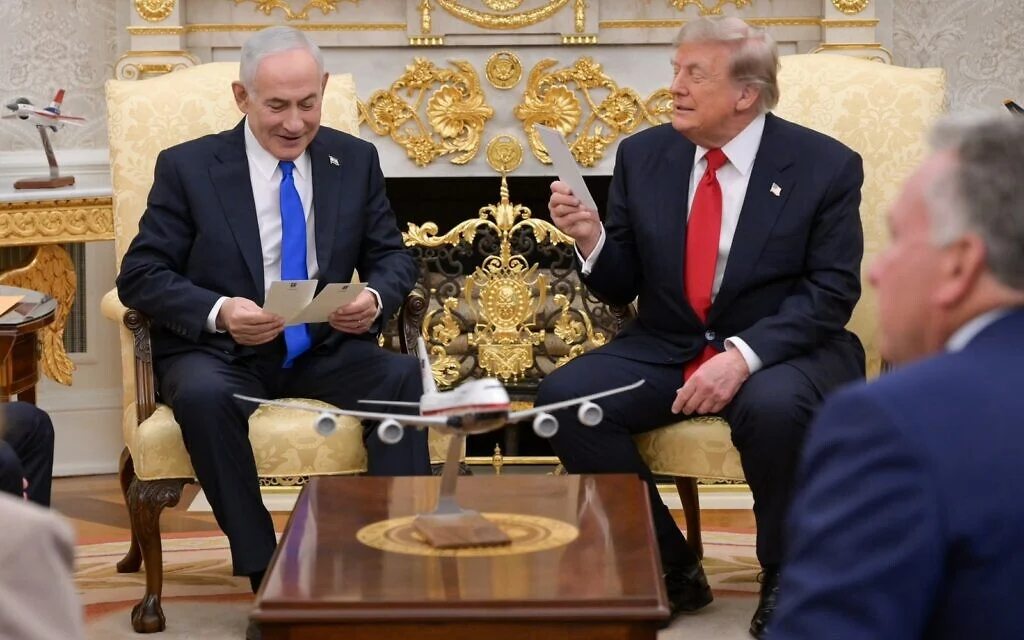
Benjamin Netanyahu spent his Washington meetings this week doing two things that do not obviously belong in the same room. He reviewed, alongside Donald Trump, three live options for handling Iran: a diplomatic settlement, tightened economic pressure, or renewed strikes, and according to the Israeli official briefing reporters afterward, he declined to state a preference among them, telling the president it was Washington’s call. In the same set of meetings, he reiterated a desire to reduce Israel’s dependence on American security assistance altogether. The two positions sit uneasily together. A state that is, at this moment, the most operationally reliant it has been in decades on American strike capacity, munitions resupply, and diplomatic cover for its Iran campaign is also the state whose prime minister is telling Washington he would prefer not to need it.
This is not contradiction so much as a textbook case of what alliance theory calls the autonomy-dependence tradeoff, and it is worth being precise about which side of that tradeoff Israel currently occupies. CENTCOM struck Iranian command centers, missile and drone factories, and a coastal surveillance site on Qeshm Island within the same news cycle as Netanyahu’s aid comments. Jordan’s air defenses shot down Iranian missiles the same week. Egypt was struck for the first time in this conflict after a drone hit a US-owned gas tanker at an Egyptian port, prompting Sisi to warn Madrid and the broader international community of serious escalation. This is a regional war in which American assets, American sanctions architecture, and American diplomatic bandwidth are load-bearing, not peripheral. Bloomberg’s reporting that Israel is developing an indigenous stealth drone comparable in capability to the F-35 should be read against that background, as a hedge against a dependency that has never been more visible, rather than as evidence that the hedge is close to sufficient.
The analogy worth invoking, and immediately testing rather than resting on, is Israel’s posture after 1967. That war produced the same instinct: a demonstration of overwhelming Israeli battlefield capability paired with a strategic reassessment that concluded, correctly, that sustained superiority would require American materiel at a scale domestic industry could not replace. The Phantom deal followed within two years, and the dependency Israel is now describing as a problem is largely the one it built, deliberately, in the decade after 1967 as the more survivable alternative to autarky. The disanalogy matters more than the analogy, however. In 1967, the dependency was new and expanding, an alliance still being constructed. In 2026, Netanyahu is describing a mature, decades-deep security relationship, tested this year by war fatigue in Washington and by an American electorate whose appetite for open-ended Middle East commitment is not what it was in 1969 or even 2001. Israel is not building a new alliance during a moment of strength. It is signaling doubt about an old one during a moment of maximum operational need.
Neoclassical realism gives a cleaner account of this than either pure structural theory or pure domestic politics on its own. The systemic-level fact is real and has been building for years: American strategic attention has been drifting from sustained Middle East commitment even as it remains willing to intervene decisively when triggered, a combination that produces exactly the kind of ally anxiety Netanyahu is voicing. But the perception gap, the space between what Washington’s actual posture is and what Israeli leadership believes it will be in five years, is doing the work here, and that gap is filled by domestic variables the systemic account cannot supply. Netanyahu faces an October 27 election, the first since October 7, 2023, in a political environment where reserved Knesset seats, a settler push for new West Bank construction, and a High Court fight over draft-dodger enforcement are all live simultaneously. A leader signaling strategic self-sufficiency to a domestic audience, even while operationally dependent on the same day, is not describing Israel’s actual trajectory so much as managing how that trajectory is perceived at home before a vote.
The indigenous drone program, the aid comments, and the refusal to state a strike preference to Trump are not three separate data points. They are the same signal read at three altitudes: to Tehran, that Israel intends to outlast isolation; to Washington, that dependency has a political cost Israel intends to be seen addressing; and to the Israeli electorate, that the war cabinet has a plan beyond the next American strike package. Whether the material capability to make any of that credible exists is a separate question, and at present the honest answer is that it does not. What exists is the rhetoric of autonomy running well ahead of the capacity for it, which is precisely the condition under which alliance dependency becomes most politically uncomfortable for the party doing the depending.