The views expressed herein are solely mine.
Mamdani’s Masks: The Left’s War in Puerto Rico
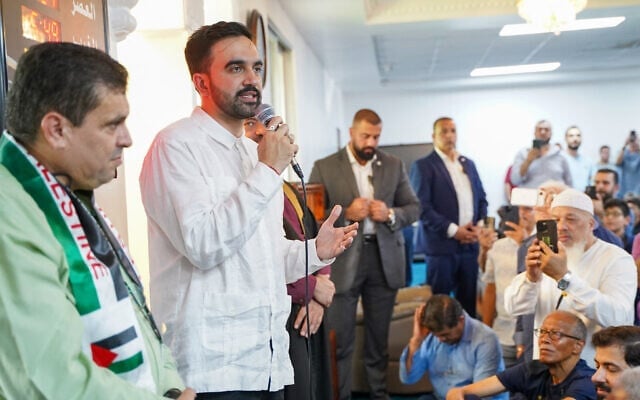
New York City Mayor elect Zohran Mamdani in white shirt, speaks to members of the Centro Islamico del Caribe -Masjid Ebadur Rahman mosque, San Juan, Puerto Rico, on November 7, 2025. (Angel Valentin / GETTY IMAGES NORTH AMERICA / Getty Images via AFP)
Forget the polite headlines and photo ops about “diversity.”
Unquestionably, Zohran Mamdani’s trip to Puerto Rico was not cultural diplomacy — it was ideological warfare.
The self-proclaimed “socialist from New York” did not fly to San Juan to “connect with the locals.”
He went there to recruit — to fuse the island’s most combustible factions: anti-American radicals, pro-independence agitators, and religious Islamist activists — into a single anti-Western front under the banner of “justice.”
Mamdani’s appearance at the ‘SOMOS Conference’ was not a coincidence; it was a strategy.
There, he told the audience that “you cannot tell the story of New York without telling the story of Puerto Rico.”
True — but his version is not one of partnership or prosperity; it is one of grievance and ideological revenge.
Behind the applause was a message few dared to say aloud: the new, anti-liberal and openly Marxist American Left has found its new frontline — and it is in the Caribbean.
While American armed forces are visibly mobilizing in the U.S. territory of Puerto Rico to counter a growing Venezuelan threat — with carrier groups, Marine deployments, and stealth jets sent to the region — Mamdani’s ironic parade through the archipelago is being used by pro-independence leftists as cover to denigrate American troops and revive the old campaign to eject the U.S. military presence (the same political script that toppled Navy bases in the Puerto Rican islands of Culebra in 1975 and Vieques in 2003).
At the same time, they want to combine this hatred with the celebrity-led (Residente, Bad Bunny, and others) protest strategy that in 2019 showed how music, hashtags, and mass rallies can collapse local governments and push Hugo Chávez’s “Socialismo del Siglo XXI” agenda which has clearly failed and destroyed Latin America.
On the other hand, his slogan, “¡Puerto Rico no se vende!” (“Puerto Rico is not for sale”), may sound patriotic, but in context, it is insurgent. It is not an economic protest; it is a declaration of ideological independence from the West.
Over the past decade, that same slogan has morphed from an anti-corruption chant into the battle cry of neo-Marxists and independence activists who dream of dismantling America’s political and economic footprint.
And now, thanks to Mamdani, that dream has an interstate bridge: New York City.
By embracing Puerto Rico’s Left, he activates a massive diaspora — over 1.2 million Puerto Ricans in New York — who can be mobilized not through civic pride, but through historical guilt and resentment.
In political terms, that is electoral dynamite.
Then there is the cultural front — where hypocrisy becomes art.
Mamdani’s ideological allies are not revolutionaries in the jungle; they are millionaire celebrities in mansions.
Residente, the aforementioned self-anointed anti-imperialist singer, rages against “Yankee capitalism” while sipping imported wine in his U.S. home in California and his luxurious penthouse in New York City. His friendship with Latin American leftist authoritarians is no accident — it is a badge of ideological virtue.
Beside him stands Bad Bunny, the anti-system “superstar” who preaches rebellion against America’s dominance while cashing Rimas Music, Calvin Klein, WWE, Hollywood, and now Super Bowl checks.
Beyond dispute, these men have turned anti-Americanism — not only in Puerto Rico but also among Latinos in the U.S. — into a global brand, merging socialism, pop culture, and identity politics into one profitable rebellion.
The result?
A revived Puerto Rican socialist and pro-independence movement that went from 4% ten years ago to around 40% of the voters today and which now influences the island’s youth, academia, and even segments of the diaspora that once proudly waved the U.S. flag.
But perhaps the most alarming symbol of Mamdani’s visit came when he entered a Hamas-sympathetic mosque in San Juan, greeted by chants of “Takbir! Allahu Akbar!”
The “Takbir” chant — meaning “God is greatest” — is sacred in Islam, yet its context determines its message.
When shouted in prayer, it is devotion; when shouted in political rallies aligned with anti-Western ideology, it becomes something else — a declaration of resistance, even defiance, against the West.
That was not a moment of cultural inclusion; it was a display of ideological alignment.
Those cries — “Allahu Akbar” echoing through a political event — were not random; they symbolized the merging of two currents of grievance: Islamism and Socialism, both bound by resentment toward America and the West.
To a naïve observer, it looked like multicultural outreach.
Puerto Rico’s Muslim population is small, maybe fewer than 10,000, mostly of Palestinian, Jordanian, and Lebanese descent.
Yet ideology is not about numbers — it is about networks.
When you fuse religious grievance, Latin American post-colonial anger, Marxist rhetoric, and Islamism, you create a hybrid that Western intelligence agencies have been warning about for years: radicalization through identity politics.
And Mamdani is mainstreaming it. He gives it legitimacy, language, and now — location.
“¡Puerto Rico no se vende!” is no longer about the island’s economy. It is about moral ownership.
In my opinion, it translates to: “America is corrupt, the West is guilty, and our loyalties lie elsewhere.”
Thus, that is not local activism — it is ideological warfare wrapped in Caribbean aesthetics.
But the irony is overwhelming.
The same people railing against American “imperialism” are doing so under the legal, economic, and military protection of the United States. They denounce capitalism from their beachfront villas and decry “oppression” from air-conditioned conference rooms.
But Mamdani’s project is not hypocrisy — it is strategy.
In fact, it is the Left’s new model of infiltration: cultural rebellion as political contagion.
Therefore, he does not need to overthrow America from the outside; he is building the ideological infrastructure to erode it from within.
This is how Western institutions rot: not from bombs, but from slogans, ballots, and the quiet moral corrosion of self-hate disguised as justice.
Undeniably, Mamdani is not just a politician — he is a prototype.
A product of elite American universities, fluent in the language of “equity” and “decolonization,” now exporting it to every place where victimhood can be monetized.
His movement is not about freedom; it is about replacement — the systematic substitution of Western values with a theology of grievance.
Hence, what begins in San Juan will metastasize in New York and could probably end wherever the free world forgets who it is.
Because revolutions today do not wear fatigues — they wear hashtags, veils, and designer sneakers — unlike in most Muslim countries — to legitimize and foster their true ideals.
Related Topics