Man Plans. AI Laughs. And Then What?
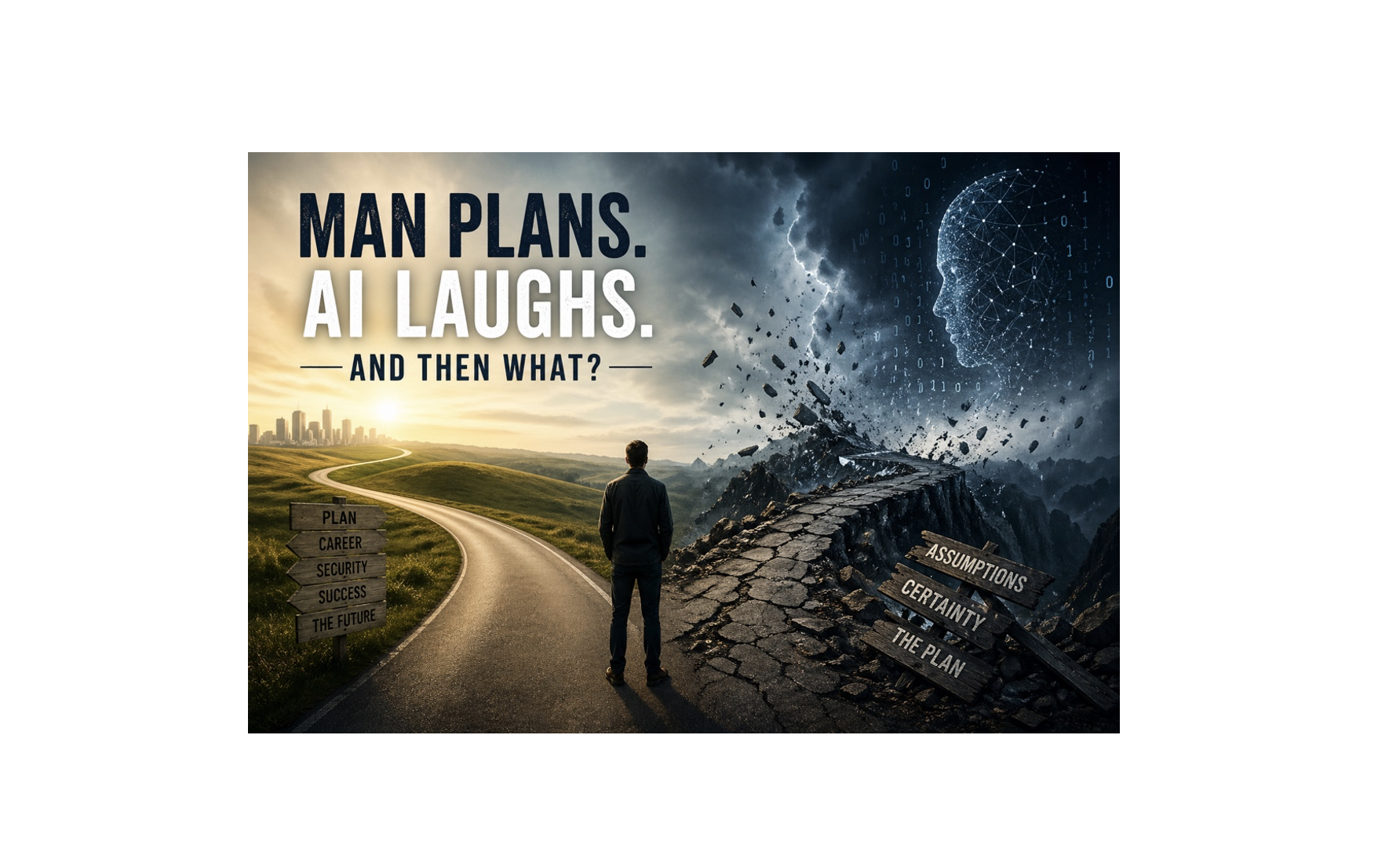
Something is being taken from you. Maybe gradually, maybe suddenly, but if you work in law, consulting, finance, journalism, or any field where expertise was the product, you have felt it. The future you built your assumptions around is becoming less certain, and the feeling that comes with that doesn’t quite have a name.
It doesn’t need one. It has always felt exactly like this.
We construct plans and then inhabit them so completely that we stop experiencing them as plans at all. They become the shape of life itself, the career, the identity, the quiet assumption that you know roughly how the story goes from here. And then something happens. A technology arrives faster than anyone predicted. A diagnosis. A redundancy. A phone call that changes the grammar of your days. The plan was never a promise. It was always a scaffold, useful, necessary even, but never the building itself. What you discover when the scaffold comes down is the only question that has ever really mattered.
Viktor Frankl arrived at Auschwitz a respected Viennese psychiatrist with a manuscript he had spent years writing. The manuscript was confiscated on arrival. His wife, his parents, his brother, killed. Every plan, every relationship, every material reality of his former life: gone. What he observed in that place, in himself and in the people around him, became the foundation of an entire school of psychology. The people who survived psychologically intact were not the strongest or the best resourced. They were the ones who retained what he called the last unconfiscatable human freedom: the freedom to choose one’s attitude in any given set of circumstances. Not optimism. Not denial. Something harder and more honest than either, the active choice to turn toward life, to find meaning in the circumstances you are actually in, rather than the ones you planned for. He didn’t survive despite losing everything. In a profound and uncomfortable sense, he became who he was because the plan was destroyed.
I’ll be brief about my own story because it isn’t really the point, but evidence matters. For 27 years I was a management consultant, partner at a Big 4 firm, Head of Consulting in Israel, with a career and a future I had mapped carefully. At 49 I was diagnosed with PSP, Progressive Supranuclear Palsy, a terminal neurological condition with no treatment, a brutal trajectory, and a life expectancy I still find difficult to say aloud. Wheelchair. Full-time carer. Daily challenges I won’t catalogue here. What followed surprised me more than the diagnosis itself. I write now, obsessively, mostly dictated at odd hours, a blog about PSP that has reached 164,000 views across 131 countries, becoming a resource for patients and caregivers who have few voices of patients to hear from. Torah commentary. Books. Advocacy. A voice I would never have found from behind a consulting desk. I would not have chosen this. And I would not pretend to welcome it. But I would not trade what it has made possible. The applecart, when it overturned, revealed what had always been inside it, waiting for the noise of a busy purposeful life to stop long enough to become audible.
The question that AI, or any serious rupture, is actually asking is not how do I protect my plan. It is: what is mine to do? Not what you were trained for. Not what the market valued last decade. Not the identity you built around skills that are being repriced. What is yours, what comes from who you specifically are, what you have lived, what only you are positioned to offer. The people I have watched navigate serious disruption almost never find their way by recovering the original plan. They find their way by allowing the rupture to open a question they had never seriously asked before.
Hope, in the sense I have come to understand it, is not the belief that everything will be fine. It is the decision, made daily, sometimes hourly, that meaning is still available to you in your actual circumstances. Not the ones you planned for. The ones you are in. Think of the caregiver sitting beside a hospital bed at two in the morning, in a life that looks nothing like the one they imagined. Attitude is not what they feel in that room. It is the decision they make anyway, with what they actually have. It doesn’t require certainty. It doesn’t require knowing the answer. It only requires the willingness to stay open to the question, and to trust, even without evidence, that the question is worth asking.
There is an old Jewish saying: man plans and G-d laughs. I used to hear it as dark humour. A sardonic nod to human smallness. I hear it differently now. The laughter isn’t mockery. It is the sound of someone watching a person discover, in the rubble of what they thought they wanted, what they actually needed to become. That discovery is rarely comfortable. It is often unwanted. But in my experience, and in the experience of many people I have been privileged to accompany through their own versions of it, it is almost always true.
My own disruption had nothing to do with AI and everything to do with a diagnosis I didn’t see coming, but the question it asked me was very similar. Your plans have changed. That is not the end of the story. In most cases, it is where the story actually begins.
Postscript: A small confession. I retired before AI hit hardest, so I write this as observer more than casualty. But I am not untouched by it. The dictation software that converts my voice to text, the tools that help me proofread when my eyes won’t cooperate, the AI that helps me generate images for my posts – these are what make my writing life possible at all. The technology I used as a universal frame turns out to have a personal dimension I hadn’t fully acknowledged. Even I am adapting. Perhaps that was the point all along.