
Mangroves: Silent Wall Between Us and Disaster
Imagine this: You are one of Columbus’s crew, stepping onto unknown shores, thinking you’re bound for India and instead finding the New World. Your eyes fall upon bizarre trees with spider-like roots sprouting from the water. These mangroves are beyond your wildest imagination. Wait, you are not alone! Back in the 14th and 15th centuries, European explorers were absolutely mesmerized by mangroves and their quirky sprouted roots. Columbus himself is spellbound, gushing over the verdant mangrove forests near Cuba. Raleigh noted the abundance of oysters on the branches, trunks, and roots of mangroves in Trinidad and Guyana. Despite this early fascination, the scientific world unfortunately, seems to shrug off these incredible mangrove ecosystems and even the very term “mangrove” for centuries.
India has a long coast line which boasts a diverse range of coastal ecosystems, including the amazing mangroves. But now a days, in many parts of India, talk about mangroves, and people might think you’re discussing mangoes. Everyone knows the juicy benefits of mangoes—they’re delicious and have commercial value. But mangroves? They often get overlooked. Many people don’t even know what they are. They will ask you perhaps, ‘what mangroves are?’. It’s high time to spread the word that, mangroves are incredibly important, possibly more than any other vegetation in several ways. Everybody should know, if mangoes are the food, then mangroves are the kitchen. Yes, Kitchen! Mangroves act like nature’s kitchen, preparing meals for both marine and terrestrial life. Just put aside the example of common man for a moment, this million-dollar question, “what are mangroves?” has puzzled scientists too for ages.
Defining and categorizing these unique ecosystems is no walk in the park. Even after classification, debates continue over which plant species should be considered true mangroves. Yet, the scientific curiosity and debates about mangroves rage on, underscoring the ongoing quest to fully understand these intriguing ecosystems. The term “mangrove” itself is shrouded in mystery. Some believe it’s a mix of the Portuguese “mangue” (plant) and the English “grove” (small forest). Another theory suggests it comes from the Spanish word “mangle,” similar to “jungle” (natural forest) in Hindi and other Indian languages. But there’s no proof “mangle” was used for mangroves in India. Perhaps, the meaning of Indian word “mangle/mangal” is auspicious which is totally unrelated to mangroves.
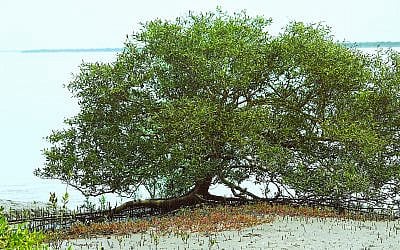
Mangroves are amazing trees and shrubs that thrive in salty or brackish waters, mostly in tropical and subtropical regions. These plants share adaptations allowing them to withstand regular tidal flooding, strong winds, waves, water currents, unstable muddy soils, high salt levels, and oxygen-poor environments. Mangroves are an ecological group of diverse species with common traits, not a taxonomic group. These resilient plants have some cool tricks up their sleeves, like improving oxygen intake and kicking out salt, allowing them to live in tough conditions that would wipe out most other plants. Mangroves with other associated plants, for a unique ecosystem along with the animals and other organisms in the same habitat.
Fast forward to today, mangroves are hailed as essential coastal guardians, providing homes for countless species and protecting shorelines from erosion. Mangroves are crucial for stabilizing coastlines, shielding them from storm surges, currents, waves, and tides. They typically grow in slow-moving waters where fine sediments can settle, and their dense network of prop roots is a hallmark feature. But that’s not all! Mangroves are vital for our well-being and the health of our planet. They provide habitats for a variety of species, protect against coastal erosion, and help combat climate change by capturing and storing carbon. In essence, mangroves are nature’s superheroes, defending coastlines and supporting biodiversity. These coastal ecosystems play a key role in maintaining the balance of coastal environments.
Mangroves are not just plants, but dynamic, life-sustaining powerhouses! Then why they are facing many problems in these days? Answer is simple, lack of awareness of people. This unawareness of common citizens is killing mangroves these days. India is also facing similar environmental concerns. For example, in many places mangroves are in the starting phase of facing the land conversion issues. Coastal lands have already started to convert into salt pans and other activities.
Once upon a time, the issue of land conversion was at its peak in Ecuador, a Latin American country. Citizens of Ecuador raised their voices against this threat to save the mangroves. Unfortunately, during the protest on July 26, 1998, environmental activist Heyhow Nanoto lost his life. His tragic death became an emotional moment for the people of Ecuador. Nearly a decade and a half later, in memory of this incident and to raise global awareness about the importance of mangroves, the Government of Ecuador proposed the establishment of an international day to UNESCO. In November 2015, in response to Ecuador’s request, UNESCO officially declared July 26 as the International Day for the Conservation of the Mangrove Ecosystem. On July 26, 2016, the first World Mangrove Day was officially celebrated. Now, after a decade, what is the current situation? Unfortunately, awareness is still insufficient. Mangroves remain at high risk, perhaps even on the verge of complete destruction. According to the Global Mangrove Alliance, an estimated 67% of mangroves have already been lost or degraded, with an additional 1% disappearing annually. Overall, mangroves are vanishing three to five times faster than global forest losses.
What can we do? We don’t need to sacrify one more Nanoto. Just read, know, understand, and tell others the importance of mangroves, at least their role in carbon sequestration or at least the importance of oxygen. This beginning is also enough. Here are a few facts about mangroves.
CARBON NUTRALITY
- 1 hectare of mangrove can store an average of 394 tons of carbon = Weight of around 65 African elephants.
- Covering just 0.1 % of Earth’s surface, they store many times more carbon per hectare than regular forests
COMMERCIAL FISH RESOURCE
- Mangroves provide habitat to 80 % of commercially important fish species.
- 1 km2 increase in mangrove areas leads to 185.84 tones increase in total marine fish production yearly
BIODIVERSITY SUPPORT
- Almost 1,533 faunal and floral species are associated with mangroves.
- Nearly 50 % of mangrove-associated mammals, 22 % of fishes, 16 % of plants, 13 % of amphibians and 8 % of bird and reptile species are threatened with extinction
- These forests pump out oxygen, improving air quality and supporting marine life.
COASTAL LIVELIHOOD
- Around 210 million people reside in low-lying coastal zones within 10 km of mangroves, with many depending directly on the mangroves for their livelihood.
- Southeast Asia having the largest share in total global mangrove cover. Indonesia has the biggest mangrove ecosystem, while Sundarbans is the world’s largest mangrove forest.
REDUCE STORM RISK
- Mangroves can reduce storm surge by 5 to 50 cm for every 1 km of their width.
- Over 100 m width of mangrove forest, wave heights can be reduced by between 13— 66 %, while over a 500 m width of mangrove forest wave heights reduction is 50—100 % which can provide protection against storms
ECO-TOURISM
- Mangrove ecotourism has gained widespread prominence, with approx. 3945 attractions in 93 countries.
- This multi-dollar industry included boat tours, wildlife watching, tree planting, kayaking, seafood eating, and snorkeling
EROSION PREVENTION
- 1 km of mangrove can reduce 75% of surface wind waves and reduce the risk of coastal erosion.
- These tough trees thrive in salty and estuarine waters, where other vegetation cannot be survived. They adapted to harsh conditions like waterlogging and salt intrusion and prevent the soil erosion through their complicated and evolved root systems.