
Political and social entrepreneur activist in Israel and Palestine
Featured Post
Maram never supported Hamas, but that won’t save her
When the war began, she was a university student. Today she has nothing – no home, no computer, no phone. What have we done?
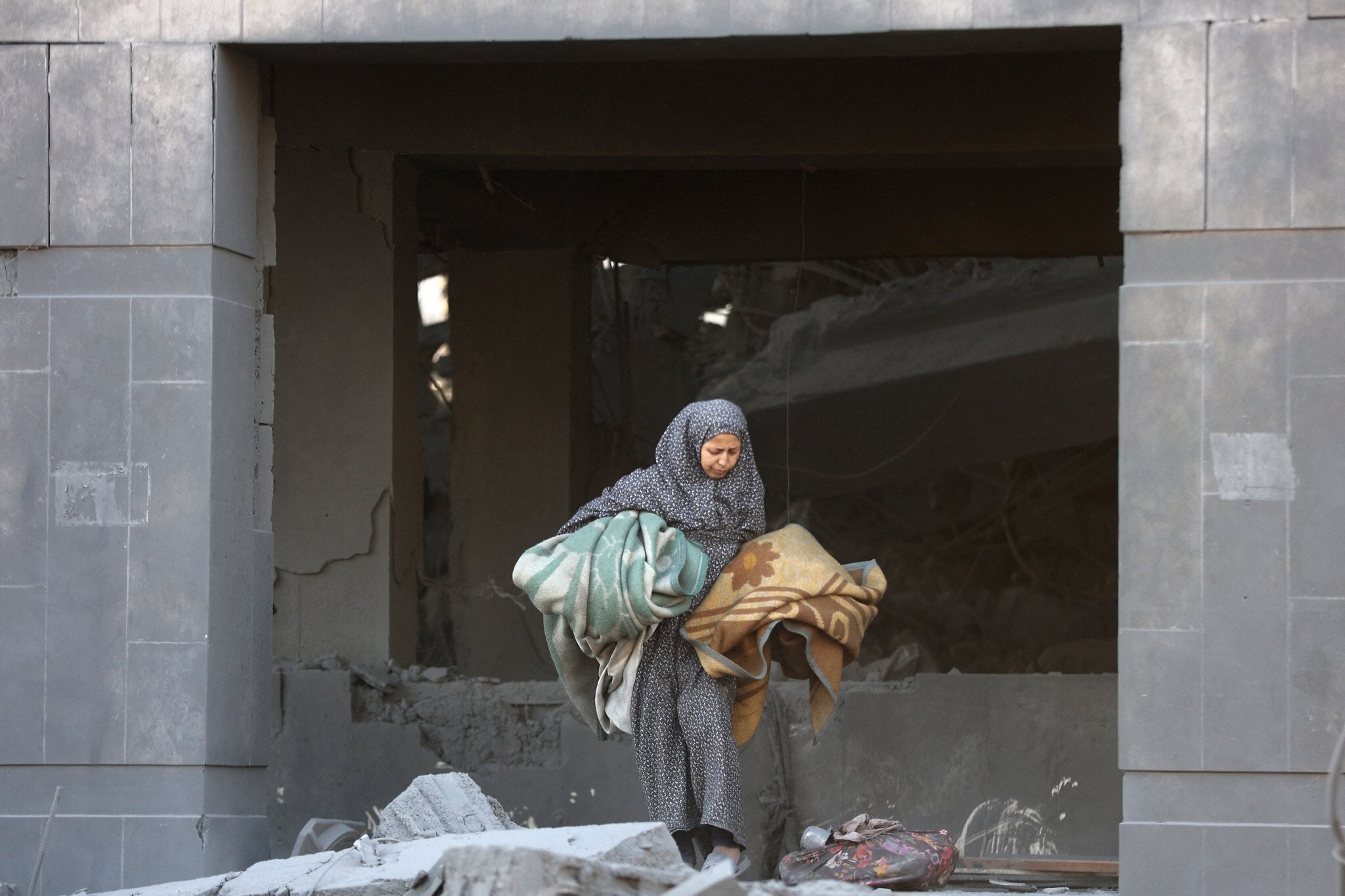
Illustrative. A Palestinian woman carries her belongings as she walk on debris after an overnight strike on the Sheikh Radwan Health Centre run by the United Nations Relief and Works Agency for Palestine Refugees (UNRWA) in the north of Gaza City on August 6, 2025. (Omar al-Qattaa/AFP)
This is the story of one young woman in Gaza. But it is also the story of an entire population. I ache with pain from her story, and I want to share her pain and my pain with you. We have to know the reality of Gaza.
Last night, I had a long conversation with Maram in Gaza. Some of you know about her because you contributed to her tuition to study computer science at Al-Azhar University in Gaza (the so-called Fatah University), which no longer exists, along with the other six universities that have been wiped off the face of the earth by Israeli bombs and D-9s. Some of you even helped to buy Maram a laptop computer for her studies. That was all before the war. She had completed three semesters with excellent grades, and she was on her way to a future of real hope and promise.
Some of you might remember that a few years before the war, Israel bombed the home of Maram’s aunt and uncle, killing them and leaving five young children as orphans. Some of you answered my call to contribute money to clothe and help cover basic needs for those orphaned children. We raised $7,000 in one week. Maram – a young, single woman taking care of her mother, living at the time in a tiny two-room flat in Gaza with her unemployed married brother and his wife and baby – took in the five children and became responsible for their care while she was studying.
Maram’s house was bombed and destroyed at the beginning of the war, along with all of her belongings, including her laptop and her telephone. She and her family barely escaped death. Since then, she has been living in a tent, moving from place to place every time the Israeli army gives the order. Two months ago, her tent was hit by a bomb and burned down. Again, they lost all of their possessions, the ones they had managed to accumulate during the previous months. Worse, Maram and her mother were badly injured. I saw the pictures of her burns, and I won’t share them here to save all of you from nightmares. Maram could not walk and was bedridden for several months. The good news is that she can now walk with the help of crutches. The bad news is that one of her cousins was killed.
Maram broke down crying on the phone as she described their misery. She raged at the Hamas leaders as well as at Netanyahu, saying, “I swear that God will do justice and these Hamas monsters and Netanyahu the monster will all go to hell.” I could only agree with her.
I asked her about day-to-day challenges, such as sanitation: are there toilets for the people to use? She said that there were public toilets, but the lines were so long that many of the young children could not wait and would urinate and defecate outside of the toilets. Imagine what that feels like, what it smells like.
I asked her about sanitary pads for women, and she said there are none and that she uses a piece of cloth that she washes and reuses. I asked if she had access to a shower somewhere. She said yes, but only infrequently, and that, in any case, a bar of soap, which costs 25 shekels (more than $7), was out of reach. They have no money. She said that sometimes the sea was the only option for washing themselves.
I send money to Maram and a couple of other young families in Gaza whenever I find a way to get it to them. It is not a lot – it helps to buy some food, but my small contributions cannot take care of their real hunger and thirst and other needs. They have no regular supply of food and water. Maram now weighs 41 kilograms (about 90 pounds). She kept saying, “We are exhausted, we only want this war to end.”
Maram repeatedly said she was embarrassed because I had sent her and her family money. She is a person who never asked me for anything. I’m the one who suggested she go to university. It was clear to me when we met online that she was intelligent and thirsty for knowledge and wanted to have a future of promise, but in her reality, she couldn’t dream of the possibility of studying.
She is a good person with a pure soul, and my heart aches for her every day. What kind of future will she have now? She has no home or possessions, and she has the responsibility of caring for her mother and four young children. Her university is gone, her laptop is gone, and her telephone is gone (she calls me from a friend’s phone). She is living in a tent. She never supported Hamas.
I remember when she found out how much university tuition costs. I gave her the personal phone number of Ghazi Hamad, a Hamas leader who was the Minister of Social Affairs at the time. “He is from your government,” I told her, “call him, they should help.” Maram refused to call – she said those bastards only help themselves; they don’t help the common people who are not Hamas. I knew she was right and that Hamas would not help her, but I always tried to confront them with their responsibility to their own people. Today, we see how much they care about the people of Gaza today.
But that is not the point of this story. The point of this story is Maram, one good young woman, and her family in Gaza.
This is a story of how humankind allows a genocide to take place and does not prevent it. I ache over what has happened to Gaza and to Maram. The crimes of Hamas do not erase the pain I feel as a human being. As a Jew and as an Israeli, my ache is compounded by our own history and our responsibility to humanity to prevent what we have done to the innocent people of Gaza. Morality must compel us to put an immediate end to this war. It must bring all of the criminals on both sides of this conflict to trial by their own people for crimes against humanity and crimes against their own people.
Related Topics
Related Posts