Marc Bloch in the French Panthéon
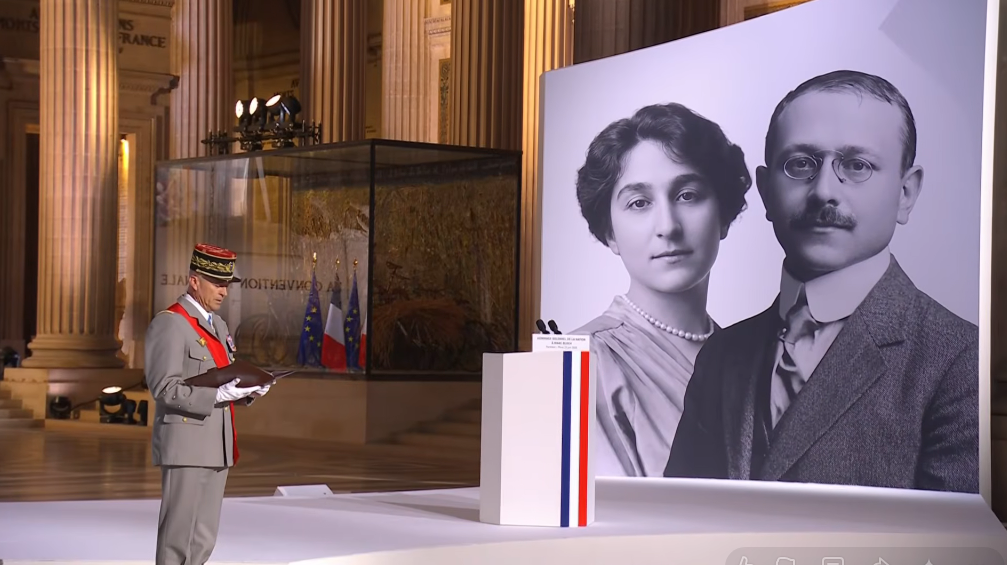
France paid one of its highest national honours this week to Marc Bloch and his wife, Simonne. Their remains were transferred to the Panthéon in Paris, the civic temple that the Republic reserves for those it considers its greatest exemplars of virtue. The tribute is entirely deserved.
Born in Lyon into a Jewish family from Alsace, Marc Bloch became one of the greatest historians of the twentieth century and co-founder of the celebrated Annales School, which revolutionised modern historiography. A decorated combatant in the First World War, mobilised again in 1939, removed from public service by the collaborationist Vichy regime on account of his Jewish identity, a member of the French Resistance, arrested, tortured, and shot by the Gestapo in 1944 — Bloch embodies, within a single life, the qualities that the French Republic most delights in celebrating: intelligence, courage, and sacrifice. That rarest of combinations: a man of thought and a man of action.
In a Europe witnessing the resurgence of antisemitism, his entry into the Panthéon stands as an urgent affirmation of republican values, human rights, and political liberalism.
The ceremony also produces an unexpected effect: it renders all the more conspicuous a certain absence. The absence of Captain Alfred Dreyfus.
The Dreyfus Affair left a profound mark on Marc Bloch’s generation. It remains one of the most emblematic miscarriages of justice in modern history — denounced by the Brazilian jurist Rui Barbosa, and the episode that inspired Émile Zola’s celebrated manifesto J’Accuse…!, published in defence of truth, justice, and the revision of Dreyfus’s conviction.
The affair cleaved France in two between 1894 and 1906. In that first year, Captain Alfred Dreyfus was accused of supplying military secrets to Germany. Tried before a military tribunal on the basis of flimsy evidence and secret documents withheld from the defence, he was convicted of treason, publicly degraded before the troops, and sentenced to life imprisonment on Devil’s Island, off the coast of French Guiana.
The conviction took place against a backdrop of fierce nationalism and rising antisemitism. Dreyfus became the ideal scapegoat for a France still traumatised by its defeat at the hands of Germany in 1870.
In the years that followed, evidence emerged that the true author of the espionage was another officer entirely: Major Ferdinand Walsin Esterhazy. Rather than acknowledge the error, factions within the Army attempted to suppress the evidence, precipitating an unprecedented political and moral crisis. It was then that Zola — the celebrated man of letters, raised in the Catholic faith — published his devastating manifesto, laying bare the judicial fraud and the antisemitism entrenched within the institutions and society of France.
After years of struggle, Dreyfus was exonerated and rehabilitated by the Cour de cassation in 1906. Since then, the affair has become a universal symbol of the fight against institutional violence, the abuse of power, and antisemitism — and of the defence of due process and historical truth.
The case also inaugurated a debate that remains urgently relevant: about the spectacularisation of criminal justice; about the devastating and unjust influence of the press and of “present-tense history” in precipitating convictions that demand critical distance; about the need to hold the institutions of the State accountable to the empire of truth; and about the imperative that the State operate according to a counter-majoritarian logic — resisting the tides of public opinion in order to pass them through the filter of human rights and measured judgement.
For over twenty years, the possibility of transferring Dreyfus to the Panthéon has been under discussion. In 2006, on the centenary of his rehabilitation, the proposal gained momentum. It returned to the agenda in 2025 and 2026, driven both by the rise in antisemitic attacks and by the posthumous promotion of Dreyfus to the rank of brigadier general. And yet the Élysée Palace continues to hesitate.
The traditional justification is well known: the Panthéon honours heroes, not victims. Marc Bloch transformed history through his actions; Dreyfus merely suffered an injustice.
The argument is shallow.
Few men have demonstrated greater moral courage than Alfred Dreyfus. Convicted of a crime he did not commit, publicly humiliated before a hostile crowd, crushed by institutions and by society, deported to Devil’s Island and subjected to years of brutal isolation — he never confessed to what he had not done. He never yielded to the pressure to admit a guilt that was not his. He never abandoned the struggle for truth and dignity.
His resistance was not military, nor was it armed: it was moral. The solitary obstinacy of one man against the State, against society, against the established order, against the Army, against the press, and against a significant portion of public opinion left those who knew Captain Dreyfus struck with something approaching awe.
Without that obstinacy, the case might never have been overturned. Without Dreyfus, there would have been no mobilisation of Zola, no J’Accuse, and none of the most enduring modern lessons about judicial error, the abuse of power, and antisemitism — lessons that contemporary society, French and global alike, seems to have allowed to slip into the sleep of its conscience.
The distinction between Bloch and Dreyfus grows ever less persuasive.
Marc Bloch represents the France that resisted Nazism. Alfred Dreyfus represents the France that was forced to confront its own prejudices in order to remain faithful to its republican ideals. They are two faces of a single conscience — two struggles, on different planes, for the supremacy of the ideas said to underpin French civilisation.
The panthéonisation of Bloch is a triumph of French and Jewish memory, beyond any doubt. But it also lays bare a contradiction: the Republic that today exalts one of the most illustrious heirs of the Dreyfus Affair keeps at arm’s length the very man whose ordeal helped — or should have helped — to shape the legal, political, and ethical consciousness of the modern world.
The ceremony of this week leaves behind an ambiguous feeling. There is cause for celebration. There is also the persistent sensation of something left unfinished.
Marc Bloch has, at last, entered the Panthéon. The ghost of Dreyfus still wanders the dark night of Paris’s soul.
Originally published in CrusoÉ magazine, Brazil