
The views expressed herein are solely mine.
Christians Butchered in Jordan. The West is Quiet
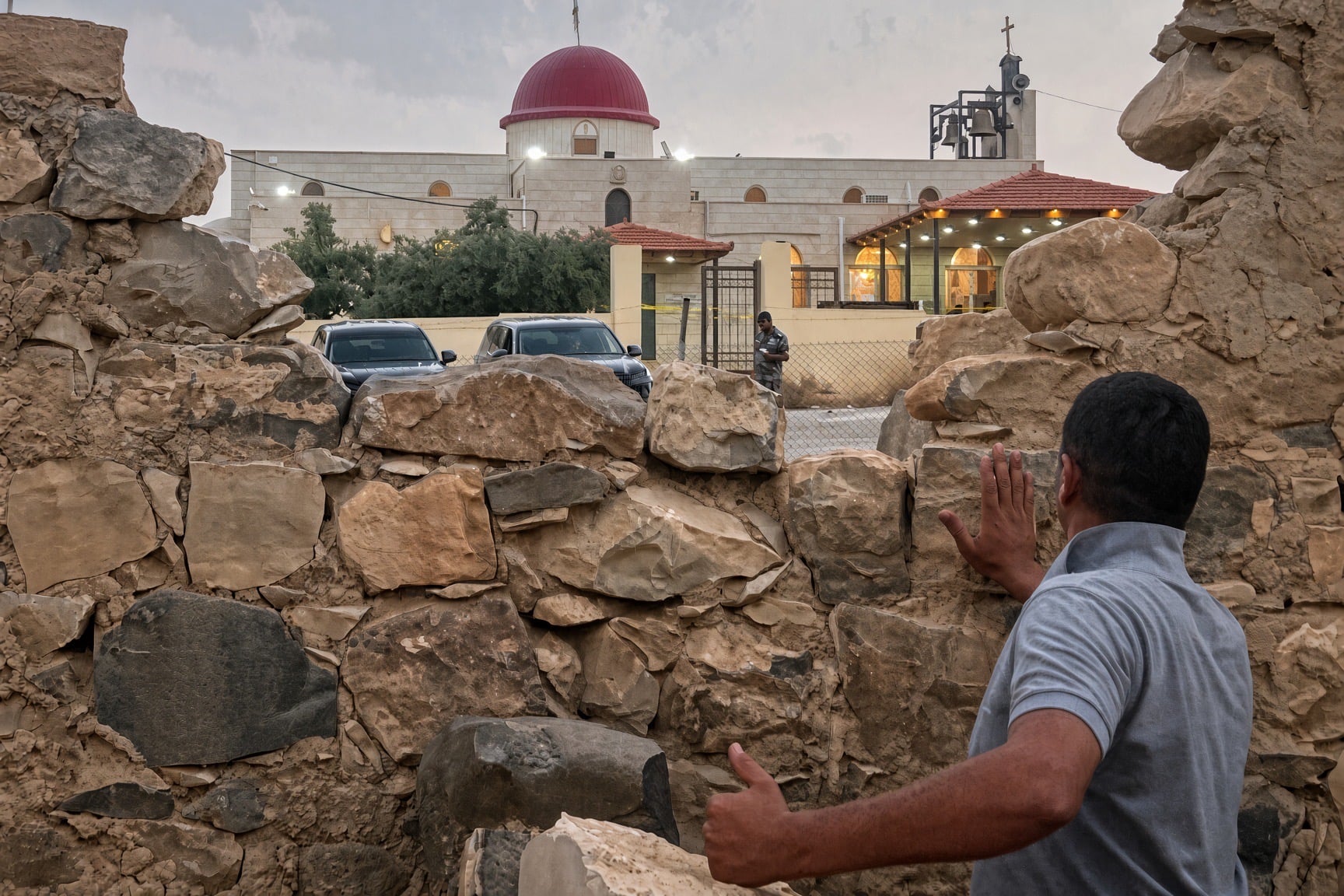
A man looks through a gap in a stone wall toward a Greek Orthodox church where gunmen opened fire during a funeral hours earlier in Hamoud village, in Jordan's Karak governorate on Friday. AP Photo/AP.
Moral accountability in modern diplomacy relies entirely on a perverse hierarchy of victimhood. Minor, localized provocations by radical Jews in Jerusalem trigger immediate, synchronized international condemnation across every social media ecosystem. Conversely, a wall of institutional indifference meets catastrophic violence targeting Christians outside Israel’s borders, exposing an elite Western psychology that values human life only when activists can weaponize a tragedy against the only true democracy in the Middle East.
On October 23rd, 2026, an unprecedented terrorist assault by three armed extremists on a funeral procession at Saint George’s Greek Orthodox Church in Hamoud, Jordan, which left 9 worshippers dead and 40 injured, exposed this deep-seated rot. Masked gunmen fired automatic weapons indiscriminately into a crowd of 200 defenseless mourners for five minutes. Yet, the streets of London and New York remained quiet, and no United Nations emergency sessions were called. Because this tragedy did not occur under Israel’s watch, the world’s outrage machinery remained entirely dark, proving that the global conscience has abandoned universal ethics for geopolitical choreography.
This selective empathy reflects a long-standing, dangerous blind spot. Over the last century, the Christian population of the Middle East plummeted from 20 percent of the region’s total to less than 5 percent today. Iraq’s Christian community, which numbered over 1.5 million before 2003, collapsed to fewer than 150,000. Syria’s Christian population has similarly been hollowed out by over 60 percent since 2011, punctuated by consistent atrocities against ancient parishes. Even in the now fully-controlled Palestinian Authority city of Bethlehem, the Christian population went from 80% to under 20% after Israeli rule ended. These grim statistics represent the methodical erasure of the region’s indigenous heritage. Nonetheless, Western policymakers watch this demographic collapse with casual apathy, reserving their loudest bullhorns exclusively for theater that advances an anti-Israel narrative.
History provides a stark warning about the cost of such moral outsourcing. During the 1860 Mount Lebanon civil conflict, Druze forces operating with Ottoman complicity massacred over 10,000 Christians in a matter of weeks. European powers delayed intervention until their own imperial interests aligned, treating the slaughter of indigenous believers as a secondary tactical variable rather than a humanitarian emergency.
Today’s international community follows that same cynical blueprint. Global observers treat radical violence across Arab states as an unalterable cultural norm while subjecting Israel to a hyper-scrutinized, impossible standard. However, inexplicably, violence in Amman or Damascus is dismissed as regional background noise, reducing ancient communities to footnotes in history.
This moral cowardice carries severe real-world consequences. By ignoring systemic vulnerabilities under radical regional regimes to weaponize isolated incidents against a democracy, the West signals to extremists that Christian blood is cheap. True solidarity cannot be conditional on geography. If global institutions only defend minorities when doing so allows them to condemn the Jewish state, they do not care about human rights at all. They merely care about the optics of condemnation.
Related Topics
- Anti-Zionism
- Antisemitism
- Antizionism
- Christianity
- Druze
- Iraq
- Islam
- Israel: Jewish and Democratic
- Israeli Foreign Policy
- Jerusalem
- Jewish-Christian Relations
- Jordan
- Lebanon
- Middle East
- New York
- Palestinian Authority
- Palestinians
- Syria
- Terrorism
- The Arab World
- Turkey
- Ultra-Orthodox Jews
- United Nations
Related Posts