Stand for Jewish life. Fight antisemitism.
Margot Friedländer (1921-2025): A Voice of Humanity
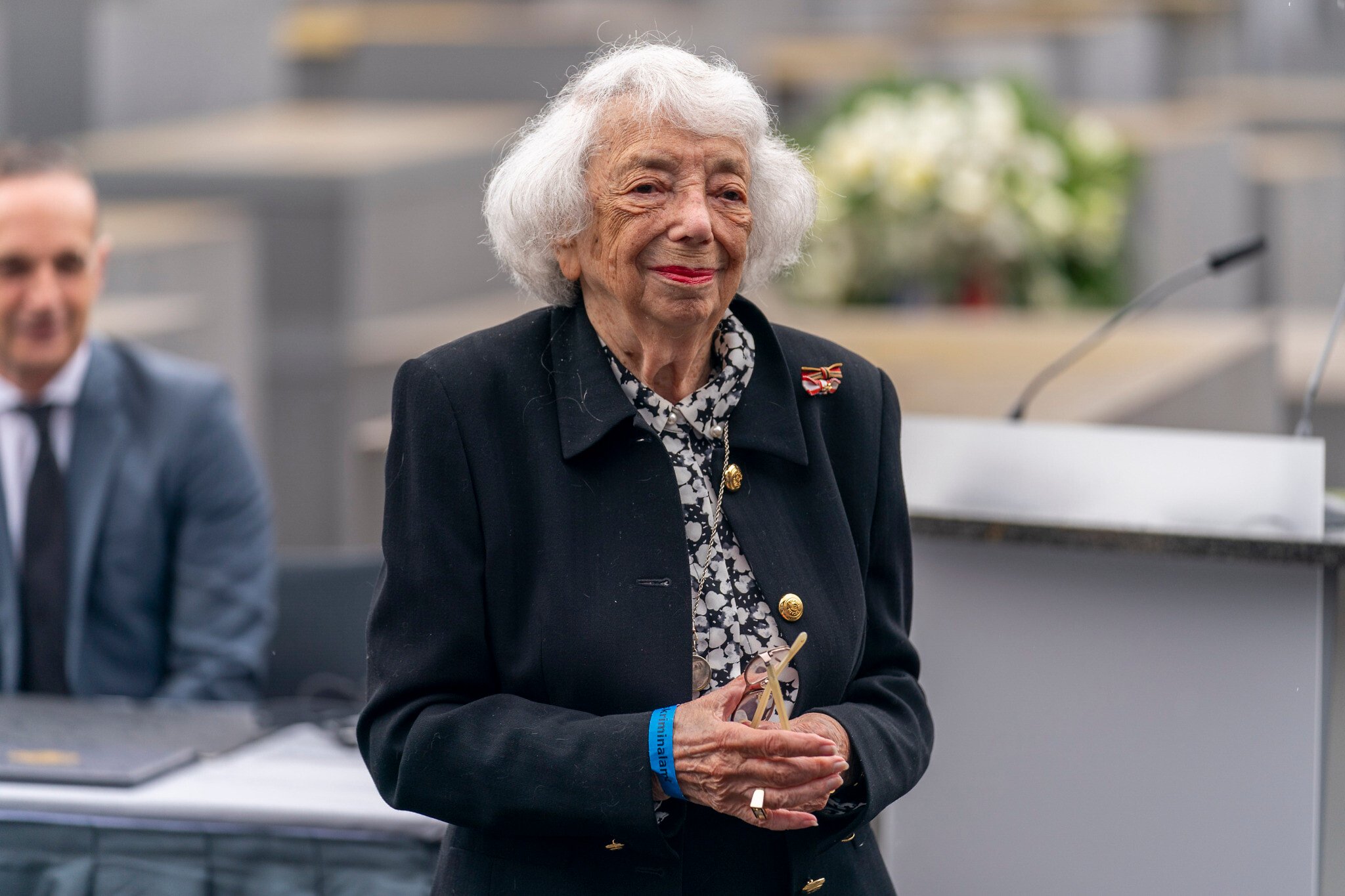
Holocaust Survivor Margot Friedlander steps away from the podium after speaking at a ceremony attended by US Secretary of State Antony Blinken and then-German Minister of Foreign Affairs Heiko Maas, left, for the launch of a US-Germany Dialogue on Holocaust Issues at the Memorial to the Murdered Jews of Europe in Berlin, June 24, 2021. (AP Photo/Andrew Harnik, Pool)
On May 9, 2025, Germany and the world lost one of the most powerful voices against antisemitism and hatred when Holocaust survivor Margot Friedländer passed away at the age of 103 in Berlin. Her death coincided with the week marking the 80th anniversary of Nazi Germany’s surrender in World War II. As we mourn her passing, we also celebrate a remarkable life dedicated to ensuring that the horrors of the past are never forgotten or repeated.
A Life Shaped by Persecution and Survival
Born Anni Margot Bendheim on November 5, 1921, in Berlin to a Jewish family involved in button manufacturing, Friedländer’s early life was shattered when Hitler came to power in 1933. She was just 12 years old when the Nazi regime began implementing its antisemitic policies that would eventually lead to the Holocaust.
In 1943, her family became targets of the Gestapo. Forced into hiding, Margot was eventually captured in April 1944 and deported to Theresienstadt concentration camp. During those 15 months in hiding, she was helped by 16 different people, demonstrating that even in humanity’s darkest hour, there were those willing to risk everything to save others.
While Margot survived the horrors of Theresienstadt, her parents and younger brother were murdered at Auschwitz. At Theresienstadt, she met Adolf Friedländer, whom she had known in Berlin as the manager of the Jewish Cultural Federation where she had worked. They married shortly after the camp’s liberation by Soviet forces on May 8, 1945.
While Margot survived the horrors of Theresienstadt, her parents and younger brother were murdered at Auschwitz. At Theresienstadt, she met Adolf Friedländer, whom she had known in Berlin as the manager of the Jewish Cultural Federation where she had worked. They married shortly after the camp’s liberation by Soviet forces on May 8, 1945.
A New Life in America
In 1946, the Friedländers immigrated to New York, where they rebuilt their lives from nothing. Margot became a US citizen, working as a tailor and later running a travel agency. For 57 years, she stayed away from Germany, the country that had persecuted her and murdered her family.
It was only after her husband’s death in 1997 that Margot began to consider telling her story. In 2003, at the age of 82, she returned to Germany for the first time since the war when a German filmmaker, Thomas Halaczinsky, proposed making a documentary about her life. This visit marked the beginning of her extraordinary journey as a witness to history.
Return to Berlin and a New Mission
In 2010, at the age of 88, Margot made the remarkable decision to return permanently to Berlin, the city of her birth and the place where she had experienced such terrible persecution. Rather than harboring bitterness or resentment, she embarked on a mission to educate younger generations about the Holocaust and to promote tolerance and humanity.
Her memoir, “Try to Make Your Life: As a Jew Hiding in Berlin” (“Versuche, dein Leben zu machen: als Jüdin versteckt in Berlin”), published in 2008, became a bestseller and was awarded the Einhard Prize for best autobiography. The title itself comes from her mother’s last message to her before being deported to Auschwitz – a powerful testament to the human spirit’s resilience in the face of unimaginable horror.
Her Message to the World
What made Margot Friedländer truly extraordinary was not just her survival, but the message she carried. Her most famous words, which she repeated tirelessly to audiences across Germany, especially to young people, were simple yet profound:
Be human. [Seid Menschen.]
These two words encapsulated everything she stood for – a call for humanity in a world that had shown her its most inhumane face.
She expanded on this message frequently:
Don’t look at what divides you. Look at what unites you. Be human, be reasonable. [Schaut nicht auf das, was euch trennt. Schaut auf das, was euch eint. Seid Menschen, seid vernünftig.]
Margot Friedländer often said that nothing is more important to her – not the Federal Cross of Merit or any other award – than the young people. When speaking to young Germans, she would often say:
I don’t want to know what your grandparents did. I am here to tell you that I don’t want you to ever be confronted with something like this. [Ich will nicht wissen, was eure Großeltern gemacht haben. Ich bin hier, um euch zu sagen, dass ich nicht will, dass ihr je mit so etwas konfrontiert seid.]
By “something like this“, Margot Friedländer meant the persecution during the Nazi era and the Holocaust.
A Tireless Witness Until the End
Despite her advanced age, Margot maintained an incredible schedule, speaking at schools, universities, and public events up to several times per week. She considered her work with young people to be her most important legacy, more valuable than any of the numerous honors she received.
What I do gives me my strength and probably also my energy, because I speak for those who can no longer speak,
she explained at an event at Berlin’s Jewish Museum in 2018.
I would like to say that I don’t just speak for the 6 million Jews who were killed, but for all the people who were killed – innocent people.
In recent years, she expressed concern about the rise of right-wing extremism and growing antisemitism in Europe. Having lived through the beginning of Nazi persecution, she recognized the warning signs all too well. Her voice became even more urgent as she witnessed history threatening to repeat itself.
At 102, she made headlines by appearing on the cover of German Vogue, using this platform to reach even more people with her message of tolerance and humanity.
Honors and Legacy
For her tireless work, Margot Friedländer received numerous accolades, including Germany’s highest honor, the Federal Cross of Merit, and was made an honorary citizen of Berlin in 2018. The Margot Friedländer Foundation continues her work by awarding prizes to individuals and initiatives that promote tolerance and humanity and fight against antisemitism and anti-democratic forces.
German Federal President Frank-Walter Steinmeier, who had been scheduled to present her with a state medal on the very day of her passing, expressed that “she gave our country reconciliation despite the horrors she went through here in her life” and that Germany “cannot be grateful enough for her gift“.
Federal Chancellor Friedrich Merz noted that Germany had lost “one of the strongest voices of our time: for peaceful coexistence, against antisemitism and forgetting“.
Carrying Forward Her Legacy
As we mourn Margot Friedländer’s passing, we must commit ourselves to carrying forward her legacy. In a world where antisemitism is once again on the rise, where hatred and division are being stoked for political gain, her simple message – “Be human” – has never been more important.
Her life reminds us that even after experiencing the worst of humanity, it is possible to choose reconciliation over bitterness, education over silence, and hope over despair. As she often told young people:
I would like you to be the witnesses we can’t be for much longer.
Now that responsibility falls to all of us. May her memory be a blessing, and may her message continue to inspire generations to come. In honoring Margot Friedländer, we must commit ourselves to building a world where ‘Never Again’ is not merely a slogan, but a reality we actively shape through our choices every day.
Zichrona livracha – May her memory be a blessing.
Related Topics