
Mark Ruffalo: How Dark Waters Became Murky
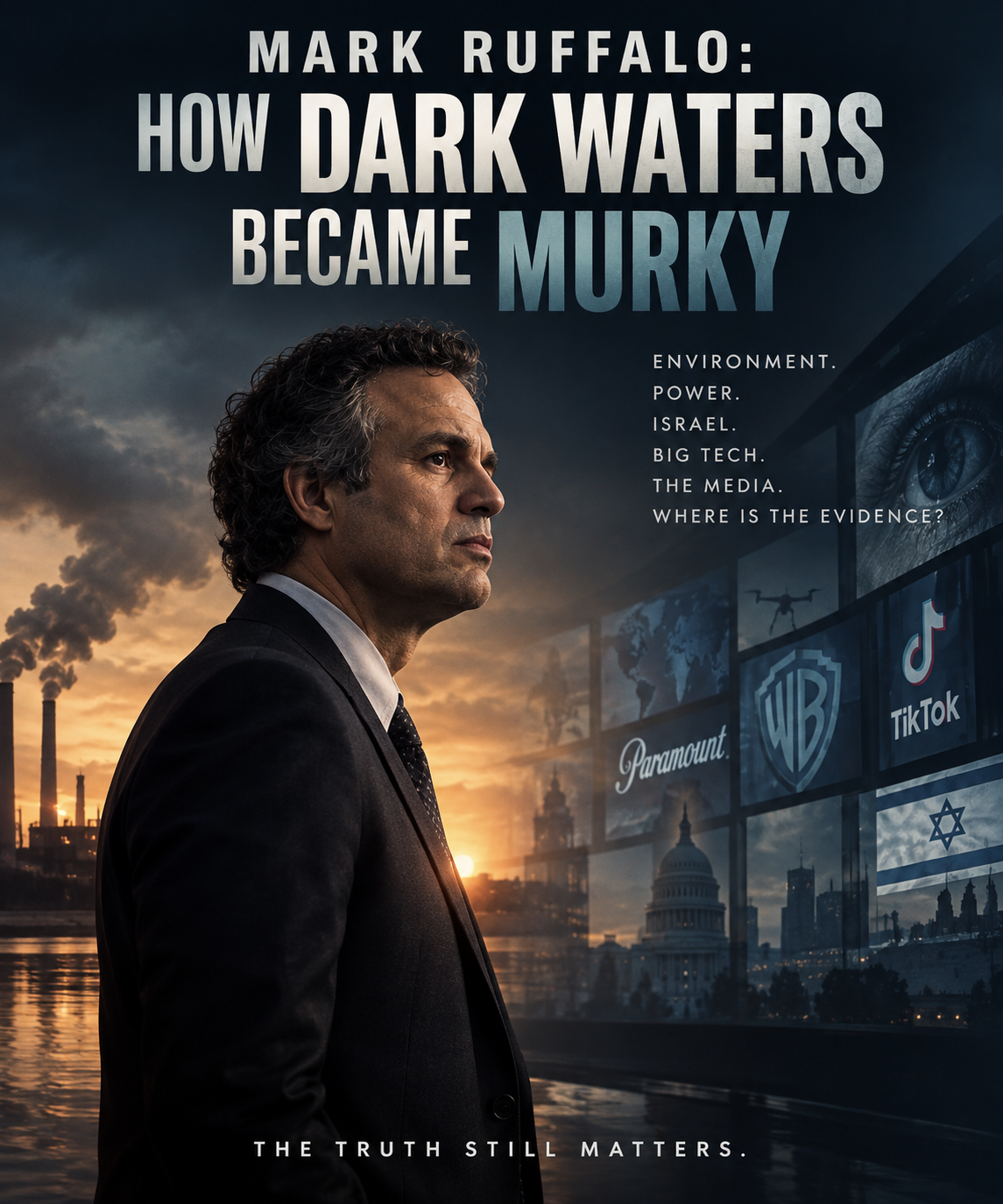
Years before Mark Ruffalo made Dark Waters, I was teaching the story behind the film to students in my Contemporary Science and Technology class at Suffolk University. My students read and analyzed the New York Times Magazine investigation of attorney Rob Bilott’s extraordinary battle to uncover how DuPont had contaminated drinking water in West Virginia with PFOA. More important than our discussion of PFOA itself was the question of what happens when a corporation becomes so powerful that challenging it becomes extraordinarily difficult.
So when Ruffalo made Dark Waters, I was delighted. I took my class to see it.
I still agree with Ruffalo about many of the issues that have motivated his activism. Climate change is real and demands serious action. Corporations can become dangerously powerful. Workers and their families can suffer when corporate interests overwhelm other considerations. Enormous concentrations of wealth deserve scrutiny. And I share Ruffalo’s concern that combining Paramount and Warner Bros. raises legitimate questions about competition, jobs and the concentration of media power.
But the facts of Dark Waters did not lead to the conclusion that the corporate world was evil.
Rob Bilott was not an environmental activist who had spent his career fighting corporations. He was a corporate attorney. For eight years, he had primarily represented large corporate clients, particularly chemical companies, in environmental matters. What Bilott uncovered about DuPont’s contamination of drinking water with PFOA ultimately drew him and his law firm, Taft Stettinius & Hollister, into a years-long battle against one of the most powerful chemical companies in America.
DuPont’s conduct demonstrates the danger of excessive corporate power. But Bilott and his law firm demonstrate something else: corporations and the people who work for them cannot simply be divided into villains and heroes according to which side of the corporate divide they occupy. A corporate lawyer, supported by a corporate law firm whose business came from representing corporations, could examine the evidence and conclude that a corporation had done something terribly wrong.
Bilott did not begin by assuming that DuPont executives were evil because they ran a powerful chemical corporation. In fact, his experience representing chemical companies initially inclined him to believe that sophisticated corporations generally tried to comply with environmental regulations. But he followed the evidence. The condemnation resulted from that evidence, and that is what made Dark Waters so compelling.
It is also a standard Mark Ruffalo increasingly seems not to apply.
Consider Ruffalo’s condemnation of fracking. He was right to call attention to its environmental risks; the Environmental Protection Agency has documented circumstances in which activities associated with hydraulic fracturing have affected drinking-water resources.
But Ruffalo went considerably further. In 2016, he declared that “there is no fracking that can be done safely.”
That is not what the scientific evidence established. Evidence that a technology can cause environmental harm under particular circumstances is not evidence that it can never be used safely.
Consider Ruffalo’s condemnation of nuclear power. Nuclear power has one of the best safety records of any major source of electricity and produces extremely low lifecycle greenhouse-gas emissions. The Intergovernmental Panel on Climate Change concludes that nuclear power can provide low-carbon energy at scale. The International Energy Agency considers continued operation of existing nuclear plants an important part of a cost-effective path to net zero.
Yet Ruffalo became a prominent campaigner for shutting down Indian Point, an operating nuclear plant supplying enormous quantities of carbon-free electricity to New York.
As Indian Point began shutting down, Ruffalo celebrated, promoting the shutdown as part of the path toward a “100% renewable energy future.” But much of the electricity lost when Indian Point closed was replaced by fossil-fuel generation, increasing greenhouse-gas emissions.
Someone deeply concerned about climate change, as Ruffalo clearly is, should have confronted the obvious tradeoff involved in removing a major source of carbon-free electricity before sufficient renewable generation existed to replace it.
Ruffalo’s moral certitude led him to support a shutdown whose immediate consequences included increased greenhouse-gas emissions—the opposite of what his climate activism was intended to accomplish.
Now consider Ruffalo’s condemnation of Israel. In 2021, during fighting between Israel and Hamas, Ruffalo made posts suggesting that Israel was committing genocide.
But then he did something worthy of respect: he reconsidered. Ruffalo publicly apologized, saying that the genocide accusation was “not accurate,” “inflammatory” and “disrespectful.” He warned that such rhetoric was being used to justify antisemitism and urged people to “avoid hyperbole.”
But he subsequently returned to the accusations that Israel practices apartheid and has committed genocide in Gaza. He now presents these not as contested accusations, but as established facts.
It should be noted that Ruffalo did not invent these accusations. Amnesty International, Human Rights Watch and other organizations have constructed extensive arguments supporting them. But their conclusions are far from settled.
On genocide, John Spencer, chair of urban warfare studies at West Point’s Modern War Institute, has repeatedly visited Israel and Gaza and unequivocally rejects the charge. The High Level Military Group, composed of former generals and senior military officials from democratic countries, has likewise reached conclusions sharply at odds with Israel’s accusers. Moreover, the U.S. government has rejected the genocide characterization.
The apartheid accusation is similarly contested. Organizations making the case argue that Israeli policies toward Palestinians amount to apartheid, while Israel and its defenders reject that characterization, pointing among other things to the citizenship and political rights of Arab Israelis and distinguishing their status from that of Palestinians in the West Bank and Gaza, who are not Israeli citizens. The dispute turns in significant part on whether Israel and the Palestinian territories should be treated as a single regime for purposes of applying the legal definition of apartheid—precisely the sort of contested legal and factual question that should not simply be presented as settled.
Ruffalo can reasonably rely on organizations he trusts. But he cannot reasonably present their highly contested conclusions as established fact.
And now we have Ruffalo’s accusations against Larry Ellison and his son David.
Larry Ellison is one of the wealthiest people in the world. His company, Oracle, has extensive government contracts. Ellison has expressed enthusiasm for AI-enabled surveillance that many would find disturbing. He is helping finance the expansion of his son David’s entertainment empire. And the proposed combination of Paramount and Warner Bros. raises genuine questions about competition, jobs and media concentration.
Oracle’s treatment of its workers has also become part of the broader indictment of the company. Oracle has eliminated thousands of jobs while investing heavily in artificial intelligence. The layoffs are real, and their consequences for employees can be severe. But Oracle is hardly unique. The technology industry is undergoing a broad restructuring as companies pour enormous sums into AI while reducing employment in other areas. Microsoft, Google, Meta, Amazon and other major technology companies have all eliminated jobs while dramatically increasing their AI investments.
Ruffalo then circulated a video of Safra Catz, Oracle’s Israeli-born former CEO and current executive vice chair, discussing technology Oracle made available to Israel following the October 7 Hamas massacre. Catz had described October 7 as a “trauma” and “catastrophe” and said that her immediate reaction was to find some way to help. It was in the context of Oracle’s response to those atrocities that she described some of its capabilities as “really profoundly scary technologies” and said there were things Oracle had done to assist the Israeli military that she could not discuss.
Ruffalo then made an extraordinary leap: he predicted that these technologies “will most likely be merged into one of the largest media conglomerates in the world” and warned Americans that they would “one day [be] used on you.”
That statement raises some obvious questions: Where is the evidence? What technology was Catz describing? What evidence establishes that undisclosed technology Oracle provided to the Israeli military is being transferred to Paramount or Warner Bros.? What evidence establishes that David Ellison intends to transform an entertainment company into a surveillance operation? And what exactly does Ruffalo believe the Ellisons intend someday to do to us?
These are not minor missing details. They are the links necessary to establish Ruffalo’s conclusion.
Oracle is not merging with Warner Bros. Larry Ellison’s wealth is helping finance his son’s acquisition. That Larry Ellison has views about surveillance that deserve scrutiny does not establish that Oracle’s technology provided to the Israeli military will be placed inside Warner Bros. And that Oracle helped Israel after October 7 does not establish that Americans will someday be subjected to whatever technology Oracle made available to Israel in the aftermath of the worst attack on Jews since the Holocaust.
But the response to Ruffalo’s accusations by more than 170 Jewish actors, filmmakers, writers, academics, rabbis and other public figures raises an additional evidentiary problem.
The signatories could reasonably have argued that criticism of a Jewish billionaire is not inherently antisemitic, that Ruffalo’s long history of progressive activism should be considered before labeling him an antisemite, and that media consolidation, billionaire influence and Larry Ellison’s enthusiasm for surveillance all deserve scrutiny.
But that is not all they did.
They signed an open letter substantially embracing—and expanding—Ruffalo’s theory. Their letter declares that the “assault on the Palestinian people” and the “assault on our liberties at home” are “deeply interconnected,” and describes the Ellisons’ activities as part of a “larger project of tech-driven domination.”
It brings TikTok into the argument, portraying the Ellisons’ involvement with the platform as part of an effort to increase pro-Israel messaging. It invokes Larry Ellison’s enormous financial support for Tony Blair’s institute and connects Blair to plans for Gaza’s future. It describes Gaza as an “open-air laboratory for AI-driven killing and control technologies.” And then it states that “The AI road to WarnerMount runs through Gaza.” Finally, it warns of the “Orwellian world” Larry Ellison supposedly “has in store for us”—a world in which his cohort will increasingly control what Americans watch while simultaneously watching us.
Those are extraordinary accusations. And as I have noted in previous essays, Carl Sagan popularized the maxim: “Extraordinary claims require extraordinary evidence.”
But where is the evidence?
Some individual facts in this narrative are real. Ellison has supported Tony Blair’s institute. Oracle assisted Israel. Ellison has spoken enthusiastically about AI surveillance. Netanyahu has spoken about the importance of social media to Israel’s ability to make its case. The Ellisons are accumulating extraordinary economic and media power.
But none of that remotely establishes a coordinated project of domination.
And that brings me back to Dark Waters.
Perhaps the more than 170 Jewish creatives and thinkers who signed the letter defending Mark Ruffalo should rewatch his movie and pay close attention to its hero, Rob Bilott. Rob Bilott did not begin with the proposition that DuPont was evil and then collect ominous facts that supported his conclusion. He investigated, obtained documents, followed the science and established what DuPont knew and what it had done.
The evidence came first. The condemnation came afterward.
The signatories defending Ruffalo appear to have reversed that process. They begin with people and institutions they already regard with suspicion—Larry Ellison, David Ellison, Oracle, Israel, billionaires, artificial intelligence and media conglomerates—and connect them into what they call a “larger project of tech-driven domination.”
But where is their Rob Bilott?
Where is the painstaking investigation establishing those connections? Where are the documents showing that undisclosed technology Oracle provided to the Israeli military is being transferred into the Ellisons’ entertainment companies? Where is the evidence that David Ellison intends to transform a media conglomerate into a surveillance operation? Where is the evidence of the sinister project their letter describes?
And there is another reason this particular speculation should concern the people who signed that letter.
There is a long and ugly history of portraying wealthy Jews as people who accumulate control over communications and the media, exercise hidden influence over governments and ultimately use that power against the societies in which they live. The most notorious example is The Protocols of the Elders of Zion, the infamous forgery purporting to reveal a secret Jewish plan to control the world through finance, politics and the media. Although exposed as fraudulent long before the Holocaust, its themes were embraced and propagated by Hitler and other Nazi leaders and helped fuel the antisemitic worldview used to justify the persecution and eventual mass murder of Europe’s Jews.
That history does not place Larry and David Ellison beyond criticism. Their wealth, business practices, political influence and media acquisitions deserve rigorous scrutiny. But when an argument combines Jewish billionaires, enormous wealth, media control, Israel, secret technology and a warning that this concentrated power will eventually be turned against ordinary Americans, surely the evidentiary bar should be particularly high.
Instead, more than 170 Jewish public figures put their names beneath the accusation.
Rob Bilott investigated first and condemned second; Ruffalo and the people who signed this letter appear to have done the reverse.
Scrutiny means following the evidence wherever it leads—not deciding where it must lead before we begin.
Mark Ruffalo needs to be reminded of the lesson of his own movie.