
Mark Twain Saw Israel Coming
What happened when the Jews found out their strength
I recently came across an essay by Mark Twain called “Concerning the Jews,” published in 1899. It is admiring, provocative, occasionally stereotypical, and at moments so eerily prescient that Twain seems to be reporting from the future.
This was one of those moments:
“Dr. Herzl has a clear insight into the value” of concentration, Twain wrote. “He wishes to gather the Jews of the world together in Palestine, with a government of their own.”
Twain did not object, but he offered a warning:
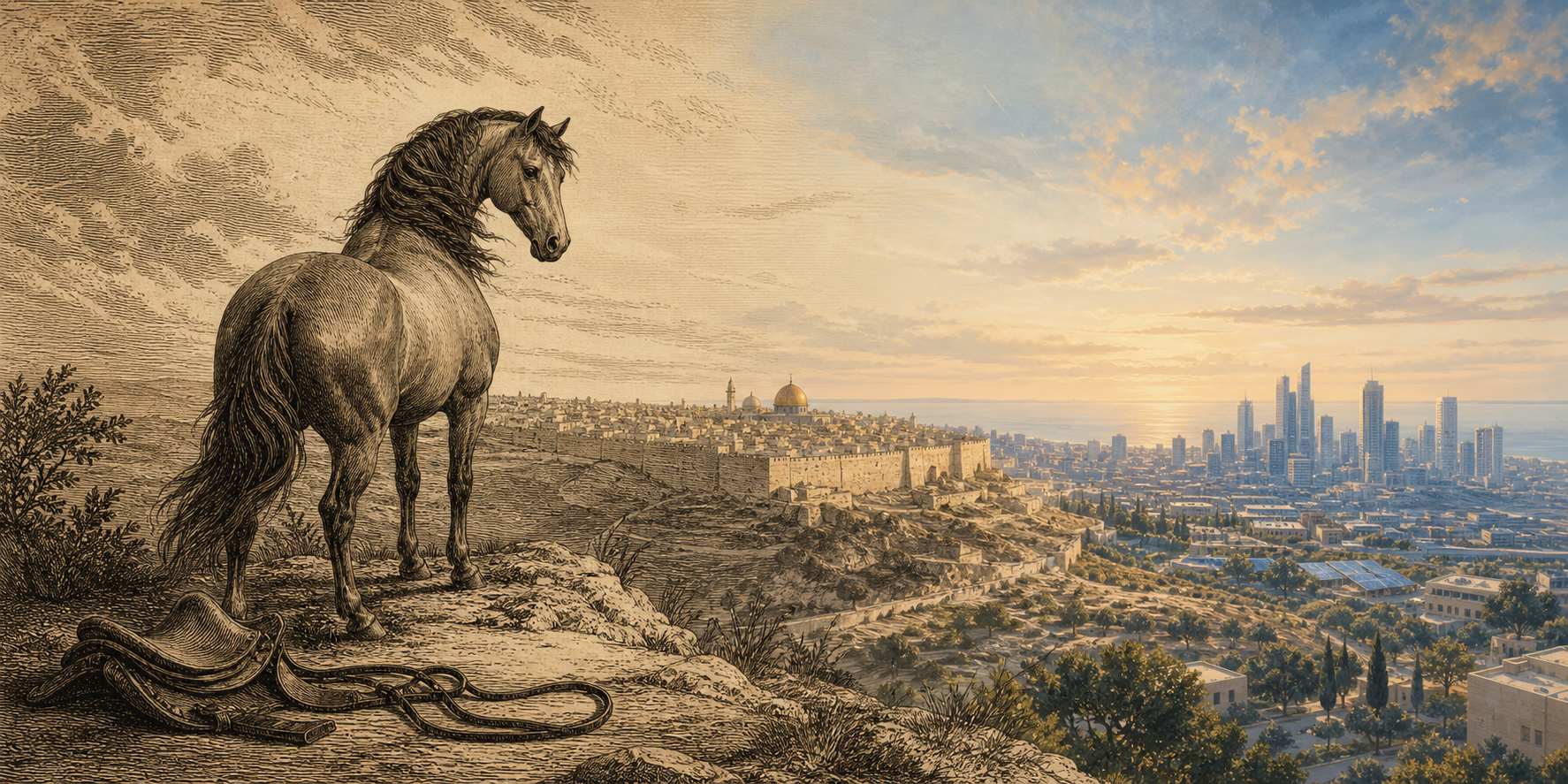
“It will not be well to let that race find out its strength. If the horses knew theirs, we should not ride any more.”
Forty-nine years later, the horses found out.
The State of Israel was born.
Twain could not have imagined Hebrew revived, deserts turned into farmland, refugees transformed into citizens, or a tiny Jewish state becoming a center of global technology. But somehow, he sensed the potential.
For centuries, Jewish talent had been scattered across the world, usually at the pleasure—and always at the mercy—of somebody else. Jews could help build a country but could never be certain it would continue to permit them to live there. Their abilities could be employed, taxed, restricted, confiscated, or expelled.
Twain’s horse metaphor captured that condition with uncomfortable precision: Jewish strength was harnessed for someone else’s purposes because someone else held the reins.
Zionism was the moment the horse looked over its shoulder.
Herzl understood that the Jewish problem was not a shortage of talent but of power: political, military, and sovereign. A dispersed people could produce extraordinary individuals. Concentrated in its ancestral homeland, that people might restore a civilization.
Nations have spent centuries accusing Jews of possessing too much power while ensuring they possessed almost none. They resented Jewish success, restricted Jewish participation, confiscated Jewish property, and periodically expelled the Jewish population—only to watch those Jews enrich another city, kingdom, or continent.
History contains few acts of national self-sabotage as reliable as expelling the Jews.
Keeping the Prejudice, Exporting the Talent
Consider Spain.
By the end of the fifteenth century, Spain’s Jews had produced one of the great civilizations of the Diaspora. Then Ferdinand and Isabella decided Spain would be better off without them. The Alhambra Decree of 1492 gave practicing Jews a brutal choice: convert or leave.
Spain kept much of their property. Other countries received their people.
The expelled Sephardim brought languages, skills, and commercial networks to North Africa, Europe, and the Ottoman Empire. The civilization Spain rejected became an asset to the societies that received it.
The pattern reached its most catastrophic expression in Germany. Long before the Nazis began murdering Europe’s Jews, they removed them from German life. Jewish professors were dismissed, doctors pushed out of hospitals, lawyers disbarred, and scientists expelled from research institutes.
The Nazis believed they were purifying German civilization. They were dismantling it.
Nothing about the Holocaust can be reduced to lost talent; its crime was murder, not mismanagement. But the self-sabotage was real. Germany exchanged physicists for racial theorists and scholars for propagandists. It burned books, emptied universities, and called the resulting darkness enlightenment.
After the Holocaust, the pattern repeated across the Middle East and North Africa. Some Jews were expelled; others fled persecution or an untenable future. Roughly 850,000 Jews lived in Arab countries in 1948. Over the following decades, those ancient communities virtually disappeared.
The regimes that drove them away may have imagined they were punishing Zionism. Instead, they were supplying Zion.
Most went to a poor and vulnerable Israel scarcely prepared to receive them. They encountered tents, transit camps, discrimination, and serious failures of absorption. Israel, as usual, was better at rescuing Jews than at receiving them gracefully. But it did something historically revolutionary.
It took them in.
They became citizens and transformed the country that absorbed them. Previously, when one ruler expelled the Jews, another decided whether to admit them. Now there was a Jewish state waiting at the end of the road.
The nations that expelled their Jews treated them as disposable. Israel turned the discarded into a country.
From Start-Over to Start-Up
The distance from starting over to starting up turned out to be surprisingly short. Starting over requires many of the same qualities as starting up: tolerance for risk, adaptation, improvisation, and the ability to imagine an improbable future. The refugee and entrepreneur both stand amid uncertainty and decide to build anyway.
Israel institutionalized that instinct. Its scarcity demanded invention. Its enemies imposed urgency. Its immigrants supplied knowledge drawn from dozens of civilizations. Its military gave young people responsibility, its culture rewarded argument, and its small domestic market forced businesses to think globally.
Necessity may be the mother of invention, but in Israel it is also the overbearing Jewish mother of invention: impatient, demanding, and unwilling to accept excuses.
Roughly a million immigrants from the former Soviet Union added scientists, physicians, engineers, musicians, and academics. Many found their credentials did not translate neatly. Doctors drove taxis; engineers swept floors. But ability does not vanish because a bureaucracy fails to recognize it. If it did, Israel would have misplaced half its population. Their skills eventually converged with Israel’s universities and technology industry. Another system lost its Jews; the Jewish state gained their future.
Government policy mattered too. Israel did not wait for an innovation economy to materialize through ethnic magic. It invested in research, universities, and venture capital. In 2025, high technology accounted for more than 18 percent of Israel’s GDP and 58 percent of its exports.
Israel’s success is not proof of mystical Jewish intelligence. It is evidence of what ability can accomplish when protected by institutions, connected through networks, challenged by necessity, and permitted to act freely.
Twain saw the brains. Herzl understood the need for a country. Israel built the ecosystem.
The New Alhambra Decree
Our age is more sophisticated. The modern decree arrives not on royal parchment but as a canceled concert, a withdrawn invitation, or a Jewish organization informed that its presence makes others feel unsafe.
No one has ordered the Jews to leave. They have merely made the rooms Jews inhabit increasingly impossible to remain in.
The new exclusion is defended as anti-Zionism rather than antisemitism. The distinction can be legitimate. Israel’s government, policies, and army are proper subjects of criticism. The line is crossed when individual Jews are treated as representatives of Israel, Israelis are held collectively responsible for their government, or Zionism becomes an ideological stain Jews must scrub away before entering polite society.
The Jew remains welcome—terms and conditions apply. In May 2024, a viral spreadsheet titled “Is your fav author a zionist?” classified nearly 200 writers and advised readers not to buy or promote those labeled Zionists. Literature apparently now requires a foreign-policy entrance exam.
Jewish American musician Matisyahu had concerts canceled after planned anti-Israel protests prompted venues to cite security concerns. He is not an Israeli official. He is a reggae singer from Pennsylvania. The distinction proved too demanding.
Then there is Eurovision, a musical competition whose traditional relationship with good taste has always been somewhat informal. Ireland, Spain, the Netherlands, and Slovenia withdrew from the 2026 contest after organizers declined to expel Israel.
Not every boycott of an Israeli is antisemitic, and a canceled performance is not an expulsion. But history does not repeat itself only at full volume. Before Jews are driven from a country, they are driven from its institutions. The process begins not with a border guard but with a conditional invitation.
The damage is not confined to Jews. A literary culture that judges novels by an author’s position on Israel will produce less interesting literature. A university that lets intimidation determine who may speak will cease to be a university. An arts institution that selects participants according to ideological purity has recreated the blacklist and given it a diversity statement.
This is not an argument that Jews deserve inclusion because they are useful. A Jew is entitled to dignity even if he never wins a Nobel Prize, launches a company, or irrigates a tomato. Jewish dignity is not compensation for services rendered.
There is, however, one enormous difference between the modern Jew and the Jews expelled from Spain: the Jewish people now have a place of their own.
That does not mean an American author whose invitation is withdrawn will make aliyah. Diaspora Jews are citizens, not temporary guests awaiting the next ship out. But exclusion does not require emigration to impoverish an institution. A writer can publish elsewhere; a student can choose another university; a donor can redirect his support.
Israel changes the balance not because every excluded Jew will move there, but because Jewish belonging no longer depends entirely upon someone else’s permission.
When the Horses Learned Their Strength
Twain ended his essay by surveying the great civilizations of antiquity:
“The Egyptian, the Babylonian, and the Persian rose, filled the planet with sound and splendor, then faded to dream-stuff and passed away; the Greek and the Roman followed, and made a vast noise, and they are gone.”
The Jew, Twain observed, saw them all—and remained.
“All things are mortal but the Jew; all other forces pass, but he remains. What is the secret of his immortality?”
Perhaps there is no single secret. The Jews carried a portable civilization. Torah did not require a palace. Memory did not require an army. A Jewish home preserved rituals that outlived the government outside it. Parents taught children a story in which exile was real but never final. Jews argued, adapted, mourned what was lost, and began again.
Always, they began again. That was the secret of Jewish survival in exile. Israel added something new: the ability to begin again in the same place.
The Start-Up Nation was first the Start-Over Nation—a country assembled from people other countries had discarded. The Jews revived a language, gathered their exiles, reclaimed a homeland, built a state, defended it, argued over it, and turned the human capital discarded by hostile civilizations into one of the most dynamic countries on earth.
The horse discovered that the rider was optional.
More than a century later, Twain’s warning should be addressed not to the Jews but to societies again making Jewish belonging conditional.
History contains few acts of national self-sabotage as reliable as expelling the Jews.
The Jews will survive. They have had practice.
The wiser question is what happens to the countries foolish enough to give them away.