The views expressed herein are solely mine.
Maronite Revolt Can Break Hezbollah
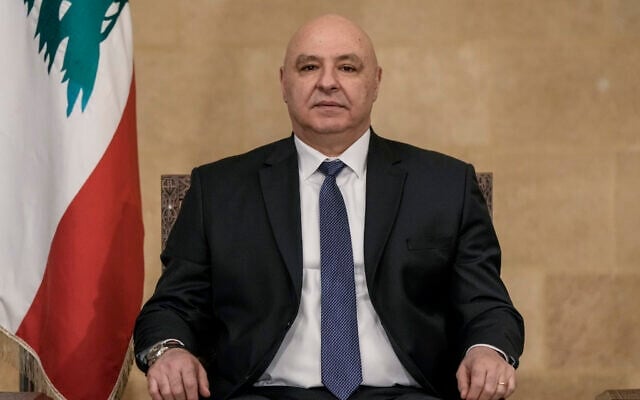
Newly-elected Lebanese President Joseph Aoun sits at the presidential palace in Baabda, east of Beirut, Lebanon, January 9, 2025. (AP Photo/Bilal Hussein)
Western diplomats love to repeat the cowardly cliché that “Lebanon is Hezbollah.” For them, it is a comforting excuse for doing nothing against the strongest terrorist entity in the world.
But the facts on the ground now make that claim strategically absurd.
As we have recently seen, Lebanon’s most influential Christians—especially the Maronite elite—are openly challenging Hezbollah’s narrative and calling for peace with Israel.
That is not symbolic; in fact, our Maronite brothers are the only internal force capable of ripping Hezbollah’s political cover to shreds.
Look at the political earthquake in Beirut: Lebanon’s new foreign minister, Youssef “Joe” Rajji, a Maronite Christian from the fiercely anti-Hezbollah Lebanese Forces, publicly declared he has “no taboos” about negotiating with Israel and insisted Lebanon must pursue diplomacy to regain sovereignty.
For a Maronite foreign minister to say that on camera in 2025 is not a nuance. It is a strategic rupture that signals that Lebanon’s Christian establishment is done sacrificing the country on the altar of Tehran’s proxy wars.
Then there is Maria Maalouf, the outspoken Maronite journalist who has been hammering Hezbollah for years and accusing them of being an “Iranian contractor destroying Lebanon’s future.”
Maria has consistently called for peace and normalization with Israel, arguing that only breaking Hezbollah’s armed stranglehold can save the country.
Thus, when a Maronite foreign minister and a prominent Maronite media figure both say “we need a deal with Israel,” Hezbollah loses its monopoly over Lebanon’s national identity.
And without a doubt, this is the worst internal threat the group has ever faced.
Meanwhile, the hard power picture is brutal. Hezbollah fields tens of thousands of fighters—its own officials claim 50,000–70,000—and controls an arsenal that ballooned from about 12,000 rockets in 2006 to over 100,000 today.
As we all know, Hezbollah is not a “party.” It is a parallel army.
By contrast, the Lebanese state sadly runs a collapsing defense budget measured in hundreds of millions of dollars while Hezbollah pulls in Iranian cash and criminal smuggling revenue that dwarfs state resources.
Therefore, expecting the Lebanese Army to disarm Hezbollah is diplomatic comedy.
And this is why the Christian shift matters.
Unlike Sunni and Shiite factions trapped in patronage and armed dependency, large portions of Lebanon’s Christian population—especially the Maronites—now openly see Hezbollah as a foreign occupation element.
As a result, Rajji’s positions, backed by his party, reflect a resurgent Christian sovereignist doctrine: no weapons outside the state, no Iranian veto over Lebanese policy, and no future without reclaiming sovereignty.
At the same time, Israel has shattered Hezbollah’s aura of invincibility.
Over the past two years, Israel has systematically decapitated Hezbollah’s leadership—Fuad Shukr, Haytham Ali Tabatabai, and most dramatically Hassan Nasrallah himself.
Hezbollah’s command network is bleeding, Iran’s cash pipeline is strained, and Tehran is losing control over proxies from Gaza to Yemen.
The “Resistance Axis” is cracking!
Add to that a Lebanese cabinet led by figures who refuse to bow to Iranian dictates, and suddenly the old assumption that Israel has no partner in Lebanon collapses.
As a consequence, a Christian political revolt combined with Israeli military pressure is Hezbollah’s nightmare scenario: a domestic constituency demanding disarmament while Israel eliminates its leadership from above.
Ergo, continuing to treat Lebanon as a homogeneous Hezbollah fortress is not just analytically wrong—it is geostrategic malpractice.
Evidently, if Israel wants a demilitarized northern border and a Lebanese state that enforces sovereignty instead of subcontracting it to Tehran, it must double down on one hard-edged strategy: back the Christians willing to say publicly what everyone else whispers—Hezbollah has ruined Lebanon, and peace with Israel is the only way out.
That means engaging Christian political leadership, supporting sovereignist initiatives, and rewarding any Lebanese movement that demands implementation of UN Security Council Resolution 1559 and the disarmament of militias.
Simultaneously, it also means signaling that Israel distinguishes between a Lebanon trying to reclaim its state and a Hezbollah bunker firing rockets on Iran’s orders.
Why?
Because Hezbollah’s greatest fear has never been Israeli bombs but a Lebanese political uprising that strips away its “resistance” myth and exposes it as a foreign proxy.
In my view, that uprising will not start in Tehran’s mosques or Hezbollah’s bunker in Dahieh. It will come from Lebanon’s Christian heartland—Maronite towns and parties that still believe in a sovereign state.
Thereupon, Israel does not need to invent this ally. It already exists.
Now it must finally treat it as a geopolitically strategic ally and a future partner for peace.
Related Topics
Related Posts