
Martyring Macklemore?
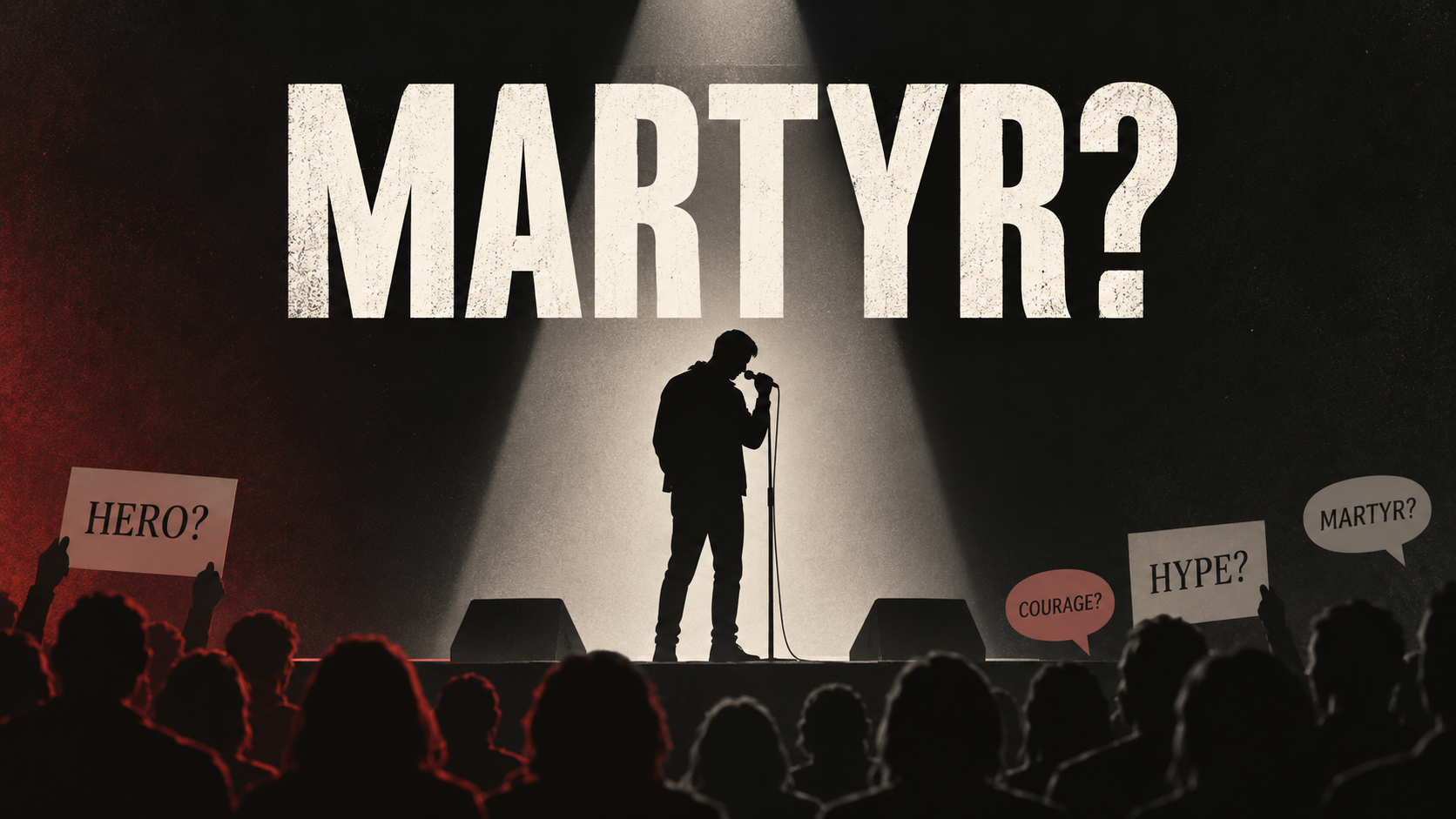
How the fear of “making martyrs” became an excuse for not fighting back.
There is a litany of arguments we hear whenever somebody makes an outrageous accusation against Jews, Zionists or Israel.
Ignore them.
Don’t amplify them.
Don’t give them oxygen.
Don’t make them a martyr.
It sounds sophisticated. Strategic. Sensible. Not to mention: it’s the path of least resistance.
The Macklemore fiasco has made me conclude that the fear of “making martyrs” is one of the most damaging barriers in our fight against antisemitism.
Whatever its intentions, the result is always the same: The accuser gets to speak. The target is told to shut up.
That is not strategy. That is a conspiracy of silence.
It is not necessarily an organized conspiracy. I don’t imagine anybody sitting in a smoke-filled room plotting how to keep Jews quiet by warning them not to “make martyrs.” No, it is probably mostly unconscious — a collection of respectable-sounding arguments that somehow all arrive at the same destination.
Don’t answer the libel. Don’t challenge the slur. Don’t contest the accusation. Because if you do, you might make the person saying it more famous.
Or worse: You might make them a martyr.
The martyr trap
The Macklemore fiasco in brief: While opening for Ed Sheeran at MetLife Stadium, in New Jersey, Macklemore used the platform to promote his “pro-Palestinian” politics: accusing Israel of genocide, displaying imagery from Gaza, and generally accosting his audience (of mostly young people) with the familiar gimcrackery of the hate-Israel catechism.
The backlash was immediate.
Jewish and pro-Israel organizations objected. Robert Kraft, owner of the New England Patriots and Gillette Stadium, objected. Macklemore was ultimately dropped from the remaining US dates of Sheeran’s tour.
Then came the predictable counterattack.
Censorship!
Cancel culture!
Macklemore the martyr!
Several musicians quit the tour in solidarity with him. Activists rallied around him. Macklemore himself doubled down.
And right on cue came the advice: See? You should have ignored him. You’ve only made him bigger.
You’ve made him a martyr.
No.
That logic is backwards.
What does “don’t make him a martyr” actually mean?
Think about what the argument requires.
Someone makes an accusation.
You believe the accusation is false, defamatory or hateful.
But you are advised not to challenge it because challenging it might draw attention to the person making it.
In other words: The louder the libel, the greater the incentive for silence.
The more provocative the speaker, the more dangerous it supposedly becomes to answer him, and the more successful someone is at turning criticism into claims of victimhood, the more effectively he immunizes himself from criticism.
That is a magnificent system.
For him.
Not for Jews (or for non-Jewish allies, like me).
The “don’t martyr them” argument creates a perverse incentive in which the person making the accusation can speak without restraint while Jews and their allies are instructed to calculate whether defending themselves might be counterproductive or strategically unwise.
The critic gets a microphone.
We get a muzzle.
Martyrdom is not something critics bestow
Are we making Macklemore a martyr?
Only if we accept his definition of martyrdom.
A martyr is not simply someone who experiences criticism or consequences.
If somebody uses an enormous commercial platform to make inflammatory political claims, other people are entitled to object.
If venues decide they do not want to associate themselves with those claims, that is not persecution.
If audiences criticize him, that is not censorship.
If Jewish organizations say, “This rhetoric is unacceptable,” that is not martyrdom.
It is disagreement.
And if his defenders respond, “Look what they did to him! He’s a martyr!” then we should challenge that claim, too.
No.
He is not a martyr.
He is a wealthy, internationally known performer with a large platform who said something highly contentious and experienced appropriate consequences.
That is how public life works.
Silence has consequences too
The supposedly strategic approach treats speaking out as risky.
But it rarely calculates the risk of silence.
Imagine a young person in a stadium hearing Israel accused of genocide.
Nobody objects. Nobody says the issue is disputed. Nobody explains that the facts disagree. Nobody challenges the speaker.
What lesson does that person absorb?
Not just that Macklemore is right.
Something subtler and perhaps more powerful: Everybody agrees.
Anti-Jewish hatred and antizionist libels thrive not only through repetition. They flourish through the appearance of consensus.
And silence manufactures that consensus.
That is why one dissenting voice matters so much. One voice is infinitesimally more powerful than no voices.
It may persuade nobody.
But it destroys unanimity.
The moment one person says, “No, that will not go unchallenged,” everyone in the room knows there is another side to the story.
A very convenient conspiracy
This is why I have become suspicious of the entire etiquette surrounding “amplification.”
Don’t amplify. Don’t platform. Don’t dignify. Don’t engage. Don’t feed the trolls. Don’t make them martyrs.
Every individual argument may occasionally make tactical sense.
Collectively, however, they form something much larger.
A culture of silence.
A mechanism by which people who attack Jews, Zionism or Israel are permitted enormous rhetorical latitude while Jews themselves — and allies like me — are encouraged to exercise restraint.
It is a remarkably effective scheme for letting critics off scot-free.
And the most remarkable part is that almost nobody involved has to consciously intend that result.
That is what makes it so powerful.
The silence polices itself.
Let no smear stand
“Don’t make trouble” is a stereotypically Jewish response to trouble. (As a non-Jew, I’m out on a limb bringing this up, but here I am, world!)
Zionism upended stereotypical Jewish responses.
Zionism recognizes that Jews don’t make trouble. Others bring the trouble to Jews, and Jews (and allies) can either rise to the fight or back away slowly.
Zionism ended the tradition of backing away slowly.
Zionism recognizes that the fight needs to be fought. The trouble is not of Jewish making, but confronting it before it grows is absolutely Jewish people’s existential obligation.
Macklemore is just the latest in a kabillion examples of diaspora Zionists arguing amongst ourselves about whether to fight or let it go.
I am increasingly convinced that we need to act like Israelis. Don’t pick the fight. But don’t back down.
Let no lie go unanswered.
Challenge every attack.
Contest every smear.
Confront every falsehood.
That does not mean launching a national campaign against every anonymous idiot on social media. Proportionality and judgment matter. Sometimes ridicule is enough. Sometimes a correction will suffice. “Calling in” (opening a discussion and trying to educate the offender) before calling out can be an effective strategy sometimes.
The people attacking Jews have figured out something Jews and their allies haven’t seemed to: Repetition works wonders. Volume cuts through the noise. Confidence can look like truth, even when it’s not.
And unanswered accusations gain authority simply it looks like everyone agrees. Therefore they must be true.
So when someone tells me that criticizing Macklemore (or others like him) will only make him a martyr, my response is simple.
Only if we let that lie go unchallenged, too.
If he makes the accusation, answer it: You’re not a martyr. You are experiencing the consequences of your actions.
If he repeats the libel, rebut it again.
Never let it go.
Leave no fake claim of martyrdom unopposed.
Are we Zionists?
Then we should walk like Zionists.