Tectonic Shifts
Math’s $1 Million Millennium Prize Winner—AI?!
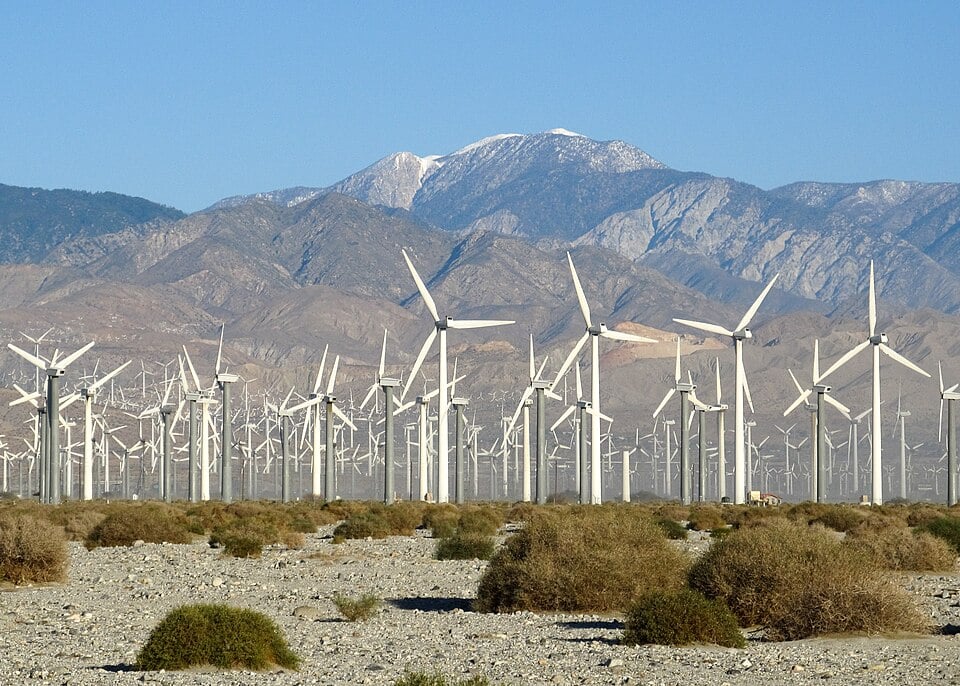
San Gorgonio Wind Farm, near Palm Springs, California. Photo: Ken Lund; courtesy Wikimedia Commons.
Seven years ago in an article entitled “Tectonic Shifts Adds Champagne to Million Dollar Math Prize, I declared in the Times of Israel (7-15-2019) that I’d gift a $1,000 bottle of champagne—aside from the million dollar prize offered by the Clay Mathematics Institute—to the genius who finally cracked one of the seven great Millennium Prize math problems: solving the Navier-Stokes equations. People have achieved such heights fairly recently, with Andrew Wiles besting Fermat’s Last Theorem in 1994 and Grigori Perelman proving the Poincaréconjecture in 2003. So the odds were pretty good that I’d someday have to pay off on my offer.
The good news is that only weeks ago Navier-Stokes has indeed now been solved, but the bad news is there’s no hero to whom the champagne can be presented: AI solved it. Teams of humans are busily checking the arcane, labyrinthine, brain-breaking mathematics to assure everything adds up, but the consensus is they’re 90%-plus convinced the problem’s been unraveled.
This certainly opens the door on the tumultuous debate concerning the sacrosanct realms into which AI is now intruding—and plenty of mathematicians worldwide are definitely up in arms at this infringement into their discipline. But that’s for others to debate; I put up the champagne to make a point about climate change and there’s still very good reason to keep the topic focused right there.
The Navier-Stokes equations are as requisite for climate science as the Pythagorean theorem is for triangles. Yet climatologists have limped along without them for the last two centuries, and an honest appraisal of what the discipline has produced in the way of wildly inaccurate forecasts unfortunately speaks to that deficit.
Navier-Stokes isn’t guesswork though; it’s the mathematical real McCoy, treating Earth’s atmosphere and oceans as what they are: massive interconnected and compressible fluids. These formulae are powerful enough to handle the uber-complex manner in which the planet’s constantly changing, ever flowing biosphere exchanges heat, is compressed or expanded, speeds up or slows down.
Those fundamental variables tracked by the Navier-Stokes equations impose order on the swirling chaos that ends up creating weather and climate. The four devilishly daunting differential equations that measure the rate of change of the rate of change of the great climate pistons, PhysicsWorld aptly describes as “the core engine behind global climate.”
In short, climatology can’t do without the Navier-Stokes equations, and yet has had to, for as long as there’s been a climate science. Dr. Paul Williams, for example, Royal Society fellow, esteemed professor of atmospheric science, mainstream climate change proponent, lamented recently that the secrets of the climate system are locked away in the Navier-Stokes equations, but they’re too complex to be solved directly.”
So it’s beyond fantastic that climate researchers should finally possess something with which real scientific projections might be made, hopefully giving better results than the last half century of near doomsday-like forecasts that have fallen flat, one after the other. Looking back now into the past, climate change as a somewhat outlandish bête noir, looming over the entire world for these last decades, supposedly set to drown Florida and melt ice caps—none of that was conjured up using the Navier-Stokes equations, obviously. Researchers just plugged millions of lines of code into computers, trying to skirt insoluble formulae. The problem with these what-if digital scenarios is even the slightest, microscopic input error at start can produce terribly flawed end results—the kind climate groupthink has been serving up for so long.
So even if it’s AI that has to be thanked, something important has doubtlessly occurred. Climate science, for one thing, could be put again on track, as it was back in the 1960s when politics first started nudging the discipline to derail itself away from solid and indisputable fact and instead pandering to partisans shouting for bread, circuses and apocalypses.
Sixty-five years ago American mathematician and meteorologist Edward Lorenz’ “Butterfly Effect” took the world by storm. He proved how chaotic, how unpredictable, how daunting were Earth’s climate and weather systems. If random flaps of butterflies’ wings in Brazil last year can result in tornados in Texas next year, only an omniscient deity or a race with super-computers could even dream of taking on such impossible tasks as forecasting climate events a decade or a century hence. That was then, this is now—and then made more sense.
Science knew all that in 1961. Yet the lure of submerged coastlines and Hollywood-esque disasters was too much. And politically correct slaps on backs along with mind-boggling amounts of cash combined for the only real “tipping point” that materialized, one tiring with the scientific method and dispensing with it.
That’s a terrible thing to lose, that empirical, systematic reasoning being the best single creation of civilization in the last five hundred years. Adding extreme monetary insult to that injury however is the tally of stupendous sums frittered away, some $14 trillion, flushed down a collosal toilet, the amount invested planet-wide in global warming and climate change fandangos and whirligigs over the last half century.
And even worse, while the world’s economy has been held back, suffocated in regulations, strangled by moratoriums, its massive energy resources shunned and efforts to access it hampered, carbon-taxed humanity’s comfort and needs, especially the poorest, has been effective downgraded, of little account compared to the laser-like focus on a future of fear, panic, compliancy, and belt-tightening. This is no way to run a super-sophisticated 21st century planetary economy; indeed, there’s very little to like in cultural traits such as these.
Those never have been American qualities, or Western values though; perhaps it’s finally time for a bit more savvy, gumption and horse sense and a tad less pessimism.
Related Topics
Related Posts