Left is not a dirty word
Matti Caspi and the Israeli Soul
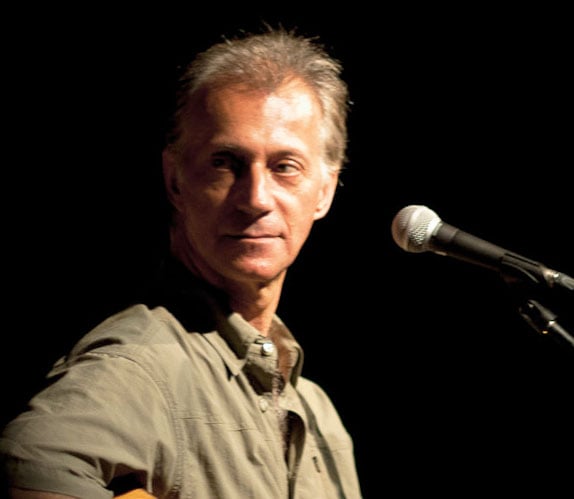
Matti Caspi in 2010, image Gilad Avidan via Wikimedia Commons
He grew up on a kibbutz, learning to play the piano and harmonica from immigrants, surrounded by the green of the kibbutz and the blood red of Holocaust stories. Trauma and peaceful flowering nature were one in his upbringing.
He began his career in the army, with the army entertainment corps, starting to sing when they realized he could keep a melody.
He became known as a singer who sang his songs in a quiet tenor, stony-faced, barely breaking a sweat under the lights while delivering piercing lyrics and complex melodies. He sang about love, yes, but about flowers plucked from fields – it is forbidden to pick wildflowers/there is room for worry. An anthem to sing at soldiers’ funerals. Soul music in which you have to dig beneath the surface to experience the emotions.
His kibbutz shaped him, the army shaped him, and he joined a left-leaning group of Israeli artists, nearly all alumni of the army entertainment corps, who sang about peace. He was a secular Jew who questioned God, writing that in creating light, He gave us darkness, in creating joy, despair. He wrote about his country, calling Ben-Gurion a “little-big man.” He sang with the big ones, including the dour Leonard Cohen. Not all of his songs were dark, of course. Caspi embraced both sides of creation, singing sly tales of a puppies who steal bones, with a ho bidi bam bam.
So far, he saw us as we see ourselves, born into a generation just a few years past the Holocaust, into a family of pioneers willing the Jewish dream into existence, into an idyllic setting with enemies all around. People who grew up to walk their dogs in Tel Aviv, and waxed nostalgic about their army days. People whose taste in foreign-language music had expanded beyond the Beatles. It was a myth and reality rolled into one, fully embraced on all sides.
Caspi, we learn by skimming his biography, was married three times, but he never actually divorced his second wife, and was thus indicted on charges of bigamy. He brought world music to the Israeli audience, but he also suffered from that quintessential Israeli fever – the desire to live abroad.
He only made it a few years in California, in Venice, a scene as far from Israel and our love of a certain kind of music as can be, where high culture consists of skateboarding with a shirt on.
When he came back to Israel, his fans received him with open arms. Because, if anything, we are supremely open to flaws – the woman who lives in overdraft, the man who falls in love once a year, the one who is always moving back to Israel and the one who can’t stay away, despite their aspirations. They are us, just as much as the heroic soldier on the battlefield or the cocky tech developer on their way to a billion-dollar exit. And for a certain set, they are us, despite our growing image abroad as militant, messianic fascists who steal others’ land or ultraorthodox men in black clothing spitting at women.
He was an Israeli who reached the pinnacle of success, who finished his performing career as he started it: playing for soldiers. It was his choice.
He was eulogized by President Herzog, but not by Prime Minister Netanyahu. Because to the end, he belonged to a large part of the mainstream for whom the war was not only tearing the country apart, but tearing apart their souls. He was the Israeli whose soul experienced both the light and the dark, who could support soldiers while calling for the end to the war.
He died the Israeli singer and poet who held up a mirror to a generation – a convoluted, fractured image in black, white and color, a song with which we could hum along about the light and the dark. Who showed us that an Israeli is, despite the mythology, a flawed individual just trying to make it home. We are, he told us, the people who go to see a field of poppies and cry and laugh, and never forget the wildflowers picked too soon.
Related Topics
Related Posts