
From Kibbutz to the global stage
MBS, Trump and Netanyahu Take the Stage Toward a New Regional Horizon
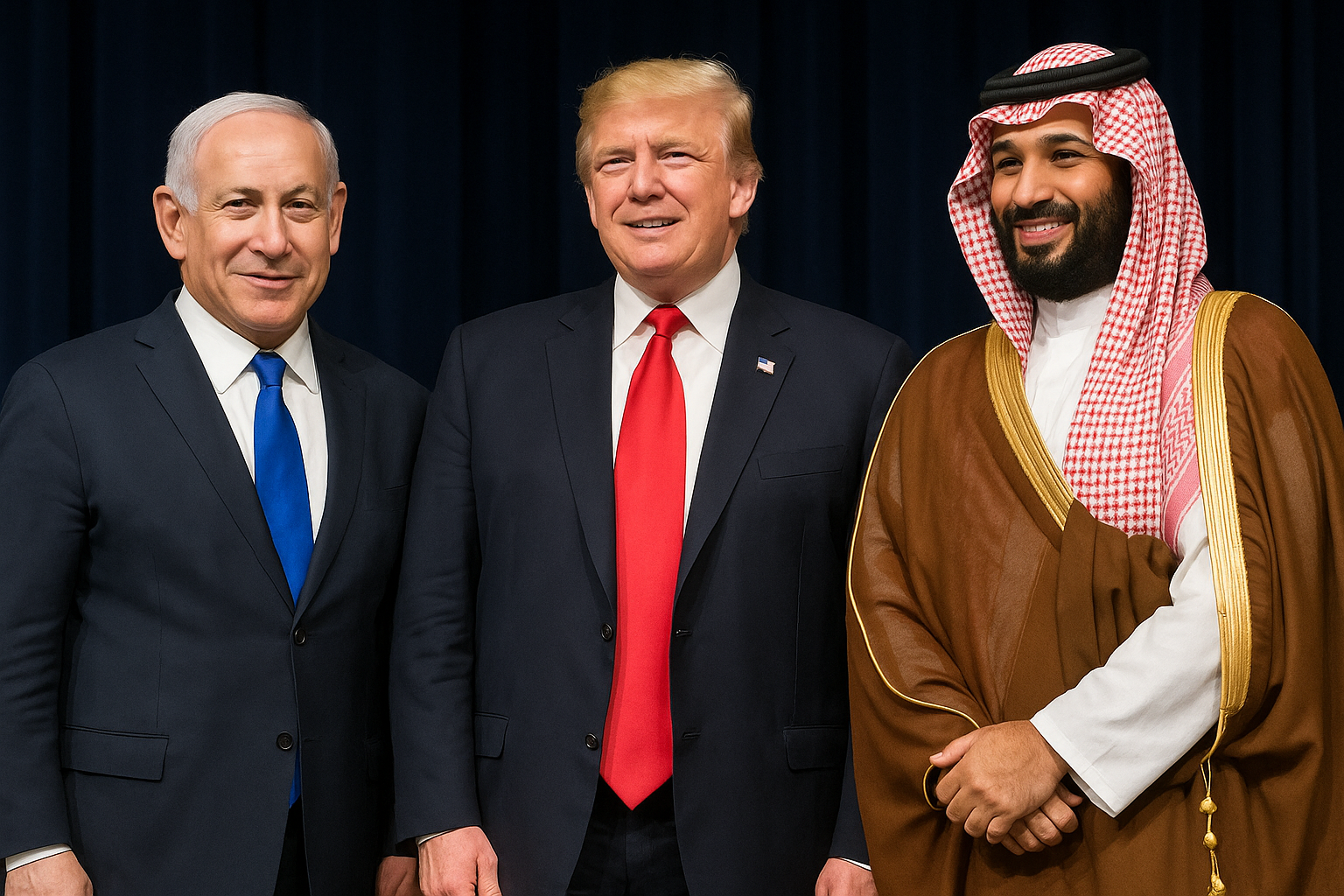
Image: Illustration: Composite image of (from left) Israeli Prime Minister Benjamin Netanyahu, former U.S. President Donald Trump, and Saudi Crown Prince Mohammed bin Salman. Image generated for illustrative purposes only.(Credit:AI-generated composite illustration).
MBS, Trump and Netanyahu Take the Stage Toward a New Regional Horizon.
A delegation of 1,000 people will accompany Saudi Crown Prince Mohammed bin Salman (MBS) on his visit to the United States on Tuesday — including nearly all of his cabinet ministers, senior officials, and business leaders.
In addition to major economic matters such as civilian nuclear energy, artificial intelligence, and cooperation in high-tech and information systems, the visit will also address defense agreements with the United States, massive investment packages, and the central strategic questions of the Middle East: the Abraham Accords and East-West trade routes, normalization with Israel, and the stabilization of flashpoints in Gaza, Lebanon, and Syria.
It appears that neither the Saudi Crown Prince nor the President of the United States can afford for the grand event planned in Washington to fail.
The American draft resolution submitted to the UN Security Council, calling for the establishment of an international force in Gaza, includes a significant policy statement:
“Once the Palestinian Authority’s reform plan is implemented, the conditions may exist for a credible pathway to self-determination and the establishment of a Palestinian state. The United States will hold a dialogue between Israel and the Palestinians to agree on a political horizon for peaceful and prosperous coexistence.”
According to reports, Israeli Prime Minister Benjamin Netanyahu spoke with Russian President Vladimir Putin and may have sought Russian support in the upcoming Security Council vote, or at least the removal of the competing Russian proposal.
The recent improvements to the American draft brought the eight Arab states — the same states that previously supported the Trump peace plan — to join the initiative, may encourage Russia to withdraw its objections, and will allow Saudi Arabia to obtain the political horizon it seeks on the Palestinian issue — this time with explicit backing from the Arab world.
On the domestic Israeli front, the government has temporarily withdrawn the proposed legislation on drafting the ultra-Orthodox and quickly approved the establishment of a state commission of inquiry into the events of October 7.
Netanyahu’s intensive activity — both inside Israel and abroad — suggests that the official Israeli position is to ensure that the historic showcase planned for mid-week in Washington concludes successfully. It is not impossible that the event will be followed by a trilateral meeting of the three leaders.
From that point, the path toward announcing an early election date becomes short — especially against the backdrop of the unusual request by the U.S. President that President Herzog consider granting a pardon to Prime Minister Netanyahu.
This coming weekend may look very different from the way it began, and could bring new hope to nations and communities that have known suffering and loss — as the long-awaited prospect of renewal and stability finally begins to break through.
Author: Rafi Glick ( רפי גליק).
Related Topics
Related Posts