Me, My Star, and My Jewish Identity
Have you ever felt naked while fully clothed?
You look in the mirror, see yourself—but the reflection feels wrong.
Have you ever worn a smile that hides uncertainty?
I have.
I’ve always been a proud Jew. While my relationship with Judaism has evolved over time, it’s always been central to who I am.
I wear my Judaism proudly. I am a proud Zionist.
For the past 15 years, I’ve helped young Jewish adults and students find their own relationship with Judaism and Israel—teaching them to embrace their authentic Jewish identity. I’ve told them there’s no such thing as “Jew-ish.” You are a Jew. Exactly as you are.
But in the last few months, I’ve been forced to look the other way at my own teachings.
Twice, I was told to hide who I am—not metaphorically, but literally.
To take off my Star of David. To cover the Hebrew on my clothes. To put my identity away—for my own safety.
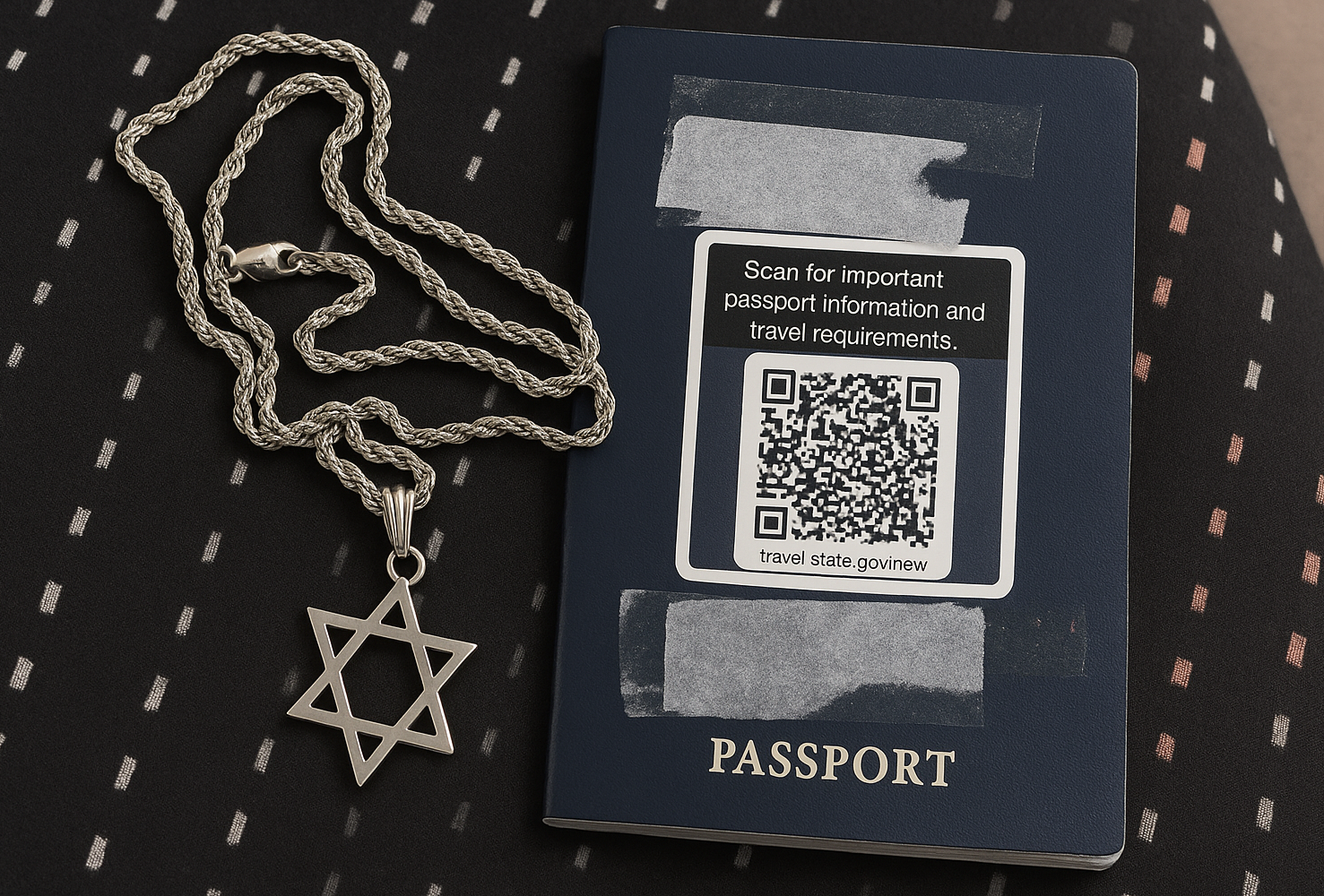
In the months after the October 7, 2023 attack, I found myself tucking in my Star of David necklace. I’d check my car before walking away, making sure no Hebrew or Jewish items were visible to a passerby. Tucking in my necklace felt uncomfortable—but at least it was still there. Still on me. Just hidden.
My first trip to Israel after the attack was in February 2024.
Walking through the aftermath of that hell was a stark reminder: it didn’t matter whether you identified or not.
Since returning from that trip, my necklace has stayed visible—not because it suddenly felt safe, but because it felt necessary.
I came home confident in my decision not to hide from fear.
And I meant it.
Between February 2024 and May 2025, I traveled to Israel twice more.
With each visit, I felt more confident, more grounded in my Jewish pride.
I started wearing the symbolic dog tags honoring the hostages and I added a new Shema ring to my left hand.
My Jewish identity wasn’t just visible—it was deliberate.
But in May 2025, during a long layover in Paris on my way home from staffing yet another Birthright Israel trip, that all changed. For the first time, I was told to hide.
Before exploring the city, I called a colleague in security.
“Do we need to take any precautions?” I asked.
Not as a woman. Not as a tourist. Not even as an American.
But as a Jew.
His answer was immediate:
“Remove anything that identifies you as Jewish or as a supporter of Israel. Everything.”
So, I changed out of my Birthright shirt. I tucked away my dog tags.
And then I hesitated. Alone in my hotel room, I reached behind my neck and unclasped my necklace.
My necklace.
My Star of David—the one I’ve worn nearly every day for over 15 years.
As I dropped it into my wallet, I felt naked. Exposed. Vulnerable.
On a normal day, I fidget with it constantly, holding it between my fingers. It’s oddly comforting. But that day in Paris, I walked around clutching at my bare neck. A constant reminder of what should have been there.
I had just spent ten days guiding young adults through a journey of identity—encouraging them to ask hard questions, connect with their history, and wear their Judaism proudly.
And now, here I was, removing the very thing I’d encouraged them to embrace.
Worse still, I was the one responsible for telling them to do the same.
To tuck it all away.
That disconnect—between everything I had just taught and everything I now had to enforce—broke something in me.
Three weeks later, it happened again.
This time, I was on an armored bus, fleeing a war zone.
I had landed in Israel just 18 hours before the war with Iran began.
After days of sirens, shelters, and uncertainty, we were rerouted to Jordan.
Preparing to cross the border meant preparing myself all over again—mentally, emotionally, and physically.
On that bus, I knew what was coming.
First, the luggage stickers stacking up on the back of my passport—many of them marking my visits to Israel. Carefully, I peeled them off, folded them in half, and tucked them into my bag.
Then came the hardest part: my necklace, again…
We had been told to remove Jewish symbols before entering Jordan.
I sat with it in my lap, just staring.
How did I get here?
What kind of world do we live in where I must hide the fact that I’m Jewish—twice in one month?
I’ve spent my career helping others embrace their authentic Judaism.
I’ve spent years empowering teens to celebrate their history and identity with pride.
And here I was, once again, forced to hide.
We were told to pack our Jewish items in our luggage.
I did.
Except the necklace.
That, I kept close. I slid it into my wallet, tucked it between my license and credit card, zipped it shut, and placed it gently in my purse.
These moments have shaken me.
Not just as a Jew, but as an educator.
If I’ve spent all of these years telling others to stand tall in their Judaism—how do I reconcile the fact that I couldn’t?
For most of my career, I’ve introduced myself as a “proud bacon cheeseburger Jew”—my way of saying that Jewish identity is complex, and there’s no single way to be Jewish.
That line has defined my authentic Judaism for most of my adult life.
But now I wonder: what does that mean when I’ve had to hide even the parts I never questioned?
Back home, I still flinch when I hear the siren of a firetruck racing down the road.
The first few times, I instinctively reached for my go-bag—the one I kept packed during the war, ready to grab when the sirens went off, sometimes four times a night.
I don’t want fear to define my relationship with Israel—or my Judaism.
When I lived in Israel in 2011–2012 on Israel Teaching Fellows with Masa, I used to regularly walk home alone at night.
My mom would ask, “Is it safe?”
I’d answer: “Why wouldn’t it be?”
Israel has always been the place that takes care of the Jewish people.
That hasn’t changed.
But I have.
Because now I know:
Standing tall in your identity sometimes feels brave.
Sometimes it feels risky.
Sometimes it feels like walking around Paris clutching at your bare neck.
And still—I choose it.
I am a Jew.
I am a Zionist.
I am an educator.
I love Israel—not all its politicians.
I know Israel is complicated.
I went through a traumatic experience.
Some days are good. Some hours are hard.
But I’m still here. Still healing. Still processing
Still learning. Still teaching.
Still wearing my Star.