Meaningful Jewish Service is Grounded in Education
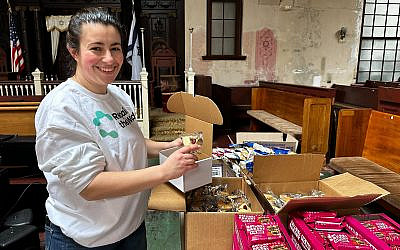
Volunteer service, for many Jewish young adults in particular, is the primary way they express their Jewish values and embody some of our most ancient teachings. Yet service alone is not a sustainable path of ongoing meaningful engagement nor a strategy to strengthen the Jewish community. When Moses is catapulted through time in an imaginative move by the wildly creative Rabbis of the Talmud (Babylonia Talmud Menahot 29b) and he sees Rabbi Akiva the great sage teaching his Torah, albeit in a slightly different form, he is assuaged. He realizes that his Torah, though transformed, is still part of the same wisdom and tradition of his people. As our people change, our Torah needs to adapt with them. The same goes for the service learning that we believe in at Repair the World. For Jewish service to welcome more people into Jewish life and create positive change across the Jewish community, it must be grounded in transformative Jewish education.
Undoubtedly, service as a stand-alone, episodic act can be impactful; the annual mitzvah day or the Thanksgiving morning soup kitchen shift helps communities around the country. However, and especially after October 7th, people are asking a pointed question: is Tikkun Olam as a value facile and reductive? The answer, we believe, is “no,” so long as we teach that these acts of repair embody what it means to be Jewish with the depth and complexity that the term itself has meant throughout centuries of Jewish teachers engaging with it. Service acts paired with serious Jewish learning move participants beyond surface engagement and connect them to enduring purpose, identity, and belonging. They learn that part of being Jewish means caring for others even over ourselves. With meaningful education, service adds value and meaning to young people’s lives as they navigate challenges and the complicated world around them.
To deliver this powerful combination of learning and service effectively, on a large scale, we must ensure that Jewish leaders and educators have the infrastructure, skills, and support to deliver effective and engaging programming.
Our community is at an inflection point. At Repair the World, we witnessed a surge of engagement post-October 7th from Jewish young adults, many unaffiliated or under-affiliated, who sought to connect with their Jewish values and identity more than ever before. This moment revealed how profoundly Jewish service resonates as an accessible, meaningful entry point to Jewish community. Once they enter, it’s on all of us to give them a reason to stay.
That’s why we deepened our commitment to our Jewish educational strategy. Over the last few years, we have developed a culture that centers Jewish education in our work supporting Jewish service experiences around the world. We work with more than 60 organizations in the Jewish Service Alliance to bring best practices to the field. Just as the Jewish community designs deep learning experiences around holidays, Israel, weekly torah portions, and more, we aim to bring the same rigor and seriousness to service learning.
As we build volunteer service programs and support others doing the same, we want Jewish education to serve as the vehicle for critical thinking, self-exploration, and community building. Issue area education, Jewish learning, hands-on service, and reflection are the key ingredients to make this happen. This is more than just theoretical. By starting with big questions and unpacking real-world tensions, we ingrain Jewish education with depth and substance into service.
What tensions arise when we try to repair the world?
Jewish education must lean into values tension. We must share texts with learners that challenge assumptions and perspectives, sparking vibrant discussions and debates. These qualities are inherent in our traditions and teachings. Jewish service learning should embrace this tension and offer something new: a challenge, a new insight, a particularly Jewish way of engaging with service and social issues. We want volunteers to gain a deeper understanding of the values and tensions that undergird their service work and the social issues within which they fall. Just as the talmudic sages wondered, ‘Et laasot laHashem, hefiru Toratecha’ — what are the times when one must abrogate the part to protect the integrity of the whole? Can we lean into the notion that some of our deeply held beliefs should be more malleable? As opposed to only serving to support our beliefs, service can force us to impactfuly confront our ideologies and rigidities.
How do we transform service into transformative learning?
Tikkun olam should not be thought of as random acts of charity. Rather, it has the potential to reshape how we see ourselves and our responsibilities to others. When done right, service becomes avodah, sacred work that demands we examine our assumptions, confront uncomfortable questions about power and privilege, and build genuine relationships across differences. Transformative service learning insists that the goal isn’t just to fix problems, but to emerge from the experience fundamentally changed. After all, the Jewish imperative of tzedakah-righteousness is not about charity or love at all; it’s an obligation I have. I do it because I must. Am I coming out of this experience understanding that I have a responsibility to the world that I didn’t realize before?
How do we deepen Elu V’Elu – Honoring Multiple Truths?
In a polarized moment when we’re pressured to pick sides on every issue, this ancient wisdom offers a radically different path: the courage to sit with complexity and honor genuine disagreement. Elu v’elu, these and these are the words of the living God, is about recognizing that people of integrity can reach different conclusions, and that our tradition has always made space for vigorous debate within shared commitment. This doesn’t mean all views are equally valid or that we abandon our moral convictions. Rather, it means we refuse to collapse complex realities into simple binaries, we resist demonizing those who see differently, and we stay in relationship even across deep disagreement. It’s the difference between “I’m right, and you’re wrong” and “I believe this deeply, and I’m curious about what you see that I might be missing.” In service work and beyond, this value calls us toward the hard work of machloket l’shem shamayim, disagreement for the sake of heaven, where our goal isn’t winning arguments but seeking greater truths together, building the kind of Jewish community and broader society where difference strengthens rather than destroys us.
By viewing Jewish service and Jewish education as a powerful combination, our community can grow stronger and help more people connect with Judaism in deeply resonant ways. To truly grapple with what tikkun-repair is, we can offer a framework of nuanced thinking that can help heal our fractures. Together, let’s commit to this path forward, developing and supporting the talented educators who make this possible.