
President of Shahvand Think Tank
Mecca Pact Implications for Israel and Washington
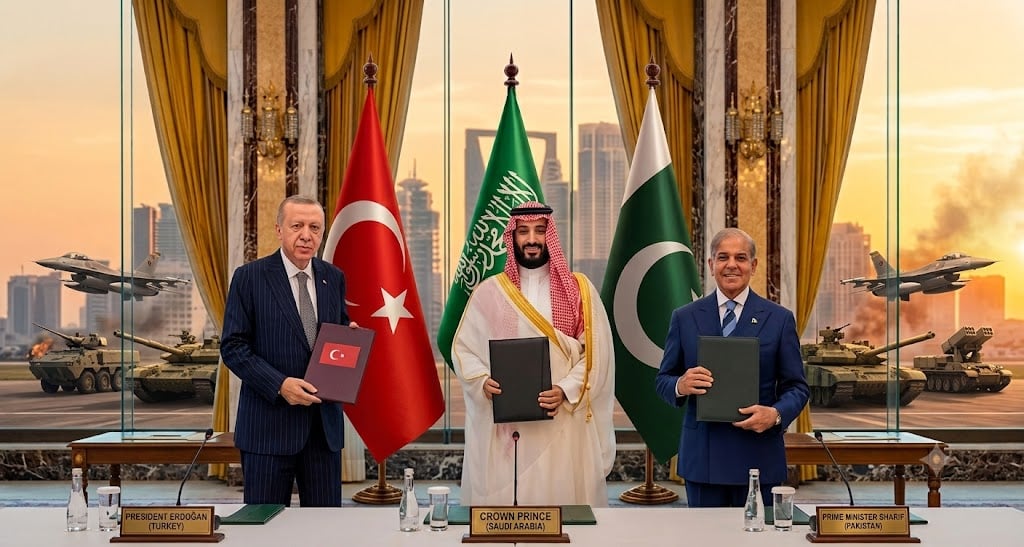
Illustration: Created by the author, for The Mecca Pact Implications for Israel and Washington
Saudi Arabia, Turkey, Pakistan, and the Rise of Strategic Autonomy
The signing of the Mecca Joint Defence Agreement on August 7, 2026, by Saudi Arabia, Turkey, and Pakistan marks an important development in the changing security order of the Middle East. The agreement states that an armed attack against one signatory will be regarded as an attack against all three and calls for expanded defence cooperation. However, its full text has not been made public, and the precise military obligations of each member remain unclear.
The pact should therefore not yet be described as an “Islamic NATO.” It is better understood as an emerging collective-defence framework and an instrument of strategic hedging. Saudi Arabia, Turkey, and Pakistan are seeking greater autonomy and additional security options without necessarily abandoning their existing relationships with Washington or, in Turkey’s case, NATO.
A New Strategic Triangle
The agreement brings together three states whose capabilities are distinct but potentially complementary. Saudi Arabia contributes financial power, energy influence, and a central position in the Gulf. Turkey possesses a substantial military-industrial base and one of the region’s most capable conventional forces. Pakistan provides extensive military experience and the strategic weight of a nuclear-armed state.
Their combination creates a potentially influential security triangle, although the three governments do not share identical strategic priorities. Saudi Arabia is primarily concerned with Gulf security, missile threats, and the vulnerability of its energy infrastructure. Turkey seeks greater strategic independence and regional influence. Pakistan’s interests include its partnership with Riyadh, defence cooperation, and the broader relationship between South Asia and the Gulf.
The pact is also significant symbolically. It brings three major Muslim-majority powers into a security framework that does not depend entirely on American guarantees. At the same time, Turkish officials have emphasized that the agreement is defensive and not directed against any particular country. Its long-term significance will depend on whether the signatories establish joint planning mechanisms, intelligence cooperation, defence-industrial projects, and a credible process for responding to an attack.
Implications for Israel and Washington
The agreement complicates the American vision of a regional security architecture linking Israel and the Arab Gulf states. Saudi Arabia has not joined the Abraham Accords, while Turkey and Pakistan maintain different positions toward Israel. It would therefore be inaccurate to present the three countries as sharing an identical policy toward the accords. Their common position is better described as a refusal to place their security within an exclusively Israeli-centred regional framework.
For Israel, the pact may reduce the diplomatic leverage that normalization with Saudi Arabia was expected to produce. It does not necessarily end the possibility of Saudi-Israeli normalization, but it gives Riyadh an additional strategic option and greater bargaining power. Any future Israeli operation affecting the Gulf or involving Iranian-linked targets would also have to consider the possibility of a coordinated response from three powerful regional states.
For Washington, the agreement creates a more complicated strategic environment. The United States could regard it as useful regional burden-sharing, seek to integrate it into an American-led security system, or interpret it as evidence that traditional U.S. influence is becoming less decisive. The most realistic interpretation is not that the United States has suddenly lost control of the region, but that its partners are increasingly unwilling to depend on Washington alone.
Turkey’s participation adds another layer of complexity. As a NATO member, Ankara’s involvement does not automatically violate its alliance obligations, particularly because the Mecca agreement has been presented as defensive and does not formally replace any existing treaty. It nevertheless demonstrates Turkey’s determination to maintain independent strategic relationships beyond the Western alliance system.
A direct American “recognition” of the Mecca Pact is unlikely to be the central issue. Washington would more plausibly assess its military implications, consult with Ankara, Riyadh, and Islamabad, and determine whether to accommodate, constrain, or co-opt the emerging framework. Any U.S. policy debate would involve not only Israel, but also the Pentagon, Congress, NATO, Gulf partners, defence industries, and nuclear-proliferation concerns.
The Iran Variable
Iran remains the most important variable in the pact’s future. Although the agreement does not publicly identify Iran as an adversary, its emergence amid Iranian missile attacks, Gulf insecurity, and renewed regional conflict inevitably gives it an anti-Iranian significance. Tehran has already criticized the arrangement, while its military and political response may determine whether the pact remains defensive or develops into a more openly confrontational bloc.
Iran could attempt to exploit the differences among the three signatories. Turkey has its own interests in Syria, Iraq, and the Caucasus; Pakistan has traditionally sought to avoid direct confrontation with Iran; and Saudi Arabia may still prefer diplomatic management of its rivalry with Tehran when possible. These differences could limit the pact’s cohesion.
The possibility of regime change in Iran introduces a second, more transformative scenario. If the Islamic Republic were replaced by a secular, Western-oriented government associated with Crown Prince Reza Pahlavi, the regional balance could change dramatically. Such a government might seek to rebuild relations with the West and Israel, stop support for Hezbollah, Hamas, and the Houthis, and renegotiate Iran’s sanctions policies.
A democratic and internationally reintegrated Iran would also become an economic and energy power once again. Rather than simply joining an American-Israeli bloc, it might pursue an independent balancing role between the Mecca Pact, Israel, Russia, China, and the West. In that scenario, Iran could become a counterweight to Turkish, Saudi, and Pakistani influence while contributing to a competitive but more plural regional order.
An Unfinished Regional Order
The Mecca Joint Defence Agreement does not yet prove the collapse of the American-led Middle Eastern order, nor does it establish a fully integrated Sunni military alliance. Its importance lies in the strategic direction it represents: regional powers are building alternative forms of cooperation because they no longer wish to leave their security entirely dependent on Washington.
The pact’s future will depend on whether its collective-defence clause becomes operational, whether the members can overcome their divergent interests, and whether Iran’s response produces deterrence or escalation. The Middle East is therefore not entering a settled new order, but a more complex era of competing security frameworks in which the United States, Israel, Iran, Turkey, Saudi Arabia, Pakistan, and a possible future Iran will all struggle to shape the balance of power.
Related Topics
Related Posts