
Memoirs of a Shul Cat

An Occasional Series
- The Minyan: Getting to Not-10
(Explanation, if needed, below.)
In the fitness world, which I am not part of, people who may not be great athletes but who love hanging around gyms, greeting regulars, and absorbing the culture are called gym rats.
Me, I’m a shul cat.
For as long as I can remember, I have hung out in shuls. When I was a kid, it was my father’s shul. That’s where I learned some of the ropes. In the decades since, I’ve been in many more shuls, two of which met in gyms. The one I daven in now has ropes dangling from the ceiling. Those are climbing ropes, not shul ropes.
The Minyan
In a shul you can’t do much without a minyan. Traditionally, a minyan means 10 men over the age of Bar Mitzvah.
Later in life, I learned that the basis for needing 10 men is the Hebrew word edah, congregation. The original edah were the 10 spies sent out by Moshe who thought that entering Eretz Ysrael was a bad idea. Of them, Bamidbar 14:27 reports that G-d said, “How much longer will that wicked congregation keep muttering against Me?”
This may seem an odd source for defining a minyan. But perhaps less odd if you spend your life davening in minyanim. When people rub up against each other in close quarters day after day, irritations amplify and lead to disputes. To appreciate what these can be like, you sometimes just have to be there, as in this example from my Old Country.
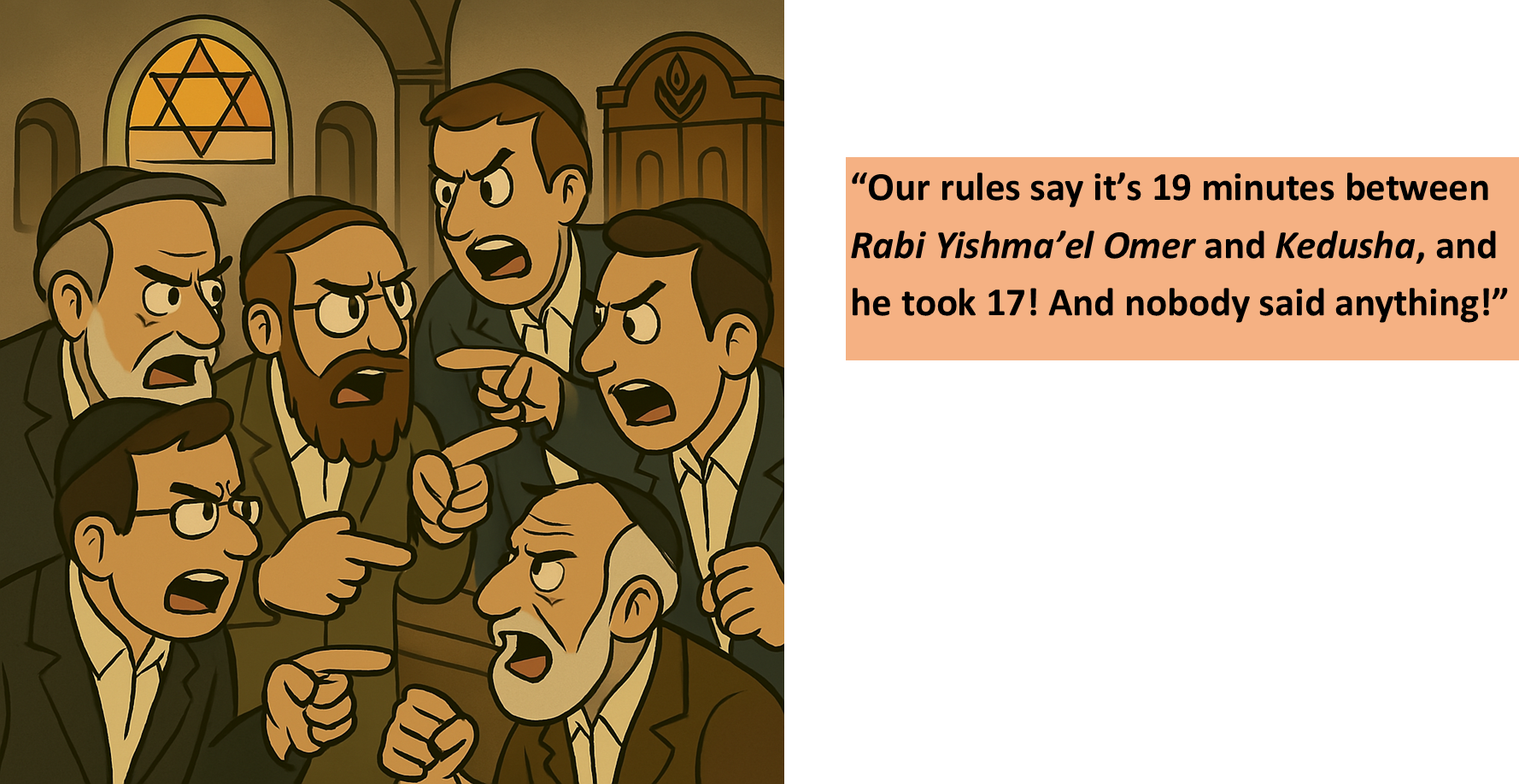
This may sound implausible, or unkind. But it’s just a quote.
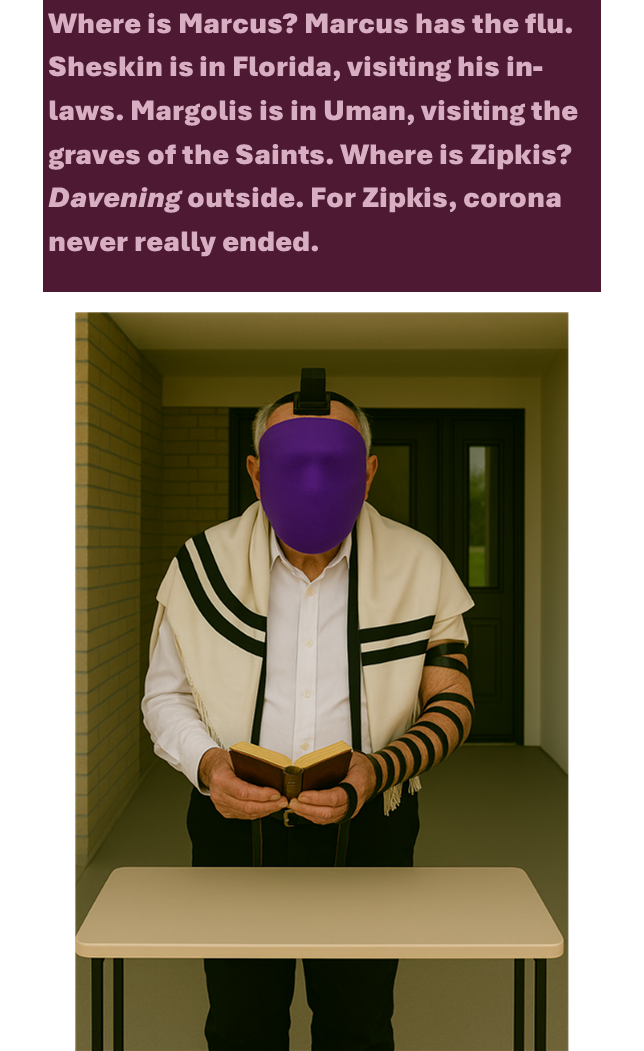
We’re 3 short….

In my father’s shul on Long Island, the morning minyan was always tenuous. When later in life I lived in larger Jewish communities, I learned to my surprise that morning minyanim can be tenuous there too. Now I live in Jerusalem, the center of the Jewish world, and even here the morning minyan has precarious moments, where people scan the street for the not-10th.
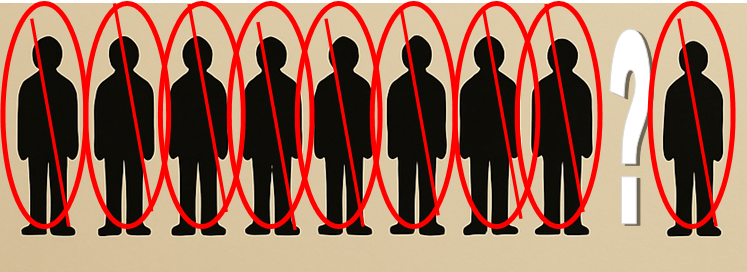
As people assemble for the morning minyan, there is preliminary banter: politics, sports, gossip. As the starting time approaches, if we’re short, we take inventory.
In my father’s shul, getting a minyan mostly depended on men saying kaddish for a departed relative. This lent getting to not-10 extra urgency, because saying kaddish needs a minyan. One thing I picked up in my salad days was how to get the davening started when you don’t have 10 and it’s time to start. Or later. Or even later than that. Or how to add an extra kaddish at the end if you didn’t have 10 at the beginning, so the men who came to say kaddish wouldn’t feel shortchanged.
Even in dense Jewish communities, you might be less impressed with the numbers of morning minyan attendees if you added all the men in all of them and divided by the eligible men in town.
A number of years ago the American Conservative movement started counting women for a minyan. I spoke to one woman who went to such a minyan every morning. “We have trouble pretty often,” she told me. “Once women started being counted, a lot of the men decided to sleep in. We often have 9 and have to make calls.”
To a shul cat like me, such continuity of ancient traditions is thrilling.
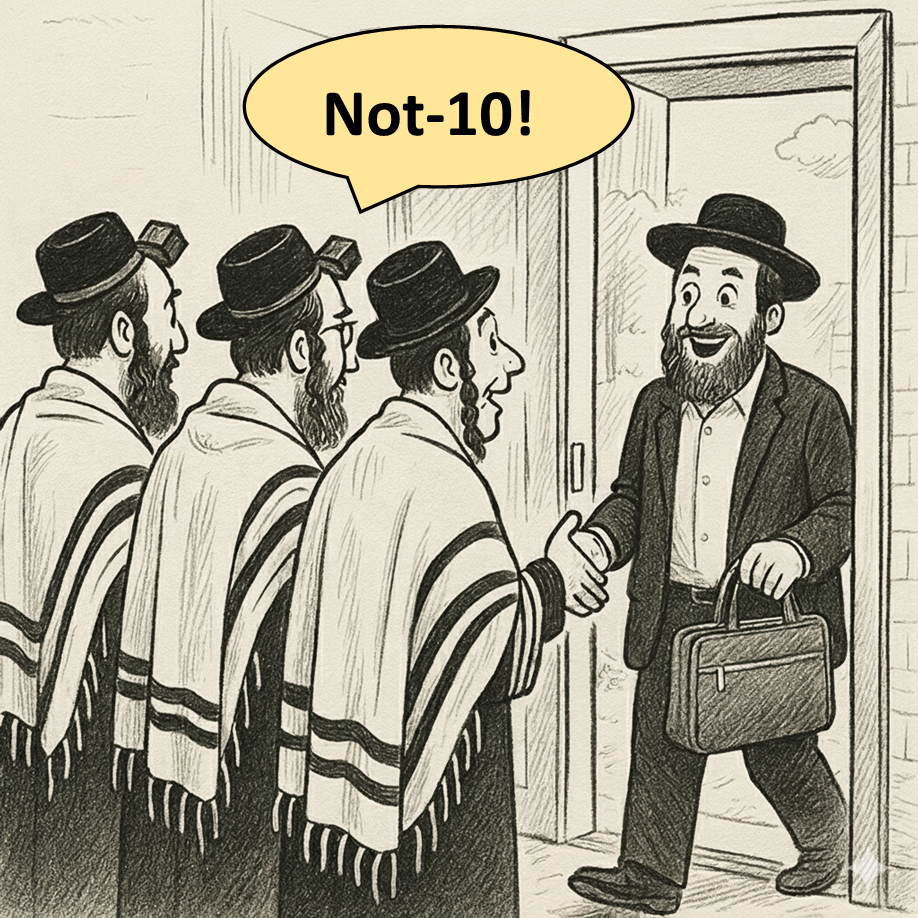
Calling for the 10th Man
An American innovation was the so called, “Jewish Center,” a place not just to daven but to have meetings, watch movies, or play basketball. This was the brainchild of Mordecai Kaplan, before he went full-monty Reconstructionist. It led to many now-archaic jokes. In Yiddish, der Tzenter means “the 10th.
I earned my minyan-calling stripes in ancient times, which is to say Before WhatsApp. Then you had to call people by telephone, when people still had land lines and answered them. This meant knowing who was a) likely to agree and b) close enough to show up before everyone gave up and left.
When called, responses fell into four categories:
- Sure–I’ll be right over!
- (Yawn) I’ll be a while. Just woke up.
3: Don’t wait for me. I’m out of town. (Out of state. Out of the country. In a space-time warp.)

4: “Stop calling me! I don’t daven with you anymore.”
We will take up answer #4 in a later post under the heading, Abandonment and Betrayal.
When the men in my Dad’s shul completed their eleven months of saying kaddish, some earnestly declared their intention of continuing to come, to support others as others had supported them. Few if any ever did, at least for any length of time. Normal life tends to reassert itself and overcome even sincere intentions.
Of course, to minyan regulars, regular attendance is itself normal life. This routine is hard to break, except perhaps by travel, infirmity, machloket— dissension–or the odd pandemic.
Not-9, Not-10—Not Coming to our Census
Jews do not count each other. Several reasons are given, centering on the importance of every individual, none to be swallowed in an anonymous count. Each time we say tachanun, we recall the painful choices David HaMelech had to make among punishments for his having ordered a census. (See Shmuel Bet 24)
One way around this is to count not by “1-2-3” but by “Not-1, Not-2, Not-3.” That way we don’t forget how many we don’t already have and how many we don’t still need.
Next in Memoirs of a Shul Cat:
2. Machloket—spats for the sake of Heaven