Memory: Sol Calero and Enrique Martinez Celaya
It was my first winter in the South of France. I was still shaken by my green card rejection, which had locked me out of the life I had built in the United States. My belongings sat in a friend’s garage in North Hollywood. Paris, where I had once walked freely to museums and galleries, had suddenly imposed strict curfews. Everything was closed. Although I lived near the Centre Pompidou and the Seine, I could no longer enjoy them. Instead, I spent six weeks in the tenth district, sitting on a hard wooden chair most of the day. This led to a blood clot in my leg, requiring daily injections from a nurse in Antibes. I worried that as soon as she asked about my nationality, she might respond with resentment. Being German could mean being seen as a perpetrator. She might overlook that my German passport was issued in Los Angeles and that I had arrived from America on an Air Tahiti flight.
Some of Nice’s public art spaces had reopened, including the Musée de la Photographie Charles Nègre, MAMAC, the Chagall and Matisse Museums, and Villa Arson, which sits on a hill overlooking the French Riviera. At Villa Arson, Calero’s installation responded to the villa’s layered architecture and surrounding landscape. It blended her Latin American and Tenerife influences with the light and colors of the French Riviera, forming a dreamlike, site-specific environment. Its location immediately reminded me of Villa Aurora, the Getty Center, and the Skirball Center in Los Angeles. These places were shaped in part by histories of exile and, like Villa Arson, perched between mountains and water. They were small oases in an otherwise freeway-heavy city, pockets of refuge.
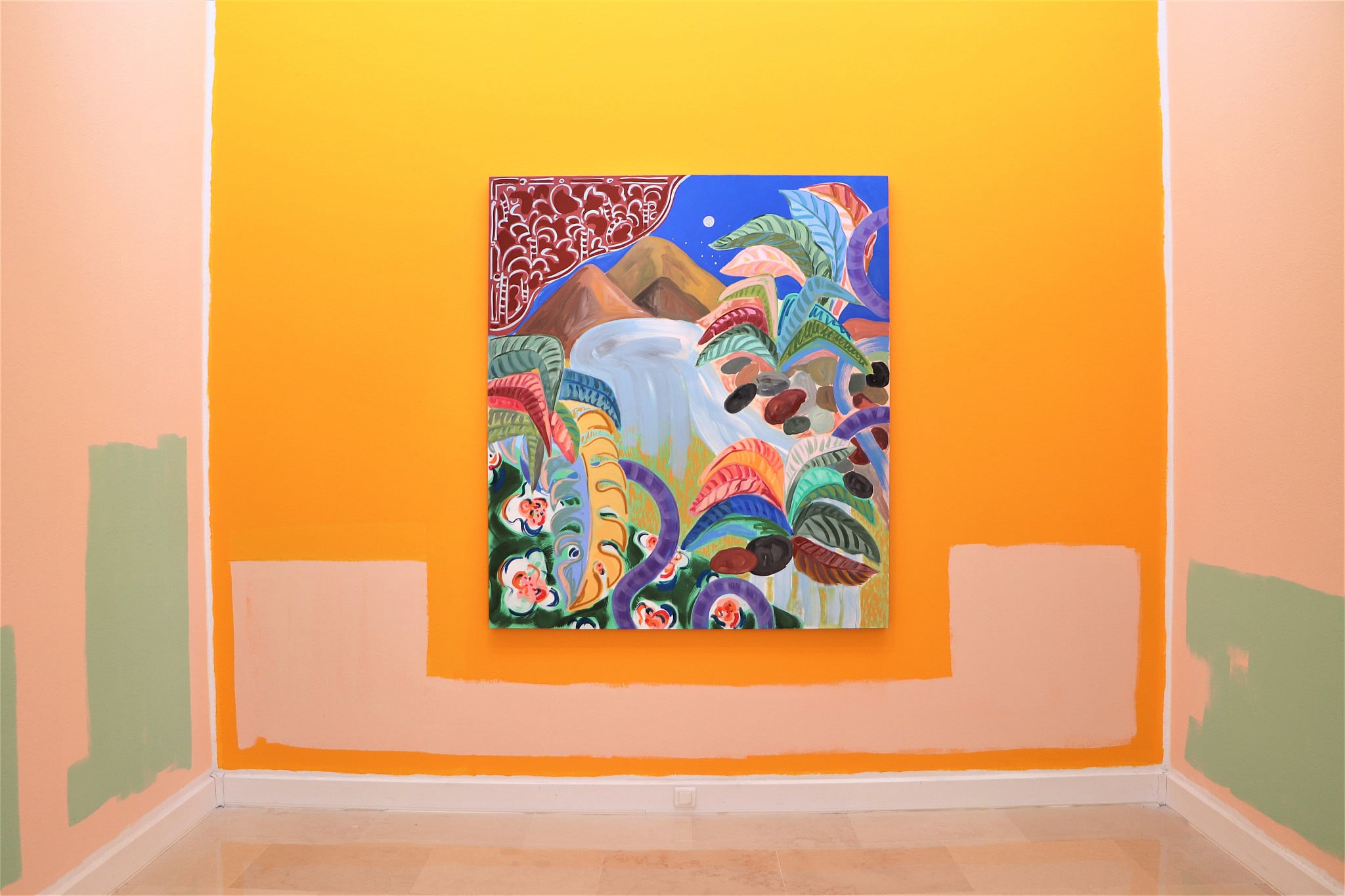
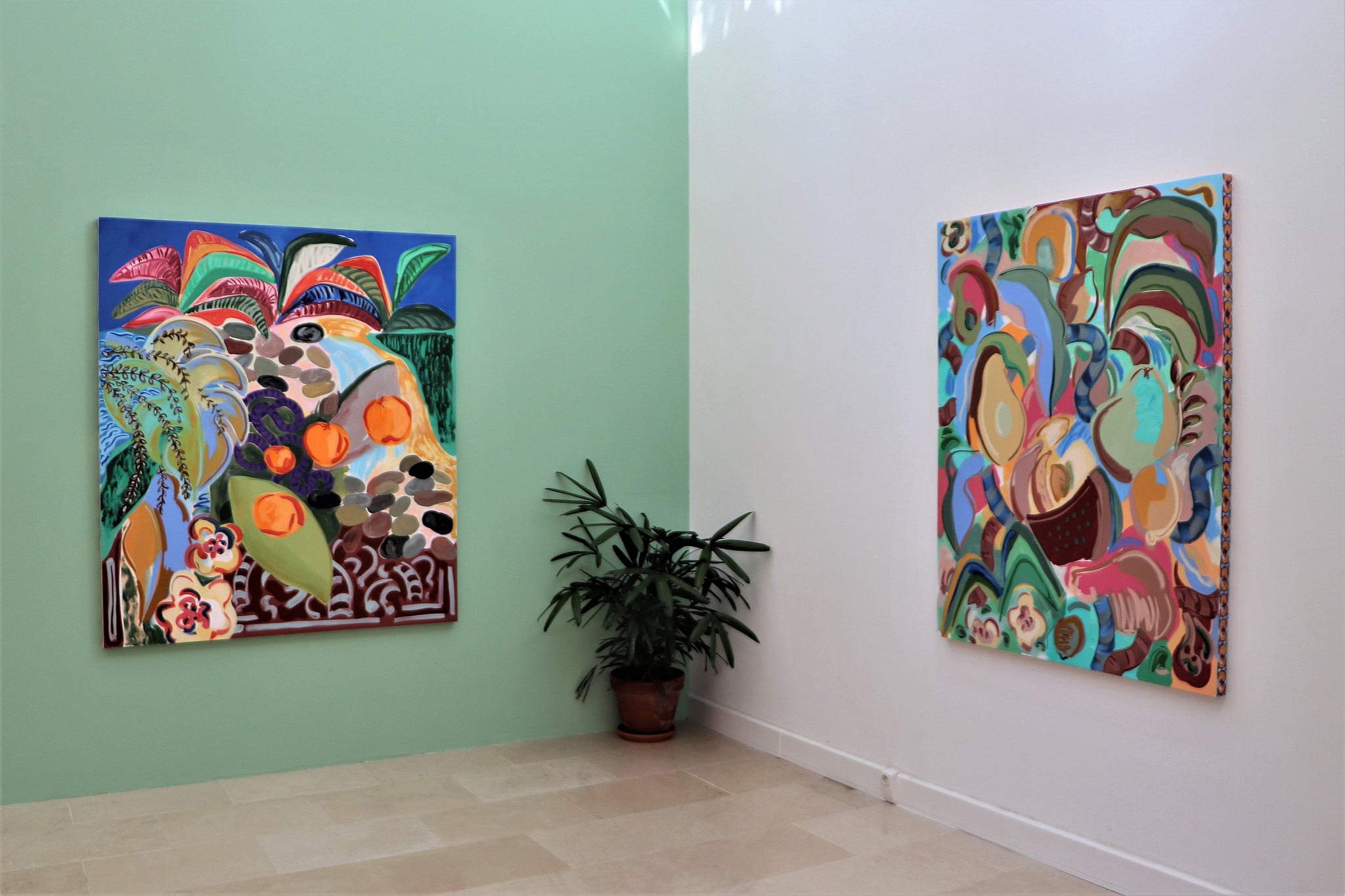
When I entered Sol Calero’s installation in 2020, I felt an immediate sense of familiarity. The exuberant paintings of organic shapes flowed rhythmically across the earth-toned walls. They echoed the Latin American visual influences I had lived with for many years in Los Angeles. Calero, a Venezuelan-born artist and artist-in-residence at the time, presented paintings that were playful yet composed. She combined elements of vernacular art with ornate details reminiscent of Matisse without ever feeling simplistic. Each room was carefully constructed, both visually and conceptually. This created a tension between emotional richness and intellectual engagement.
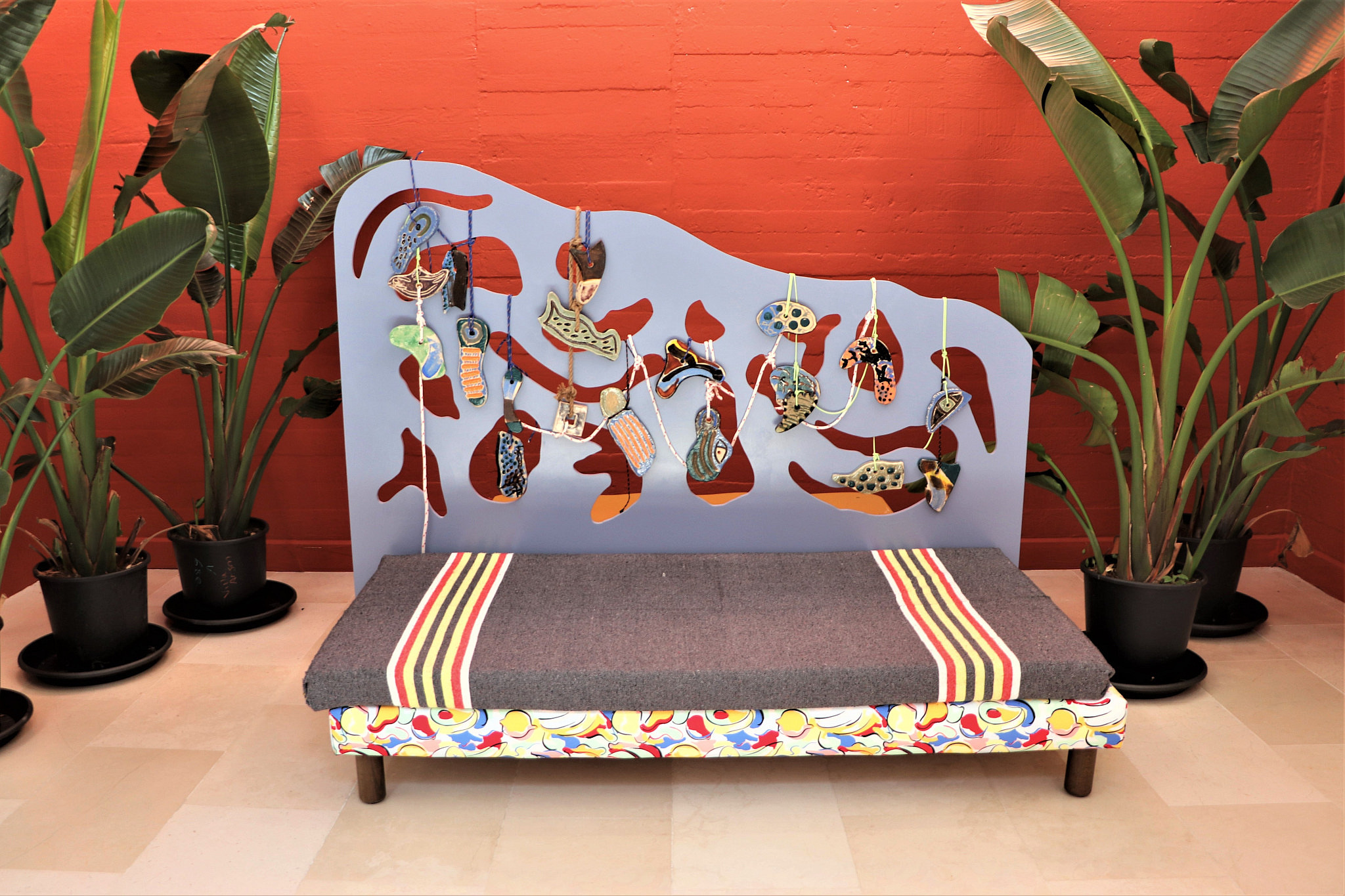
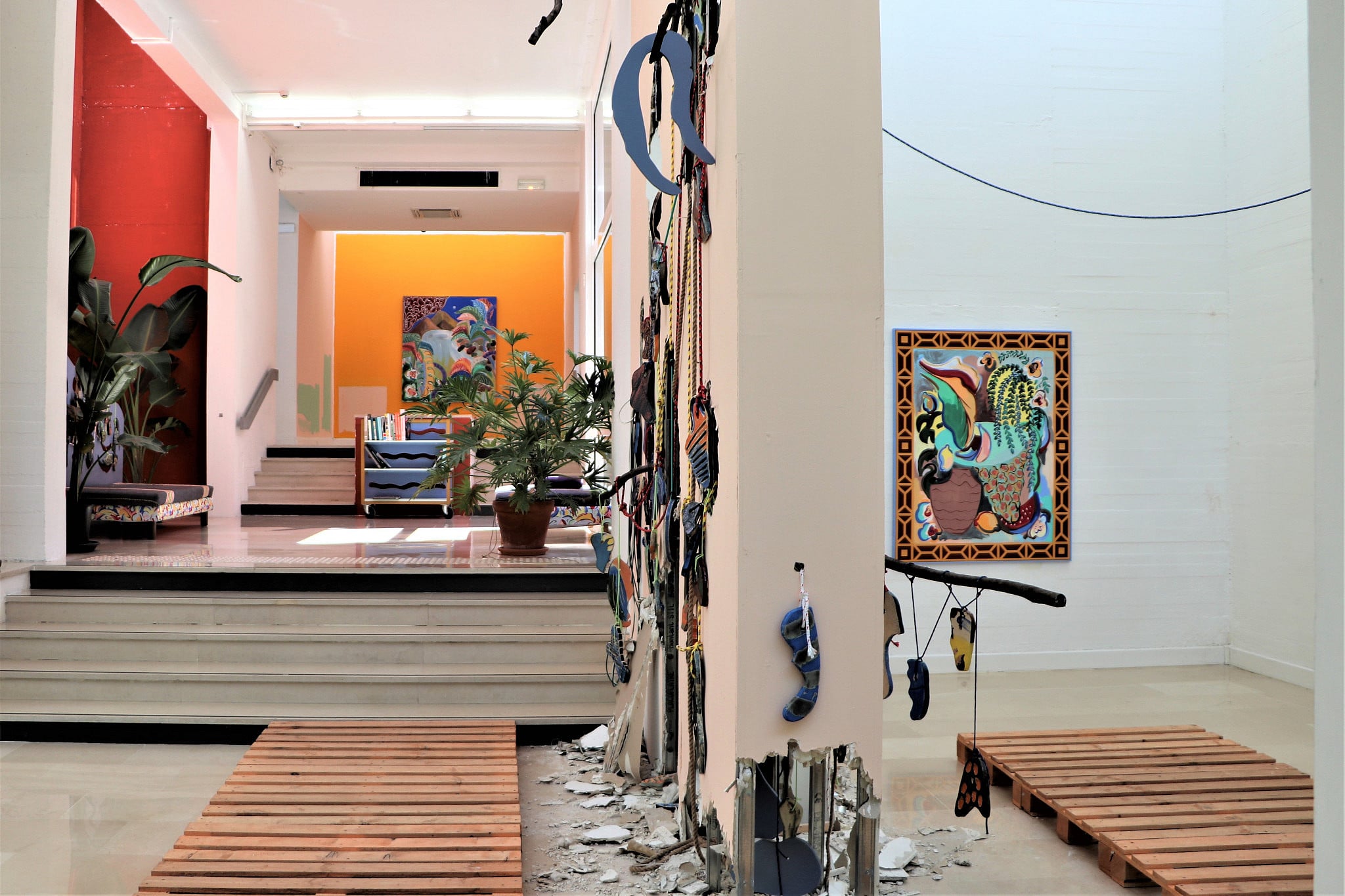
The installation radiated warmth, even as debris sometimes spilled from the walls onto the floor, introducing a sense of creative dissonance. Potted plants and colorful sofas were part of the environment, including one with an unusual shape that anchored the space as both furniture and sculpture. Strings threaded across it held dangling ornaments, adding a playful note. Painted layers surrounding the canvases created a window-like effect. They transformed the museum into a space where memory, cultural identity, and hybrid existence could coexist without threat.
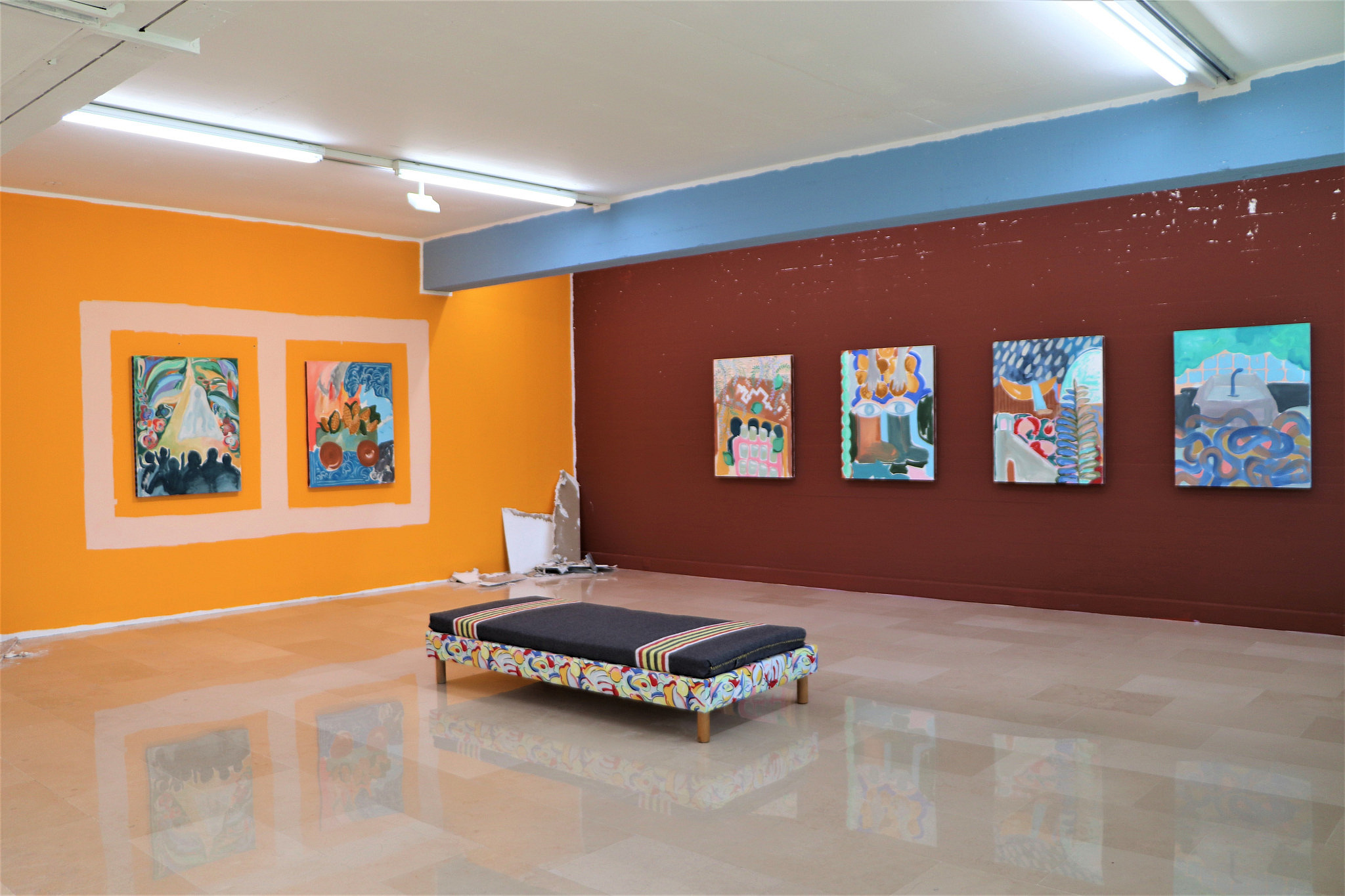
I later learned that she and her family left Venezuela in 1999, the year Hugo Rafael Chávez Frías became president. They moved to Tenerife, where she began her art studies before continuing them in Madrid. She was seventeen at the time. Today she lives in Berlin, the city I had left before eventually returning to Los Angeles in 2001. Like me, she has navigated new cultures and shifting identities across the Atlantic. Her work reflects what it means to leave one place, adapt to another, and retain what survives in a new self. Her recurring use of fruits and plants evokes the landscapes of Latin America and Tenerife. These elements are absent in Berlin, especially during winter. Her installations give shape to this sense of absence. At the same time, the works invite reflection on European colonization in Latin America, its long-term effects on artists, and the ways Latin American art now influences European institutions. This dialogue becomes particularly clear in the layered walls, where frames appear inside other frames.
In one room, a purposely damaged wall holds colorful objects that hang freely. In another, a thin beam suspends ornaments resembling Christmas decorations, creating a sense of otherness. By placing these ornaments in unexpected locations, Calero draws attention to her cultural heritage and reveals the continuous migrant experience of noticing and navigating cultural differences. The typical austerity of a European museum is replaced with something vibrantly alive. The works challenge the viewer to move beyond preconceived notions of exoticism. Through these visual strategies, Calero breaks through conventional structures and highlights details that might otherwise be overlooked. The result is art that is thoughtful, engaging, and subtly political.
The immersive art of Enrique Martínez Celaya
Calero’s immersive work brought to mind Enrique Martínez Celaya’s exhibition “Lone Star” at L.A. Louver in Venice, California, which I had written about for Artscene a decade ago. At that time, Celaya, a Cuban-born artist, author of several books on art, philosophy, and poetry, former scientist, and current Provost Professor of Humanities and Arts at USC, had returned to Los Angeles after a ten-year absence. He saw the city with fresh eyes. The show included large-scale paintings, sculptures, and installations within the context of Cuban exiles. In The Invisible, a bronze sculpture of a young boy stood in a pool of water, surrounded by mirrored walls. The sound of his tears evoked a childhood burdened by trauma. Another work, a cage-shaped figure with holes in its chest, allowed live birds to fly through it. Together, these pieces explored childhood and the transition to adulthood. They explored storytelling as a form of healing, loneliness, and the search for redemption, with art serving as a form of companionship.
Enrique Martínez Celaya: Lone Star
EMCelaya-Kussatz-artscene-0515.pdf
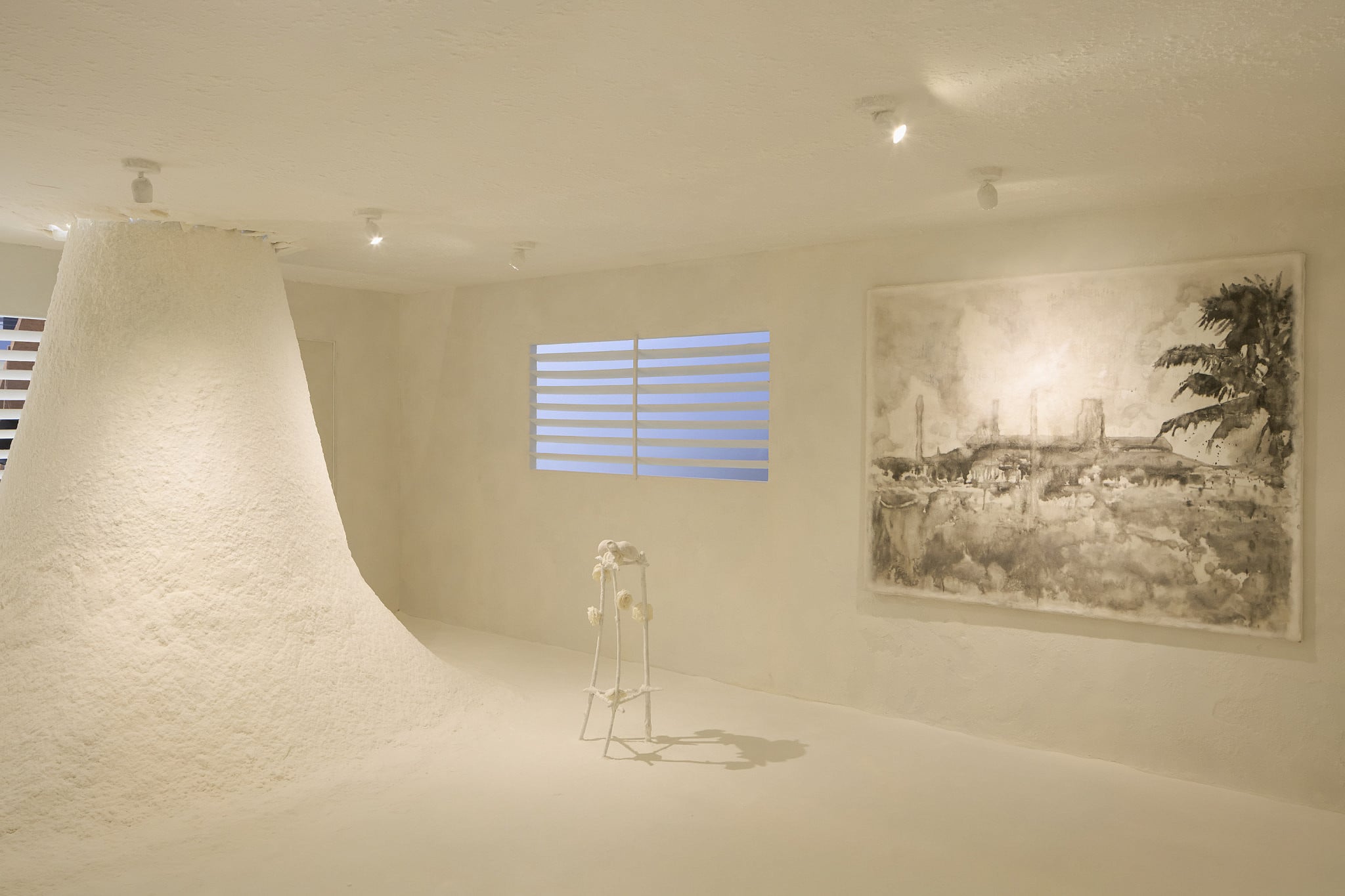
Currently, the Wende Museum in Los Angeles presents Celaya’s The Sextant, the final piece of a trilogy of his Cuba-related projects. The centerpiece is a reconstruction of a modernist house made of sugar. His father built it in Nueva Paz, Cuba, between 1957 and 1963, during the Cuban Revolution, the Cuban Missile Crisis, and the U.S. embargo, while the family awaited exile. The original house still exists in Cuba and now functions as a wedding venue. In the museum model, a construction chute carries what appears to be sugar from the roof beneath a sculpture of a sleigh pulled by a white horse, titled The Secret Engine (2025). This evokes the island’s colonial history and the global sugar trade. The sugar also references Celaya’s father, who worked on a plantation, linking personal history to broader political and economic narratives.
Surrounded by cadet-blue museum halls, the model house embodies memory, displacement, and the passage of time. Though I could not see the exhibit in person, separated by 5,500 miles, the images resonated with me immediately. They reflected its poignant exploration of exile and connected to my reflections on migration, cultural memory, and the ways personal and political histories intertwine. The horse and sleigh echo my father’s takeoff from Berlin-Köpenick before the Wall and my grandparents’ journey from Bessarabia. They traveled long distances on wagons pulled by horses through icy winters. Here, however, the white is not snow but a reminder of the Caribbean’s history. It evokes exploited indigenous people and the promises and contradictions of communism, which would later attempt to reorganize labor, land, and social life.
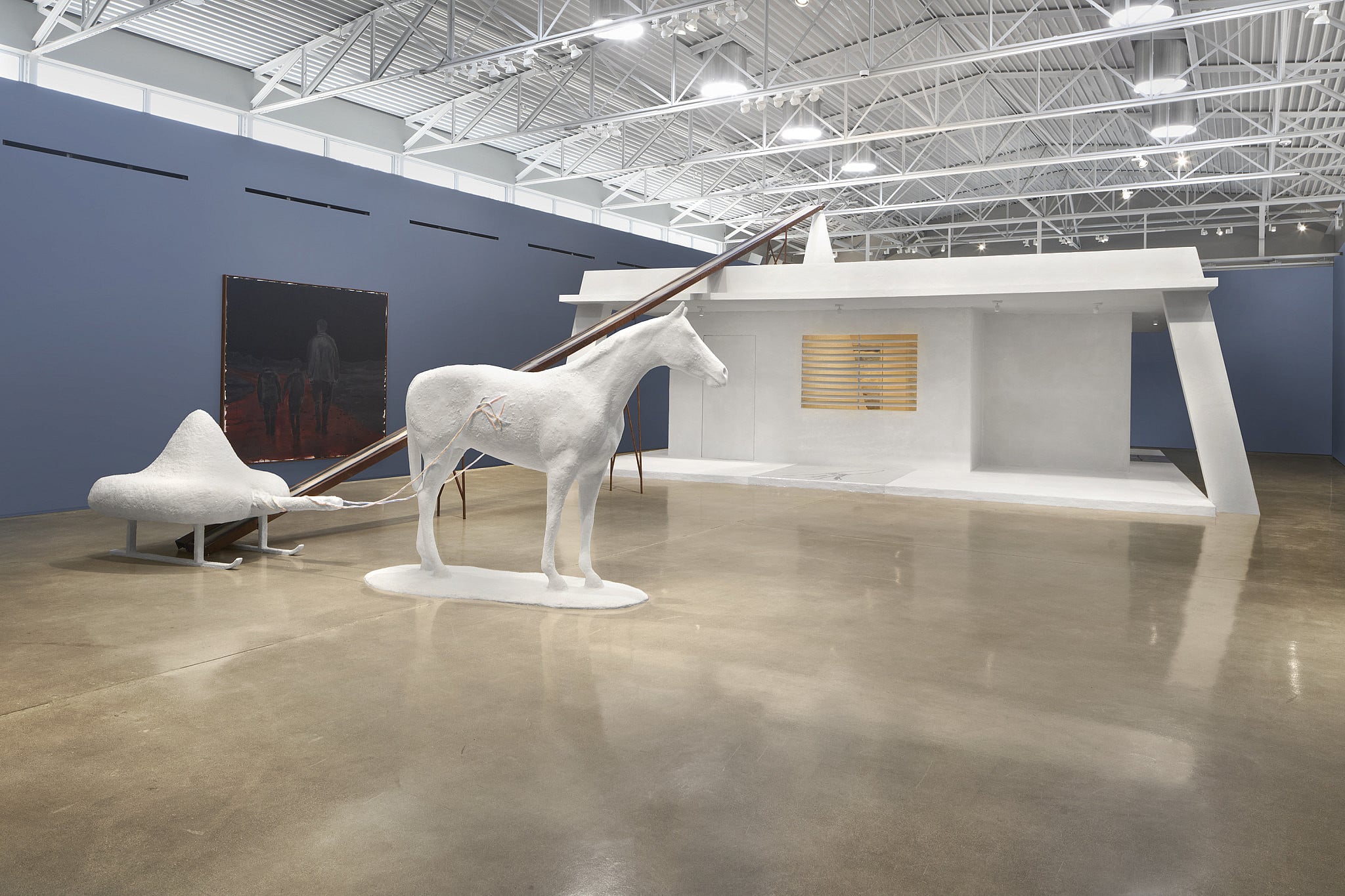
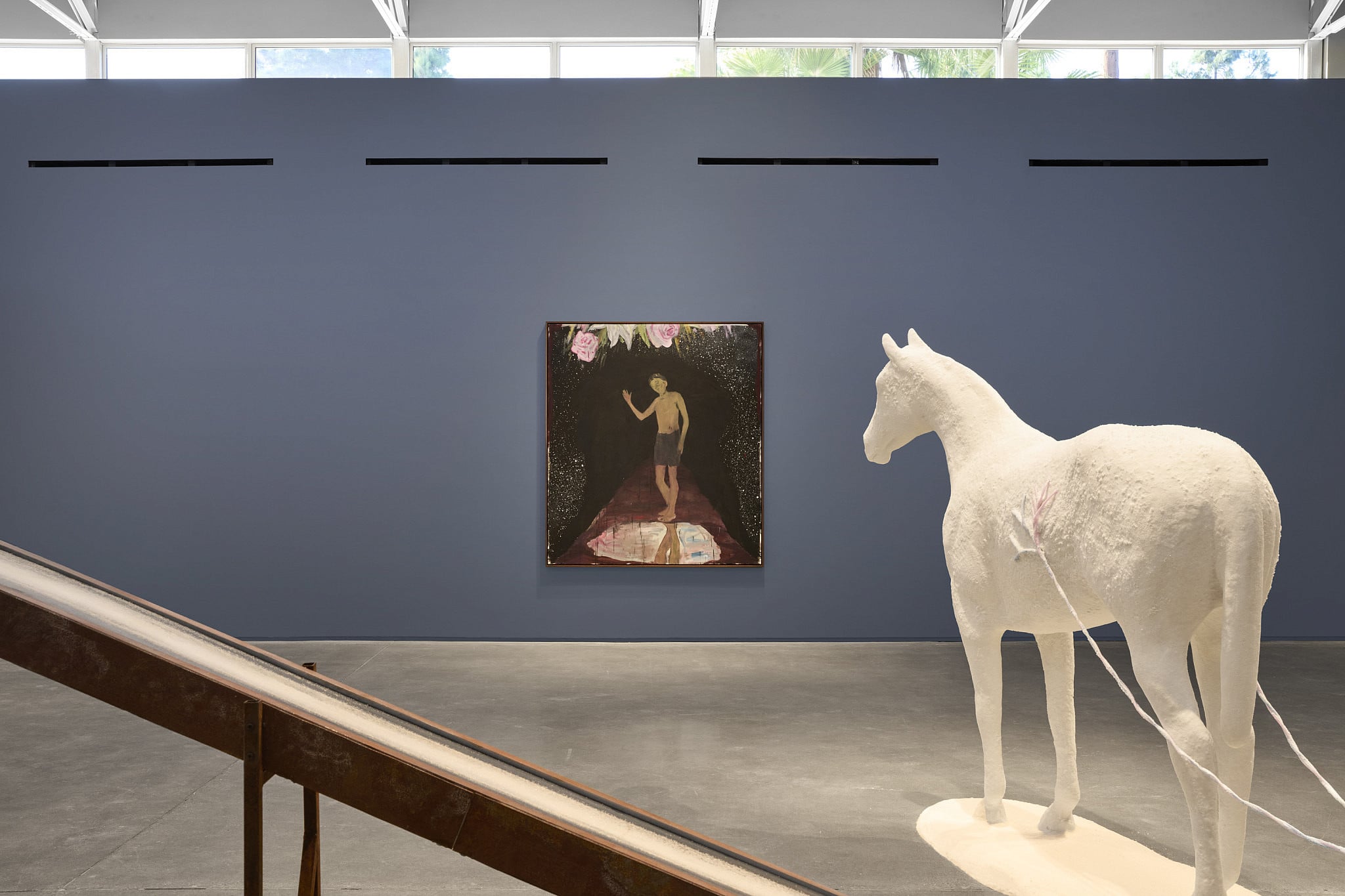
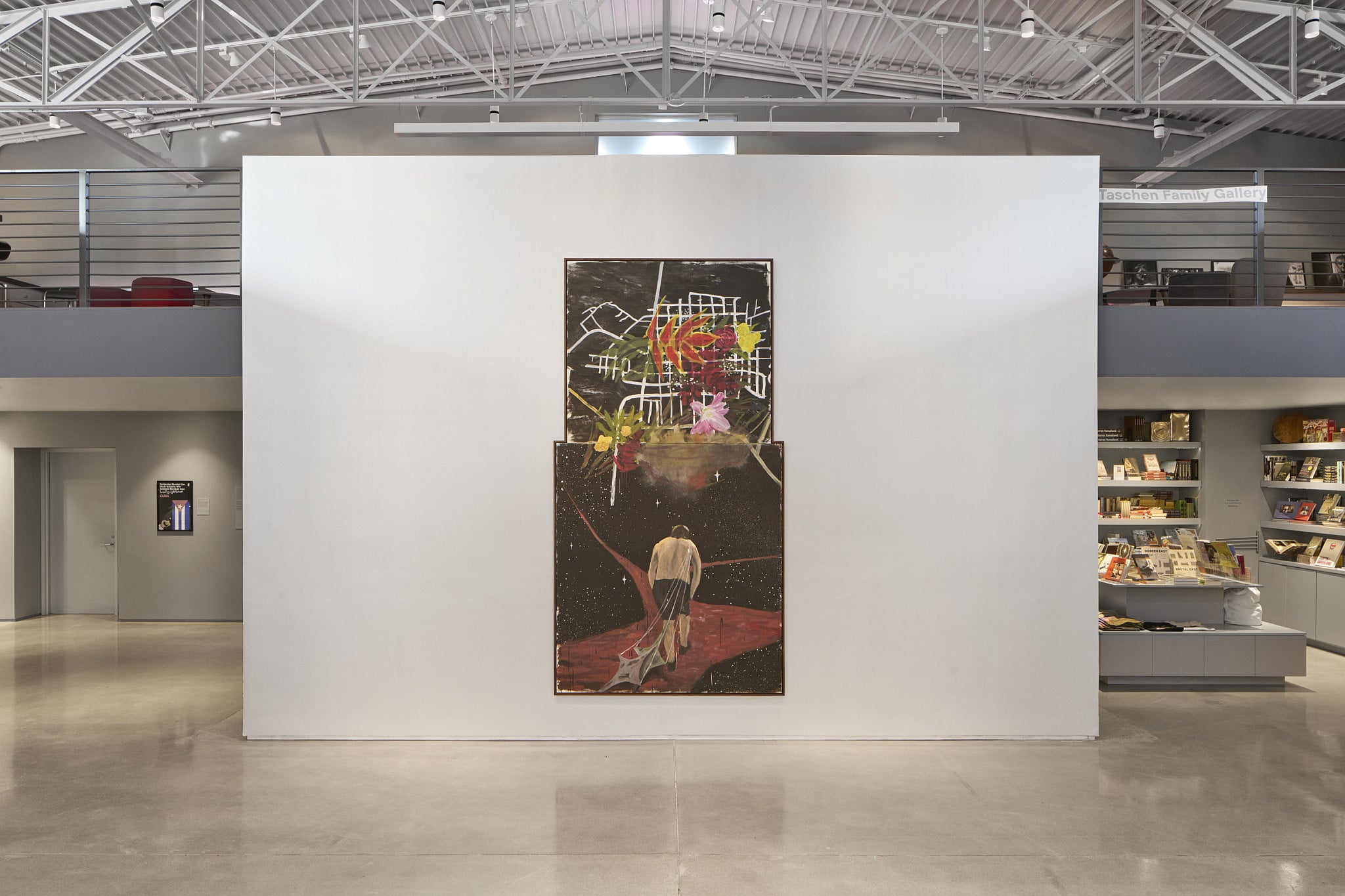
Three paintings surround the model house. The Lesson (2019) depicts a man in a suit walking along a dark path with two children. They are likely Celaya’s father, brother, and himself, reflecting family separation. Celaya’s father left for Spain alone, and the family followed him later. The Traveler’s Dream (2022) shows a young, bare-chested Celaya standing within a black, keyhole-shaped space, itself surrounded by white flecks. Pink blossoms along the upper part of the canvas create a striking contrast with the darkness, evoking both melancholy and the excitement of a life ahead. The painting seems to declare, “Here I am, ready to explore the world beyond Cuba.”
In The Vigil of Extinguished Stars (2022), a bare-chested man walks along a path with slumped shoulders, dragging a kite beneath a dark sky speckled with faint stars. Oversized leaves and flowers hover unrealistically over a white grid, creating a whimsical, dreamlike contrast with the somber figure below. This composition highlights Celaya’s blend of poetic imagination and scientific sensibility, revealing both emotional depth and structural awareness.
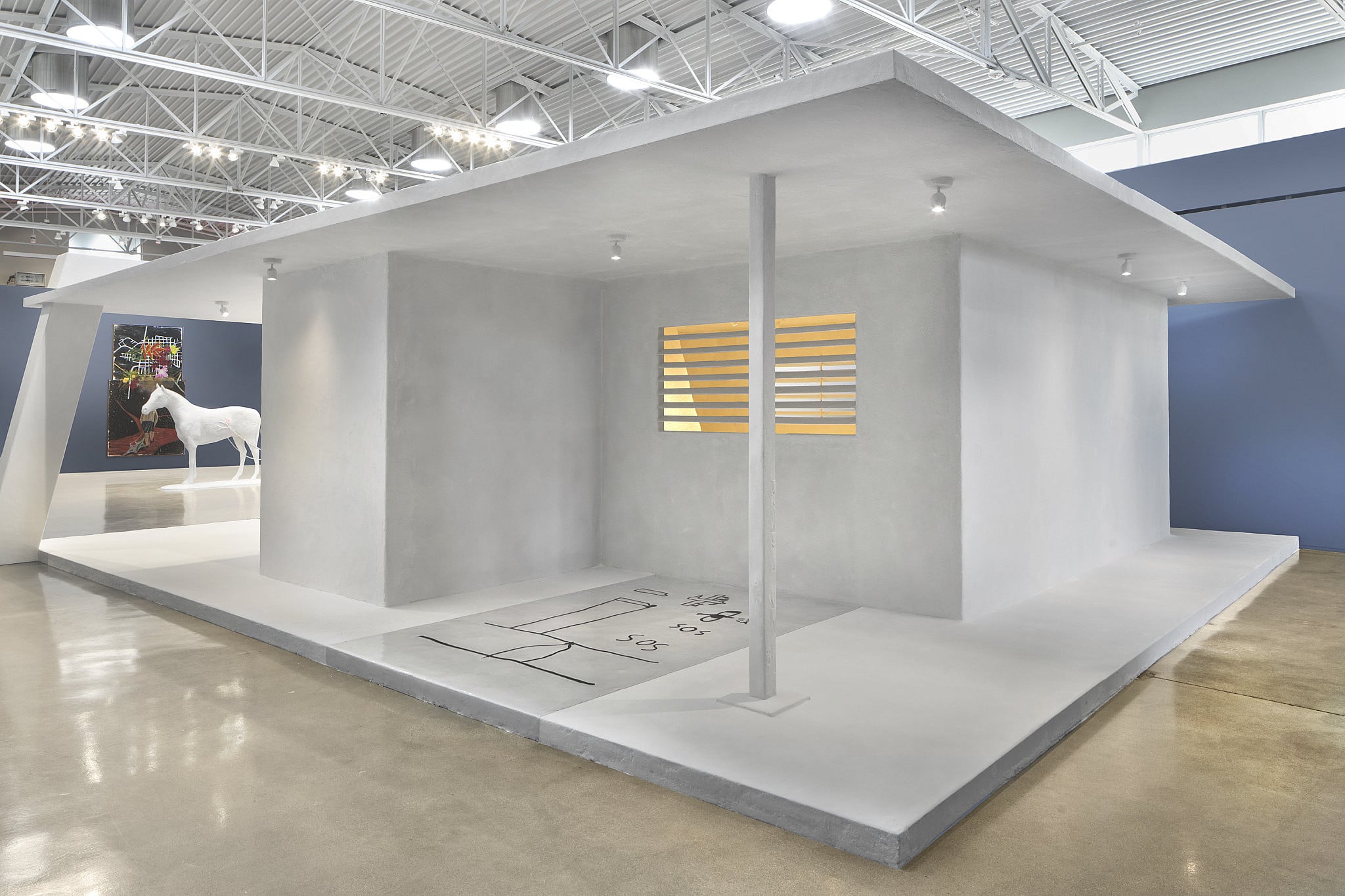
Visitors peer through the blinds, observing the house as careful witnesses. Beneath their feet, the floor bears scribbles reminiscent of a hopscotch game. Instead of numbers, it spells SOS, signaling the distress embedded in this memory. Walking across the floor becomes both a physical and symbolic engagement with Celaya’s memories, while other drawings nearby feel less emotionally charged.
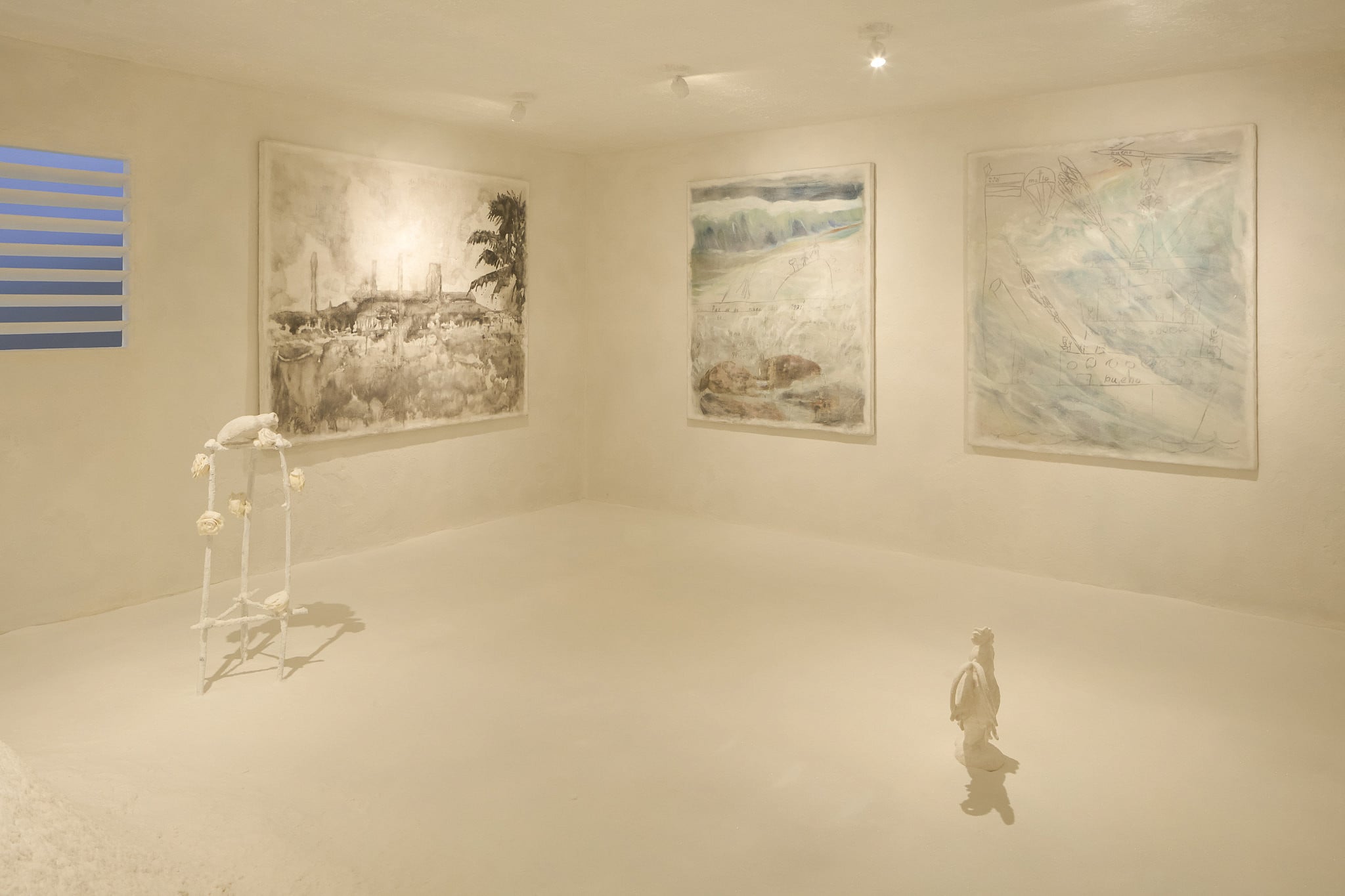
Inside the model house, two white sculptures—a rooster and a high stand decorated with roses on which two birds perch side by side, nuzzling—share space with three closely hung paintings, mostly in pastel tones, made of oil, wax, and sugar, including one depicting a sugar mill. A larger sculpture, reminiscent of a funnel, penetrates the roof, suggesting movement toward the outside world. The predominance of white in the interior carries multiple layers of meaning. It evokes innocence and memory like a blank canvas for recollection, reflecting how Celaya’s past is filtered and distilled. At the same time, the whiteness emphasizes absence and loss. It creates a sense of void that echoes exile, displacement, and the fading of memory. The interior feels dreamlike and frozen, reinforcing the house as both memory and allegory. The white also subtly references sugar, linking the installation again to Cuba’s history and to the promises and contradictions of the revolutionary ideal. The rooster, signaling the start of a new day, symbolically evokes the family’s emotional state of awaiting renewal. In Celaya’s installation, it may suggest the possibility of moving forward despite exile, loss, or memory, marking the transition from past to present and the beginning of a reflective journey.
“The Sextant’s” meticulous arrangement echoes Celaya’s background in physics and engineering. Like a real sextant, which measures angles between celestial objects to determine location, the installation charts a personal cosmos. His work operates on two levels. It is a direct, sensory experience and an allegory for the evolution of dreams and illusions. It shows how childhood expectations are reshaped, fulfilled, or disappointed over a lifetime, both in personal life and in the broader context of Cuba’s social and political history.
Together, Calero and Celaya frame memory not as a fixed record but as something porous and malleable. Both artists create environments that hold the traces of what is carried and what is lost, what is inherited and what struggles to be retained. Their installations open spaces where exile, displacement, and cultural transformation can be felt rather than merely intellectually understood. The viewer moves between worlds just as the artists themselves have. In Calero’s exuberant installations and Celaya’s luminous allegories, memory becomes both burden and engine, archive and horizon. By engaging with their work, one senses that identity is never a single place or moment. It is an ongoing navigation, a continuous act of situating oneself in relation to the past, and an enduring process of adaptation.