A Moroccan Journalist
Merchants of Martyrdom: How Palestine Is Weaponized against Morocco
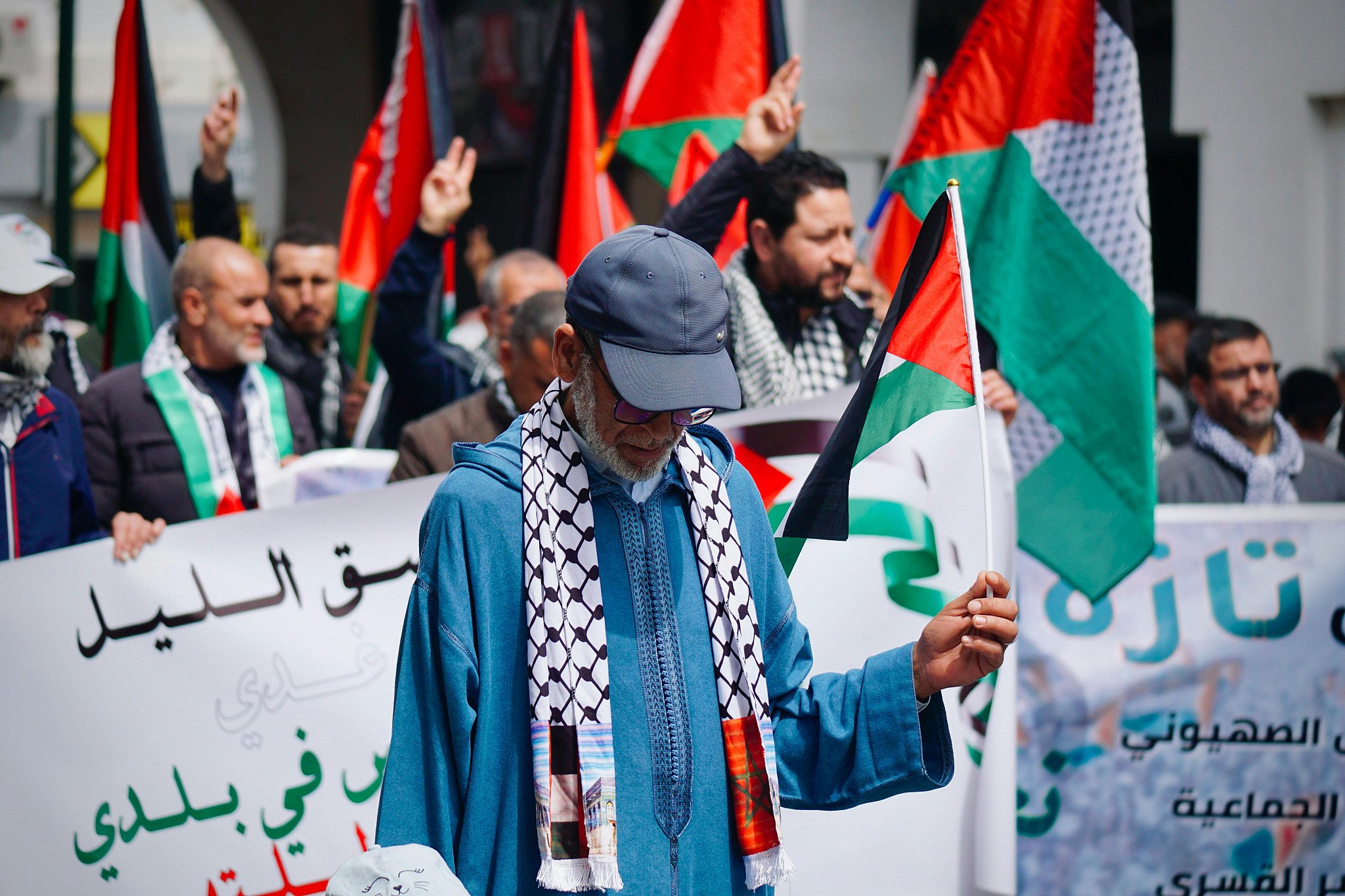
A protest in Rabat with Palestinian flags on display – one of many held on a weekly basis as a form of free expression. In contrast, Arab countries that claim to champion the Palestinian cause persecute, arrest, and block such demonstrations. Credit: Soufiane Chafiq – free for use.
In Sudan, the ground never dries from blood, yet no platforms tremble, no pens move. When millions die of hunger, silence becomes a political stance and ignoring becomes diplomacy. No condemnation statements, no urgent conferences – only dead air behind which hide faces addicted to double standards.
These same voices that raise slogans of “Arab solidarity” and “unity of destiny” fail without hesitation when called to a simple moral test. Their hypocrisy appears when disasters are measured by self-interest, when pain is reduced to the identity of the hungry. If Sudan doesn’t deserve solidarity, why speak of Arab unity? Or is Arab unity seasonal, hearts opened when necessary and closed when innocents are killed in silence?
Every time Morocco is cornered between defending its vital interests and facing opportunists, self-proclaimed “national voices” aim their arrows at the state rather than those threatening sovereignty or dictating from abroad. The mercenary media platforms in Morocco have gradually transformed into mouthpieces for Qatar-funded organizations, parroting hollow rhetoric while selling out national interests.
These propaganda machines, which speak with the tone of zealous defenders of Palestine, have never been seen criticizing Qatar or its military base in “Al-Udeid,” considered one of the prominent launching points for air operations against Gaza itself. Not a single line criticizing Qatar’s duplicitous discourse appears in their pages, yet they don’t hesitate for a moment to trivialize Morocco’s position, describing it as “surrender” and “engagement in a genocide project” – serious accusations not even made by the kingdom’s adversaries.
The truth pierces through their façade of righteousness: these media vultures have done nothing for the Palestinian cause besides wailing and riding waves of seasonal anger. Have they organized a real support campaign? Called for donations? Held their benefactors accountable before holding Morocco accountable? Their jihad consists solely of promoting statements issued by the so-called “Muslim Scholars Authority,” a Qatari organization managed from Istanbul, funded from Doha, and deployed according to geopolitical needs.
It’s pathetically easy to wave Palestine whenever Morocco’s choices conflict with regional calculations, and to play the role of “conscience holder” when the price of slogans isn’t paid from your home or national security. But a state isn’t managed with noble phrases, but with realistic interests.
Morocco has never been against Palestine, but has always balanced supporting Palestinian rights with protecting its national security, economic safety, and internal stability. Moroccans cannot accept Palestine being transformed into a stick waved in their state’s face whenever it decides to move with independent sovereign logic, or when a morally bankrupt party like PJD – the very same that signed the normalization agreement with Israel in 2020 – now builds its entire agenda on Palestine to salvage its political corpse as elections approach.
With nothing substantive to offer voters, they cynically exploit Palestinian suffering, manipulating it for political gain – especially when framed within an Islamic religious template. They prey on the sociological reality that Moroccans’ compassionate nature makes them particularly susceptible to emotional mobilization masked as moral duty. The Palestine they want to blackmail people with is not our cause. Morocco refuses to let its emotions be used to sabotage its interests.
Qatar’s savage hypocrisy stands naked: they advise their citizens in America not to address any political activity related to Palestine, fearing losing their soft power there, while simultaneously sending their mercenary mouthpieces and directed media to Morocco to incite Moroccan society to “jihad” as if we were a human reservoir for hire on demand.
Throats forbidden in Washington but permitted in Rabat? Their clerics are paid in dollars, and their fatwas formulated according to the wind’s direction; they remain silent before the White House master but roar only when it concerns a sovereign state like Morocco. It’s fake jihad, with clean funding and dirty purposes.
Mohamed El Bakkali’s recent case exposes the rotting moral core of Qatar’s Al Jazeera. He was one of their soldiers, carried their microphone, defended their discourse, and when he was captured aboard “Handala,” one of the Gaza blockade-breaking ships, the channel fell silent as if nothing happened.
They issued no statement, didn’t mention his name, didn’t condemn his arrest – simply because he is Moroccan. Had he been one of their preferred citizens from Lebanon, Palestine, Syria, or the Gulf, they would have inflamed news broadcasts for him, transformed him into a “freedom hero” with presenters’ tears.
But the Moroccan belongs under the table, even if he offered his soul for their cause. Al Jazeera didn’t just abandon him but despised him, exposing their true position: in their eyes, not all journalists are equal, and not all Arabs are “brothers.” This moral scandal reveals that the channel that once claimed to side with truth only sides with those who fit their image.
While these mercenary voices peddle empty rhetoric, history shows us where true wisdom lies in regional politics. Among the leaders born in North Africa, Anwar Sadat remains one of the few who combined political shrewdness with strategic clarity, far from the wooden language and populist slogans that captivated masses for decades without return.
In 1978, Sadat sent a clear message to Yasser Arafat, saying: “If Yasser Arafat doesn’t sit with me now at the negotiation table, no state will be declared for them after my death.” These weren’t mere passing opinions but accurate readings of power balances and the future of the Palestinian cause amid Arab division and changing international positions.
Unlike others, Sadat advised Palestinians to accept the 1967 borders as a basis for establishing the Palestinian state, then negotiate later on major issues like Jerusalem and refugees. He himself succeeded in recovering the entire Sinai, signing a peace agreement on his terms, including American guarantees and long-term military and economic assistance, without compromising sovereignty or national decision-making.
In contrast, the Palestinian leadership rejected his advice under pressure from Arab mantras and dogma, missing a rare historical opportunity. After more than four decades, no Palestinian state has been established, the land has eroded beneath its owners’ feet, while the cause has turned into a card used by collapsed regimes or mercenary militias.
What if Sadat’s advice had been taken seriously instead of inciting against him and considering him a “traitor”? Perhaps the path of the Palestinian cause today would be completely different, with an established state and strong negotiator, instead of the spiral of escalation, division, and loss. The real betrayal wasn’t in Sadat signing peace, but in ignoring his voice when he spoke the truth.
Now we witness the spectacle of foreign provocateurs like the Palestinian TikToker living in Europe, screaming at impressionable Moroccan youth with the voice of someone who pays no price: “Choose between Mohammed VI or Gaza!” – explicitly calling for demonstrations before royal palaces and sit-ins at Moroccan military barracks, as if Morocco were a country without sovereignty, its army without history, and its people without awareness.
Similarly, Ibtihal Aboussad, the former Microsoft engineer who trended for a few days for raising the voice of a cause she ultimately gained nothing from – except some added followers on her social media and a boost of self-esteem that she had done what world leaders couldn’t – was dragged to Morocco after being expelled from America.
She barely set foot on Moroccan soil before distributing lessons on struggle and inciting sit-ins for Palestine, as if Morocco became a dumping ground for her disappointments or a platform to compensate for her American failures.
These pathetic instigators, if they had an ounce of honesty for supporting Palestine, wouldn’t direct all their incitement toward Morocco and Moroccans, but would address Palestinians themselves in Europe, America, and the Gulf, or at least those with money and platforms, from Qatar to Saudi Arabia, from Kuwait to the Emirates and Syria.
But they know well that those populations can no longer be led by mindless chants or follow revolutionary charlatanism. In Morocco, they’ve found an open field: everyone incites, everyone issues fatwas, everyone outbids, everyone covets leadership even if that leadership leads to the abyss. Cowardly incitement that chooses the weakest voice, not the strongest impact, betting on kindness, not ignorance.
In food aid camps in Gaza, caravans of goodness pour silently without shouting, coming from Morocco – the land of history and dignity. Food baskets including Moroccan vegetables and fruits, milk, flour, and semolina from the Atlas land, prepared with generosity from a people not waiting for applause.
These initiatives come through coordination between the Bayt Mal Al Quds Asharif Agency (BMAQ) – part of the Al-Quds Committee chaired by King Mohammed VI – Morocco’s field arm in protecting Palestinian dignity, and the Gaza Reconstruction Association, a Moroccan non-governmental organization that acts without showing off and aids without favors or one-upmanship.
We stand with Palestine, but not with those trading in it to settle scores with countries they didn’t choose. Morocco isn’t a testing ground for their failed ideologies or a platform for their displaced anger. This nation has provided for Palestine what gas statelets haven’t, but it will not offer its children as sacrifices in another remotely controlled holocaust from comfortable capitals.
Morocco calls for a two-state solution – a Palestinian state next to an Israeli state, not a Palestinian state instead of the Israeli.
Related Topics
Related Posts