
A Moroccan Journalist
Middle to Whom? East of What? Decolonizing the Map Inside Our Words
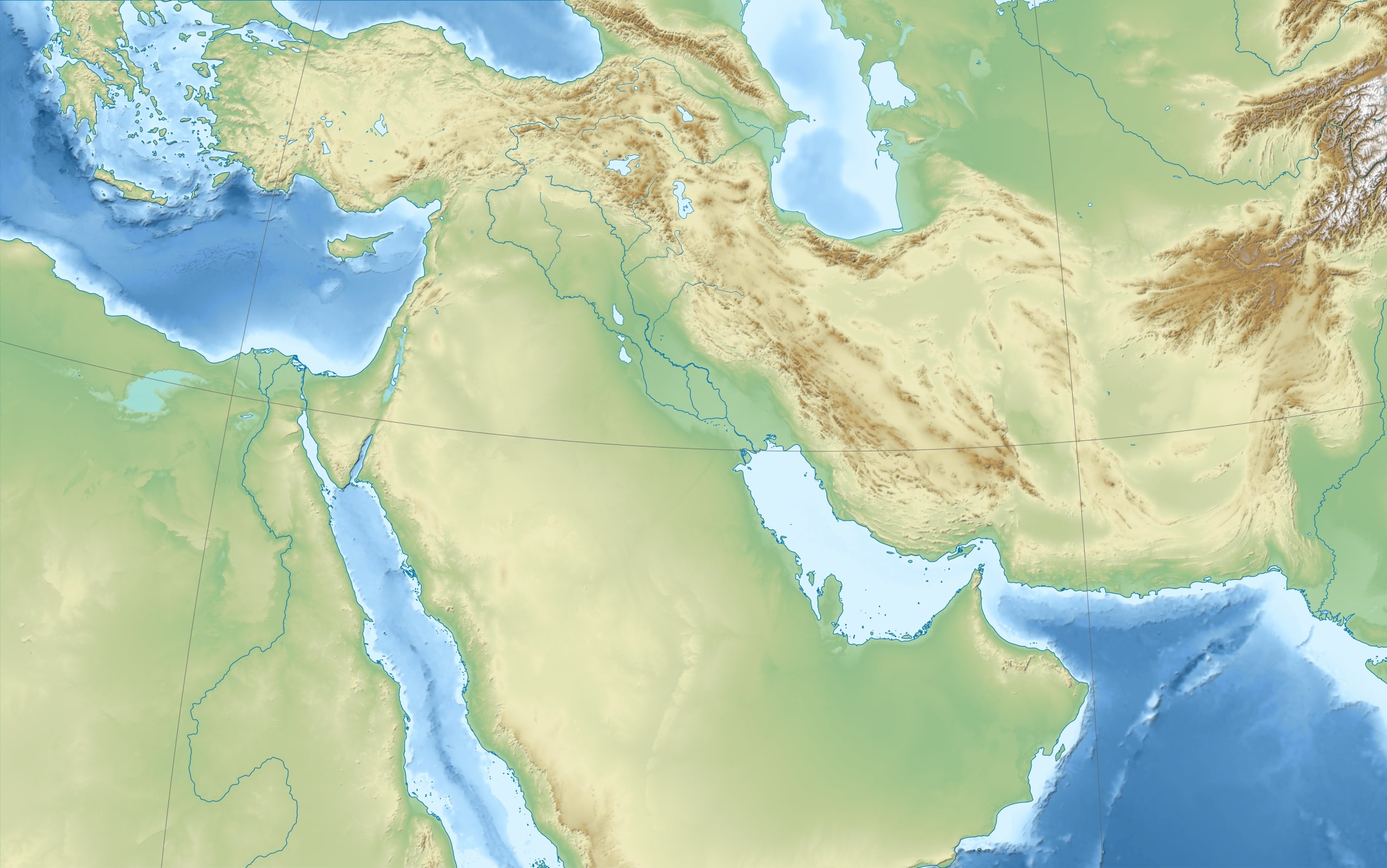
Blank physical map of the Middle East. (Wikipedia)
I’m not the first – nor will I be the last– to argue this: it’s time to decolonize not only our lands but also our language. The phrase “Middle East” looks harmless on a page, yet it smuggles in an entire worldview: a center presumed in Europe or North America, and vast peoples oriented around that center as “near,” “middle,” or “far.” Middle to whom? East of what? Language here is not a mirror; it’s a compass someone else calibrated.
Cultural studies teaches us that naming is never neutral. Words organize the world; they fix hierarchies and draw borders in our heads before anyone draws them on a map. “Middle East” is a textbook case of symbolic power: it compresses dozens of histories into a single direction relative to an imperial vantage point. It is a phrase born in military memos and shipping routes, then naturalized in textbooks and TV chyrons. The term doesn’t just describe; it prescribes how we think – what belongs together, who is adjacent to whom, and which stories are supposedly “regional.”
But a region stitched together by someone else’s compass produces someone else’s common sense. Why should Baghdad, Sana’a, and Jerusalem be narrated in the same breath as if their politics, languages, and horizons were one? Why should North Africa be appended as an afterthought – hyphenated into MENA – as if Africa itself were a side room in Asia’s corridor? The phrase “Middle East” does cultural violence by flattening differences and erecting a center/periphery logic that we then internalize and reproduce.
Now, a quick side note for my own backyard. Even “Maghrib” (the West), which Moroccans have long used, reveals this problem in miniature. It positions us as somebody’s “west.” We didn’t invent the cardinal points; we inherited them, and with them, inherited relational identities – west of who? east of whose story? That’s not an argument to abandon our names, but a reminder to handle them with awareness: orientation is power.
So what do we say instead? There’s no single perfect fix, but there are better practices. “West Asia and North Africa” (WANA) or “SWANA” foregrounds geography without granting Europe the role of zero point. “Arab region” can work in linguistic and cultural contexts, while “North Africa,” “the Sahel,” or “the Gulf” are precise when precision is what we need. Often, the best language is the simplest: name the countries you mean. The more specific the words, the less imperial the map that sneaks into the sentence.
And yes, we can push the logic to expose its absurdity. From Rabat’s vantage point, one could plausibly talk about the “Middle West” (the Atlantic arc) or even the “Far West” (the Americas). From Tehran, “Near West” might be Anatolia; from Lagos, “Near North” could be the Maghreb. The point isn’t to invent new cartographic egos; it’s to prove that all such labels are vantage-point fictions. If names are fictions, let’s choose the ones that don’t invisibly crown a metropole.
Decolonizing language is not a mere semantic tweak; it’s an epistemic reorientation. When we abandon “Middle East,” we recover analytical clarity. We stop lumping Palestinians, Israelis, Iranians, and Amazigh communities under one directional umbrella and start asking sharper questions: Which histories intersect here? Which empires cut across which trade routes? Which languages and laws actually link these places – Arabic, Hebrew, Amazigh, Kurdish, Persian, Ottoman, French, Spanish – and to what effect? That shift matters in classrooms, newsrooms, and ministries. It changes syllabi, headlines, and policy briefs. It refuses a borrowed atlas.
Some will say: the phrase is conventional, why fight it? Because convention is precisely how power survives. Every time we repeat “Middle East,” we retrace a colonial worldview as if it were natural geography. We shouldn’t be embarrassed to annotate our terms: “West Asia (often called the ‘Middle East’)” is already a better sentence. Style guides can lead; universities can teach the history of the label; journalists can model country-level specificity; policymakers can stop drafting memos to an imaginary region and address actual polities and publics.
I’m not the first, and I won’t be the last, to make this case. That’s the point. Decolonization is a relay, not a solo. Others have questioned the phrase before me; others will refine it after me. What matters is that we stop outsourcing our intellectual coordinates to a history that wasn’t written for us. If we demand sovereignty over land, we should demand sovereignty over language – the everyday borders of thought. When we redraw those borders, the map doesn’t just look different. We begin to live differently within it.
Related Topics
Related Posts