The views expressed herein are solely mine.
Hamas Disarms for Cameras, Kills for Power
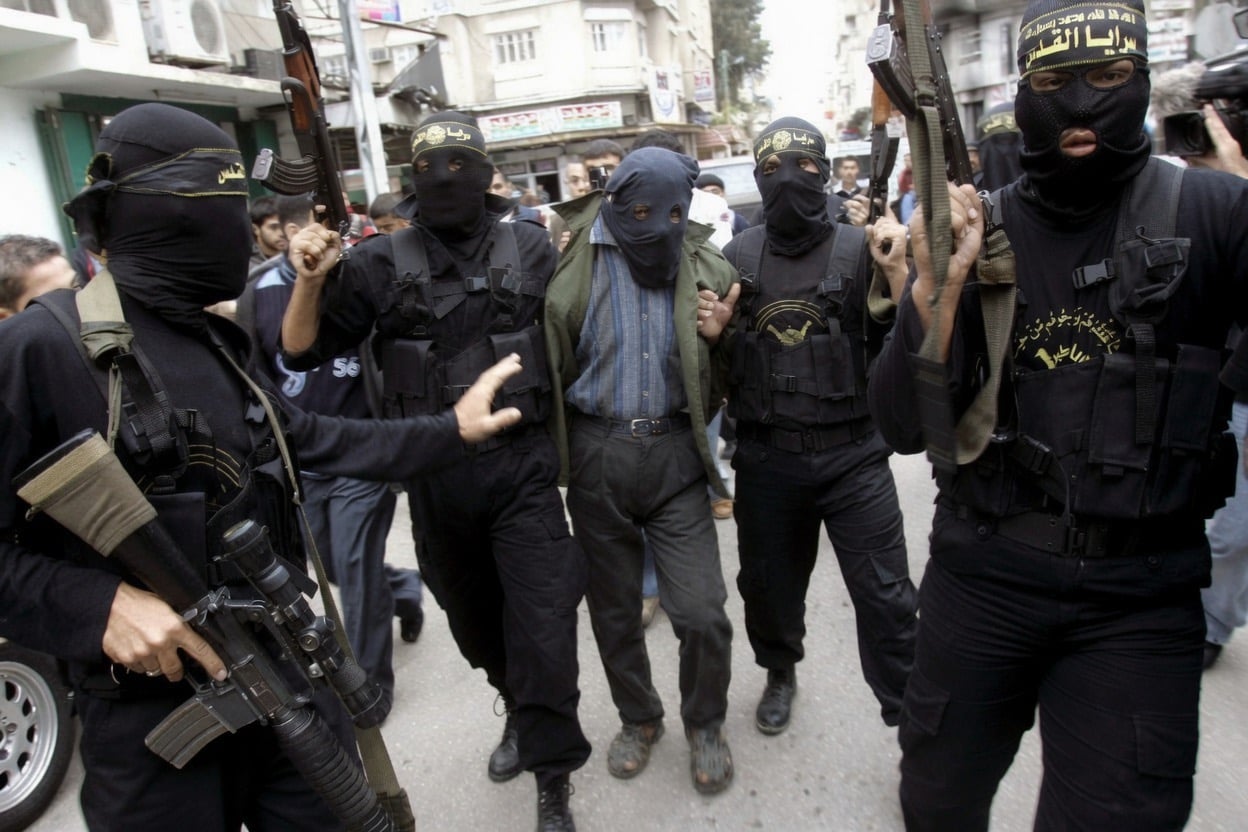
Palestinian Islamic Jihad masked gunmen hold up their guns as they display one of two men whom they alleged were Palestinian collaborators for Israel, in Gaza City, November 5, 2006. (AP/Khalil Hamra/File).
The latest United Nations report on Gaza exposes the fraud at the center of every negotiation with Hamas. The terrorist group tells diplomats it may disarm while its own enforcers execute, maim, and beat Palestinians to preserve power. This is not a contradiction. It is Hamas’s operating system.
The United Nations Office of the High Commissioner for Human Rights documented 249 cases of extrajudicial punishment in Gaza between August 2024 and January 2026. Those cases included 108 deaths. Nearly one-fourth involved Hamas-affiliated forces; these were Hamas operatives and police units, the same coercive infrastructure that Western diplomats now pretend can be separated from the terrorist group’s rockets, tunnels, and command structure.
The punishments targeted alleged collaborators with Israel, aid looters, thieves, drug offenders, political rivals, anti-Hamas activists, and members of Israel-backed clans that appeared where Hamas’s rule weakened. That list matters. Hamas was not merely settling scores. It was eliminating the possibility of a postwar Palestinian alternative. Every rival clan, every independent activist, every local security node, and every Palestinian willing to challenge Hamas’s monopoly became a target. Ergo, internal terror is not a side effect of Hamas’s rule. It is the modus operandi of Hamas’s regime.
Indeed, this should end the fiction that Hamas can disarm voluntarily. A terrorist group does not spend months executing and maiming Palestinians in public only to surrender the coercive system that made those punishments possible. When Hamas speaks of disarmament, it means repackaging force under another label. A rifle surrendered for cameras means nothing if Hamas keeps the police stations, intelligence files, tunnel entrances, smuggling routes, aid lists, courts of fear, and men with masks who decide who may live.
Even the United Nations, an institution consistently hostile to Israel, has now documented Hamas’s war against Palestinians. Thus, Western governments should pay attention to the irony. The same diplomatic class that lectures Israel about restraint now possesses evidence that Hamas governs Gaza through terror. Ignoring that evidence is not compassion. It is complicity dressed as peace process management.
Hamas has always played the West this way. It offers process when cornered, ambiguity when pressured, and humanitarian language when exposed. It signs enough to buy time, rejects enough to retain weapons, and trusts foreign officials to confuse delay with moderation. Qatar and Turkey provide political oxygen, media cover, and diplomatic shelter. Iran supplies the strategic logic. Hamas converts Palestinian suffering into leverage, battlefield survival into legitimacy, and Western guilt into a shield.
The regional lesson is deadly. If Hamas survives as a terrorist authority in Gaza, Iran keeps a forward operating asset on Israel’s southern flank. Hezbollah sees that embedding among civilians works. The Houthis see that international outrage can rescue terrorists from defeat. Other jihadist actors see the model: start a war, hide behind civilians, execute local rivals, promise reform, and wait for Washington and Europe to restrain Israel.
Enough is enough. The State of Israel cannot accept that model. Neither should the West. Reconstruction money must not become ransom paid to Hamas’s bureaucracy. No Western dollar, euro, or Gulf pledge should flow through Hamas-linked ministries, charities, police units, contractors, or clan intermediaries. Border crossings must be monitored by actors with enforcement power, not by diplomats writing memos. Aid distribution must bypass Hamas networks. Police units must be rebuilt from scratch. No member of Hamas’s terror system should control security, reconstruction, education, border access, or humanitarian lists.
Why? Because the issue is not whether Hamas signs a paper. The issue is whether Hamas loses the power to coerce. Disarmament must be verified, irreversible, and imposed, not trusted or appealing to the same fictitious model that the Spaniards did with the Basque terrorist group ETA. “De-Hamasification” must mean the destruction of its governing muscle, not merely the collection of some rockets.
Hamas does not merely threaten Israel. It devours Palestinian society from within. The United Nations has now placed numbers behind that truth: 249 cases, 108 deaths, and a terrorist apparatus still pretending it can become a political partner. Believe Hamas’s disarmament pledge, and the next war has already begun.
Related Topics
- 2025 Hostage Deal
- Antisemitism
- Donald Trump
- Europe
- Gaza
- Gaza Border
- Gaza Disengagement
- Gaza Reconstruction
- Gaza Rocket Attacks
- Gaza Strip
- Hamas
- Hezbollah
- Hostages in Gaza
- IDF
- Iran
- Islam
- Israel At War
- Israel-US Relations
- Israel: Jewish and Democratic
- Israeli Foreign Policy
- Israeli Politics
- Israeli society
- Lebanon
- Middle East
- October 7 anniversary
- Palestinian Statehood
- Palestinians
- Qatar
- Saudi Arabia
- Spain
- Terrorism
- The Arab World
- Turkey
- UAE - United Arab Emirates
- United Nations
- Weapons
Related Posts