Life Member, Hadassah Westchester, Hadassah Writers' Circle
Mishkan and Community: Sustaining the Joy and the Awe
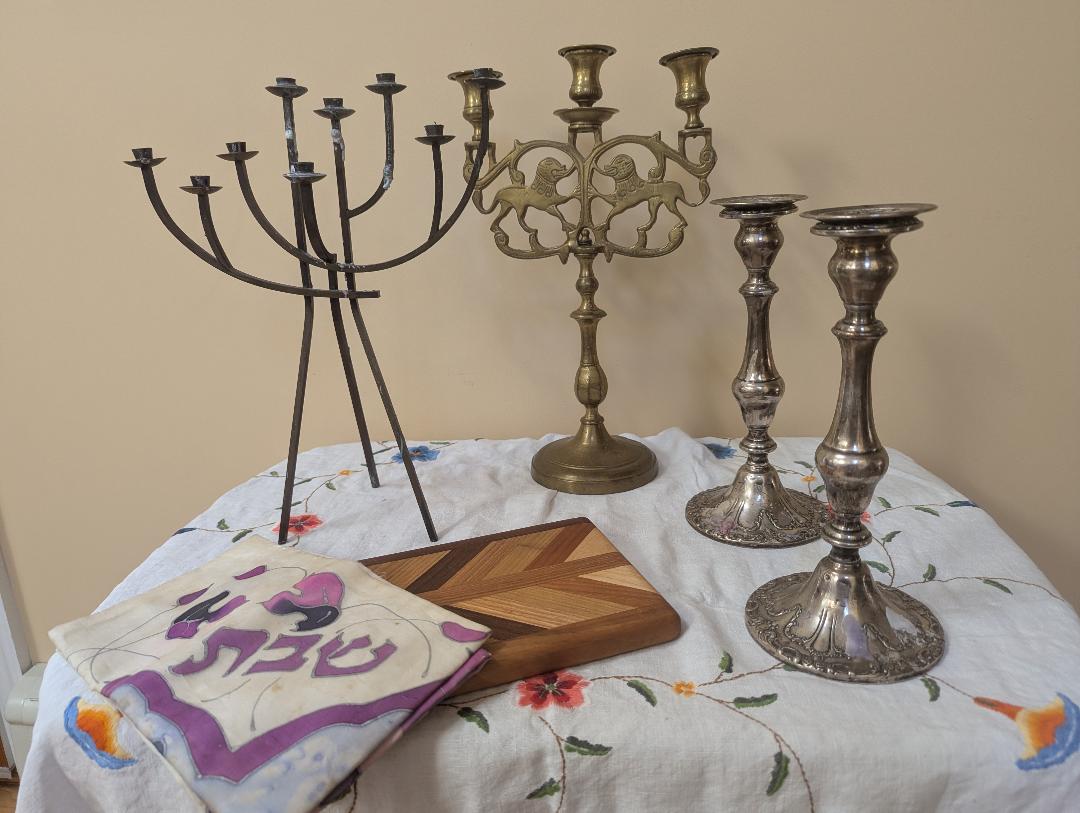
Photo courtesy of the author.
This is Part Two of a two-part series by the author on Building and Sustaining Mishkan.
Constructing a portable sanctuary for their God, as described in the biblical book of Exodus, was a community-wide endeavor for the ancient Israelites. They had collected raw materials and engaged skilled craftspeople from every tribe to create a moveable dwelling to celebrate the God revealed to them at Mount Sinai.
Using the best materials available and employing the talents of community members, they imagined something new. They redirected the highest quality, rarest materials — gold, silver, gemstones, tanned hides and finely spun linen in the richest hues (with which other societies honored royalty) into a tabernacle that would celebrate and elevate their all-embracing and all-consuming God.
Their goal was to meet Moses’ challenge to “have awe of [God] be upon you . . . .” (Exodus 20:17). The result was an ark (mishkan, מִּשְׁכָּ֔ן), curtains and implements that would accompany them for worshipping God as they wandered through the wilderness. Eventually, these were to be installed in a temple in Jerusalem.
Some 700 or more years after Exodus detailed this construction project, the second century CE Rabbi Ishmael B. Elisha taught the biblical line “This is my God—I laud him, the God of my father — I exalt him!” (Exodus 15:2) as meaning “I shall glorify Him in the way I perform mitzvot.” This concept became known as hiddur mitzvah, the practice of using beautiful, decorated objects for ritual acts. And it seems to me that this is precisely what the Israelites did when they constructed that first sanctuary and its accoutrements. Provided with the finest materials, the most skilled artisans and designers were empowered to create a beautiful and awe-invoking place for the community to interact with God.
Over the many centuries since, Jews have followed the practice of hiddur mitzvah, using special objects for communal ritual observances. Museum collections and synagogues display beautifully embroidered covers for Torah scrolls and embroidered cloth or inlaid wooden covers for the ark that holds the Torah scrolls, often with an ornate nir tamid (eternal light fixture) hung above it. Jews created celebratory ritual objects with the best they could afford.
For home observances, think hand-dipped shabbat candles, an ornate or elegantly simple household mezuzah. In my house, we light colorful candles set into one of several artsy hanukkyiot (Hanukkah candelabras). For Passover, we place the traditional items on a ceramic seder plate from Jerusalem and the three designated matzot in a holder my father’s mother sewed. The Shabbat challah waits its turn under a colorful hand-dyed silk cover. The brass Shabbat candelabra that my grandmother received from her mother as a wedding gift in a poor corner of Romania, circa 1920, was probably not expensive compared with what I can afford today, but it was no doubt the best within their means and today is even more precious because of its history.
When I’ve asked, the artists and artisans who handcraft these Jewish ritual objects attribute their art to a variety of inspirations: a desire to pass along beautiful religious objects to future generations, a wish that their creations embody spiritual aspirations and the hope that they serve as living memorials to previous generations. Some craftspeople explain that the creation processes are meditative and elevate their own Jewish experiences.
As far back as I can remember, I have been making things — with yarn and fabric purchased for a specific project or the scraps of wire, cardboard, wood or whatever I have had at hand. Some of the resulting items were both reasonably accomplished and practical—Purim and Halloween costumes, dresses, sweaters, cookies and the like.
Other creations’ only reason for existence was that I’d made them—wire figurines, clay pots, an extensive cardboard amusement park, for example. I make some things because they are useful and some things just because.
Over the last few years, I’ve returned to drawing and painting, creating paintings of recognizable scenes as well as purely abstract images. For these, I find the process of “making” all-absorbing. Certainly, I can become engrossed in my craft activities — sewing a lace dress and filling hamantaschen, for example, require my full attention. But when painting and drawing … well, it’s something different. The flip from my typical analytical left-brain mode to a right-brain one changes everything. I can’t describe the feeling but I know that it feels a world apart.
I am trying to explain this because I want to convey what I think the artists and artisans of the Hebrew Bible might have felt when assigned to create the Mishkan — an ark to hold the Israelites’ most significant object— and a place for God to dwell amongst them. It’s not just an assignment; it’s an all-absorbing calling.
It’s not likely that we can fully imagine the awe experienced by those recently liberated Israelites faced with dramatic divine revelation at Mt. Sinai. Nor can we truly comprehend the challenge and joy of those artisans who, the text says, created that first holy sanctuary. What we can do is promote the practice of hiddur mitzvah to help us remember that awe and, perhaps, share a taste of those feelings.
Michele is a member of the Hadassah Writers’ Circle, a dynamic and diverse writing group for leaders and members to express their thoughts and feelings about all the things Hadassah does to make the world a better place. It’s where they celebrate their personal Hadassah journeys and share their Jewish values, family traditions and interpretations of Jewish texts. Hadassah members are proud of their Zionist mission and their role as keepers of the flame of Jewish values, traditions and beliefs as well as advocating for women’s empowerment and health equity for all. Since 2019, the Hadassah Writers’ Circle has published nearly 800 columns in The Times of Israel Blogs and other Jewish media outlets. Interested in writing? Please contact hwc@hadassah.org.
Related Topics