
Life Member, Hadassah Westchester, Hadassah Writers' Circle
The Israelites’ Joy in Creating the Mishkan, God’s Earthly Abode

Photo courtesy of the author.
This is Part One of a two-part series on creating and sustaining a mishkan and bringing the biblical experience into the present day.
When it came time for the ancient Israelites to celebrate the God who had just been revealed to them at Mount Sinai, they quickly learned that this god was different from those they had encountered before. The old ways of worshipping those other gods would not work (see the story of the golden calf). This God, their God, had been revealed to them all in a spectacular display of sight and sound: a pillar of fire, bolts of lightening, cloaked by a cloud, and accompanied by sounds so intense they could be seen. . Now the peoples’ looming task was to fulfill God’s instructions to “make Me a sanctuary that I may dwell [settle down] amidst them” (Exodus 25:8). What kind of sanctuary could possibly house this all-enveloping God who dictated laws and proffered a vision of a land of milk and honey?
Moses, the people’s prophet, asserted that “For it is to test you that God has come, to have awe [יִראָה /yirah] of him be upon you. . . . (Exodus 20:17). Creating a tabernacle, an earthly sanctuary (mishkan/מִּשְׁכָּן) that would sustain feelings of awe and exaltation worthy of this God would require something new.
Organization and cooperation were essential. Ultimately, members of the Levite tribe took charge of the sanctuary. More specifically, Moses’ brother Aaron and his male offspring became the kohanim (כֹּהֲנִים), the priests tasked with performing sacrificial rites and caring for the holy implements. They would be the caretakers and officiants, not the builders. Rather, the enterprise of building a place for those rites and creating those implements became an enterprise in which everyone participated.
The most gifted craftspeople were engaged. Bezalel and his deputy Oholiab were assigned overall project management.
“See, יהוה (God) has singled out by name Bezalel, son of Uri son of Hur, of the tribe of Judah, endowing him with a divine spirit of skill, ability, and knowledge in every kind of craft. . . and to give directions. He and Oholiab son of Ahisamach of the tribe of Dan . . .” (Exodus 35:30-35).
Bezalel and Oholiab, in turn, set about organizing supplies. Reading the supply list, beginning in Exodus 25, we readily grasp the value implied in some of the materials, starting with “gold, silver and copper; . . . fine linen. . . .”
What might be less obvious today is the exclusivity associated with other materials. While the materials listed would have been known to the Israelites from their sojourn in Egypt—an affluent society with access to the Nile River’s abundant fresh water as well as creatures of the Mediterranean Sea—these could not have been produced by desert wanderers. But the aspiration to use only the best components is clear.
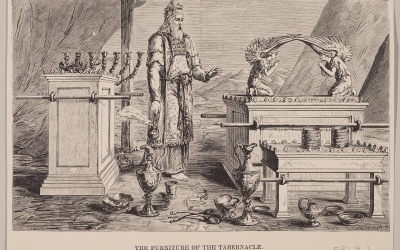
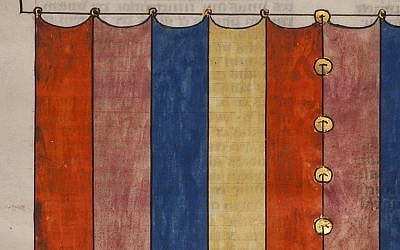
For instance, the text invokes images of richly colored textiles—blue, purple and crimson yarns. It turns out that in cultures of the ancient Middle East (which would carry forward into European societies), the dyes needed were often exclusive to royalty. Even today, high officials’ clothing display these hues. (See, for example, Roman Catholic cardinals’ vestments and King Charles III’s coronation attire.)
Techelet /תְכֵ֧לֶת (blue) seems to be derived from a small gland in a specific sea mollusk and requires careful processing of thousands of the creatures to amass in any useful quantity. Argamon/אַרְגָּמָ֛ן (purple) may also have been derived from these mollusks, while tola’at /תוֹלַ֥עַת (crimson) was made from the shells of a tiny insect.
The linen fiber dyed in these rich hues would have been similarly difficult to obtain. Growing hemp for linen requires a lot of water, and even more to spin it into weavable yarn. Egypt’s Nile River would have made cultivation and processing possible in ways desert terrain could not. As a practical matter, the materials might or might not have been obtainable, but their use in this text reveals an aspiration to create with nothing less than the best quality components.
To work with these supplies, Bezalel and Oholiab convened the most skilled craftspeople. “And everyone who excelled in ability and everyone whose spirit was moved came, bringing to יהוה (God) an offering for the work of the Tent of Meeting and for all its service and for the sacral vestments” (Exodus 35:21).
The women, in particular, stepped up: “And all the skilled women spun with their own hands, and brought what they had spun, in blue, purple and crimson yarns, and in fine linen” (Exodus 35:25).
And the designs were exquisite. Rashi, the renowned 11th century Torah commentator, interprets the instructions for the curtain for the innermost holy-of-holy enclosure to create a woven tapestry, a time-consuming process requiring masterful skills. The next curtain, moving outwards, was to be embroidered, requiring yet a different skill set.
Now, you might read the lengthy supply lists, the descriptions of the building process, the objects created and the fabrics woven and infer that carrying out these instructions was a rote exercise—a matter of following a pattern. But even to follow the Torah’s seemingly detailed instructions requires innumerable artistic decisions. Should the gold rings have a mat or shiny finish? Smooth or textured? Should edges be squared or rounded? How finely should the wool be spun and how should the colors be blended? And, what do cherubim (or “winged-sphinxes”), the design commanded for the tapestry as well as to be carved over the mishkan, look like?
From the artisans’ perspective, this work would showcase the epitome of their professions and permit them to contribute in the most significant way possible. The Israelites would turn the best, rarest, costliest materials that other cultures used to honor kings and pharaohs into the sanctuary to celebrate their God, a God above and beyond other gods and human rulers. Building a structure in which to meet and honor the god that represented the highest possible authority could be accomplished only with the finest materials and the finest craftwork.
In the end, the mishkan, central to the people who would wander through the wilderness for many years to come, was a collective effort, a cooperative activity that helped shape the “mixed multitude” who fled Egpyt into an Israelite community. Individuals contributed what they could: Those who possessed materials donated them. Those with goods that could be traded for the designated linen, gold and acacia wood, etc. traded them. Women spun fine yarns. Weavers wove. Metal workers hammered, while woodworkers cut and carved.
For me, the detailed catalog of materials designated for the mishkan was authorization for the Israelites to use all available skills (literally, the Hebrew translates to “the heart’s wisdom”) to create a place truly special to communicate with God, to convey God’s awe. Awe graced their handiwork. The text acknowledges its worth. And I imagine that the feelings of the makers, artists and artisans who had been granted the rarest opportunity to create something as singular, as special as the mishkan, are best conveyed by the words of a later psalmist:
“May the favor of my Sovereign, our God, be upon us;
let the work of our hands prosper,
O prosper the work of our hands!” (Psalm 90:17)
Indeed, the entire community of Israelites joined in, creating a dwelling worthy of God’s awe and of their emerging peoplehood.
Related Topics