
Russian-American-Israeli Palestinian. Palestine is Israel.
Modern Monetary Mechanics (MMM): The Theory Behind the Noise
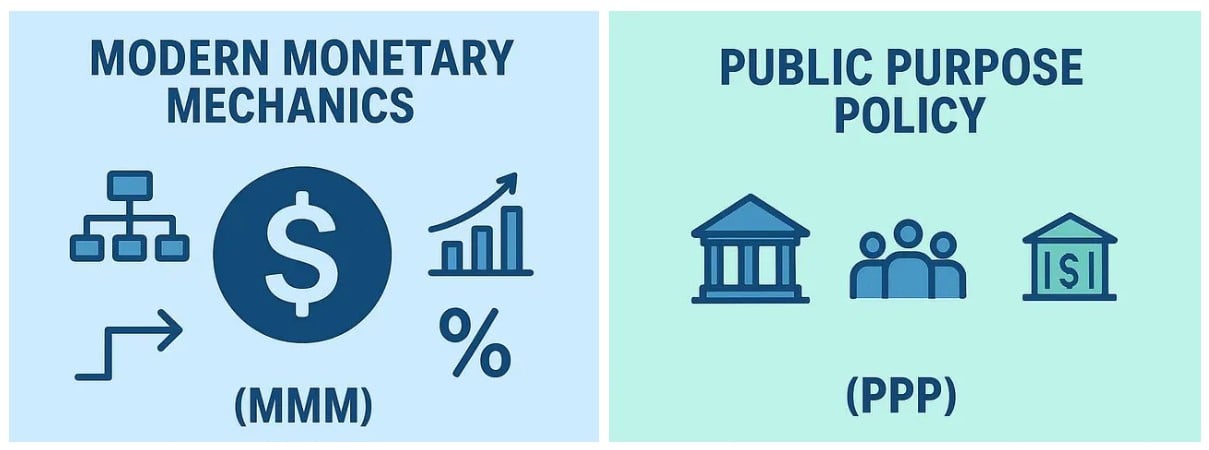
Modern Monetary Mechanics (MMM) provides the foundation; Public Purpose Policy (PPP) shapes how societies choose to use it. Image © Ivan Bassov, 2025. Licensed under CC BY 4.0.
Turning MMT into Mainstream Economics by Stripping Out the Ideology
Modern Monetary Theory (MMT) is an approach to understanding how modern governments manage money, spending, and deficits. It examines the mechanics of sovereign currency, but also proposes activist policies like full employment guarantees, which makes it both intriguing and controversial.
MMT has generated enormous attention — and enormous confusion. Much of this stems from the fact that it bundles together two fundamentally different things: a descriptive theory of how the economy actually works, and an ideological program for how governments should act.
The descriptive theory explains the real mechanics of money, deficits, and sovereign currency — concepts that traditional textbooks often misrepresent. The ideological layer, by contrast, proposes policies such as guaranteed full employment and other activist programs. These are policy choices, not necessities dictated by the mechanics.
Because proponents often blur the line between these two components, MMT has drawn criticism — sometimes justified. But if we separate them, what remains is one of the clearest, most rigorous modern frameworks for understanding how economies function.
This is where the distinction becomes crucial:
(1) Modern Monetary Mechanics (MMM) — the analytical, descriptive core.
MMM explains how sovereign money actually works, including:
- How governments create and spend currency.
- How deficits interact with economic output and employment.
- How monetary flows affect prices, interest rates, and financial markets.
- A framework suitable for rigorous academic study, neutral and evidence-based.
Example: When a government issues currency to fund infrastructure, MMM clarifies the mechanics of its effect on the economy — without prescribing that it must do so.
This is mainstream economics waiting to happen — a framework for understanding real economies without ideological bias.
(2) Public Purpose Policy (PPP) — the prescriptive, ideological layer.
PPP concerns what governments should do with the powers described by MMM:
- Full-employment guarantees and socially directed fiscal programs.
- Normative, value-driven policy decisions.
- Optional interventions, not dictated by economic mechanics.
It is precisely this component that made MMT controversial and kept it outside the mainstream.
Importantly, MMM is not a theory of the U.S. economy — it is a framework for understanding any modern monetary system with a sovereign, floating currency. Whether the issuer is the United States, the United Kingdom, Israel, Japan, Canada, Australia, or any comparable nation, the mechanics are the same. MMM describes the operational reality of modern monetary systems everywhere, independent of politics, ideology, or geography. Understanding MMM also clarifies real-world debates about government budgets, public spending, and social programs, making abstract economic concepts practical and relevant.
It’s also important to note that countries that do not issue their own currency — such as Eurozone members — fall outside the scope of MMM. While the euro provides stability, lower transaction costs, and easier trade, it also constrains monetary sovereignty: member states cannot print money, set independent interest rates, or run deficit spending freely. This trade-off underscores why true monetary sovereignty is essential for the mechanics described by MMM.
The problem today is that MMT mixes these two layers, giving the impression that describing how money works somehow entails endorsing activist policies. This conflation turns rigorous economic insight into a political debate before the mechanics are even understood.
It’s time to strip MMT of PPP. Call the descriptive theory Modern Monetary Mechanics, teach it, study it, refine it, and subject it to the full tools of academic scrutiny. Examine its predictions, test its assumptions, and integrate it into the broader corpus of macroeconomics.
PPP, by contrast, can continue to exist as a separate field of study — a discussion of public purpose and policy choices — without contaminating the scientific clarity of MMM. As the saying goes: don’t throw the baby out with the bathwater. Don’t let ideological ambitions obscure the truth of economic mechanics.
By separating MMM from PPP, we gain two things:
- A rigorous, widely teachable framework for understanding modern economies.
- A clear, honest discussion about what societies might choose to do with that understanding.
One is science; the other is policy — and they should be treated as such.
It’s important to acknowledge that while MMM and PPP are conceptually separable, in practice they are often intertwined. Understanding the mechanics of money naturally invites policy thinking: once you see that a government can issue its own currency, it’s tempting to conclude what should be done with that power. Historical MMT proponents often blur this line, which is why critics conflate the theory with ideology. For teaching, analysis, and academic study, however, MMM can and should be treated independently — separating the mechanics from the choices — even if, in real-world governance, the two influence each other.
Related Topics
Related Posts