
Modern Times
“Buck up — never say die! We’ll get along!”
Modern Times, CHARLIE CHAPLIN
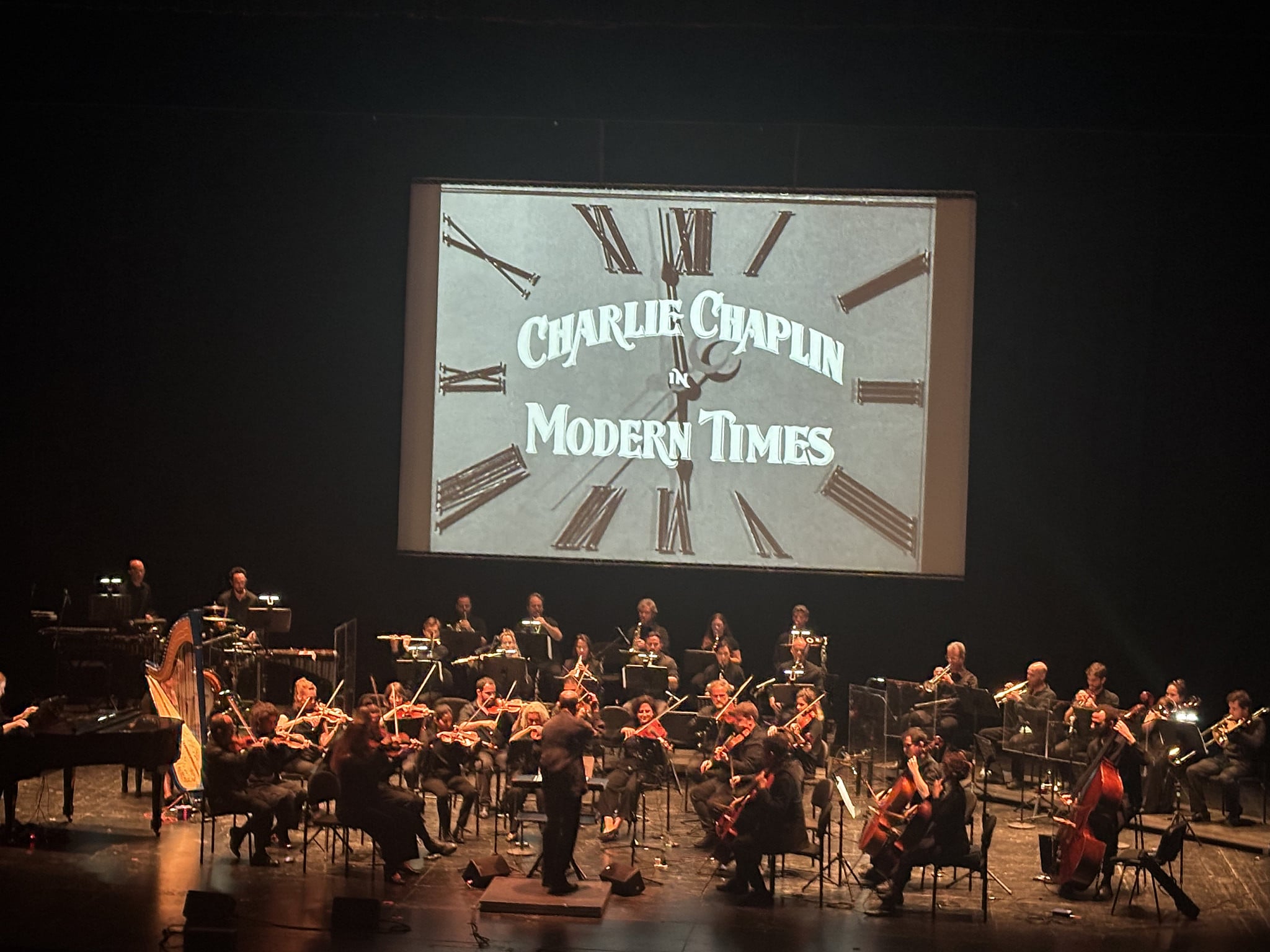
Charlie Chaplin’s Modern Times was performed at the Herzliya Performing Arts Center with a live score by the Revolution Orchestra, turning the silent film into a tightly synchronised cinematic–musical experience under conductor Roi Oppenheim. The performance was framed as more than a screening, becoming a reflection on technology, modernity, and the fragile place of human expression in rapidly changing systems. The event also invited a broader comparison between the industrial upheavals of Chaplin’s era and today’s AI-driven transformation of creativity, labor, and artistic authorship.
The Performance
Yesterday I attended a screening of Modern Times by Charlie Chaplin, with the Revolution Orchestra playing Chaplin’s original score live on stage. The film was shown on a giant screen as the orchestra played.
I was immediately drawn into a rare cinematic–musical experience that blended silent-era cinema with rich, precise live instrumentation, turning the hall into something between a concert and a time capsule.
The orchestra was remarkably precise throughout, matching every gesture, cut, and emotional shift on screen with astonishing sensitivity and timing. Under the guidance of conductor Roi Oppenheim, the audience received a thoughtful and engaging introduction that presented the film not merely as a historical artefact, but as a living reflection on technology, humanity, and the nature of “modern life” in its own era. This context deepened the experience, allowing every musical cue and visual gag to land with greater emotional weight.
One of the most memorable moments came at the end with an encore of Chaplin’s iconic melody “Smile,” transforming the finale into a shared moment of warmth and reflection. It felt like a rare and precious performance, carefully crafted, deeply felt, and quietly powerful, where cinema and music merged into something larger than the sum of their parts.
The Modern Times
By 1936, Charlie Chaplin, the master of early mute cinema, faced two parallel technological cliffs. One, on the edge of silence, as he watched the world around him begin to speak. A technological revolution took over movies. The rise of talkies or film with sound turned his poetic, quiet movies into an endangered language, as if laughter itself now required a voice. The other cliff he faced was on the edge of another technological revolution swiping the world as President Franklin D. Roosevelt advanced the New Deal, using modern industry and technology to rebuild a shattered economy and restore public confidence. Across Europe, figures like Adolf Hitler and Benito Mussolini harnessed the same technological momentum for control and propaganda, fuelling the rise of fascism. The workers’ movement was being reshaped as organised labor. Through trade unionism, they sought to channel industrial unrest into structured power within rapidly modernising societies. Caught between two roaring ages, Chaplin stood on a narrowing ledge, where the voice of machines began to drown the fragile poetry of silence and the human soul struggled to be heard.
How Is This Movie Relevant for the AI Age
I was struck by how beautifully organised and powerful the performance was, yet I left with a sense of sadness that something so relevant to our moment, so sharp in what it says about technology and humanity, was mostly experienced by an older audience. In a country like the Startup Nation, where young people are deeply embedded in building the next wave of technological change, it felt like a missed opportunity that so few of them were there to engage with Chaplin’s warning. There was something ironic in that absence, as if cinema itself, like silent film in the 1930s, has become an older medium that young people no longer naturally turn to, even when it speaks so directly to the world they are shaping.
The shock Chaplin felt in 1936 mirrors the unease of today’s AI age, but now things have gotten a lot worse. In the 1930s, machines were used as tools of efficiency that both oppressed and empowered workers. 90 years later, technology reshapes not just tools but the language of creation itself, turning what was once uniquely human into something scalable and reproducible. Machines ceased to be tools and became agents of efficiency that compete with and replace humans themselves.
Just as sound demanded that silent artists either adapt or vanish, artificial intelligence now challenges writers, artists, and thinkers to redefine their voice in a world where machines can imitate, replace, and destroy them.
Charlie Chaplin adapted by turning constraint into invention, blending silence with sound in Modern Times and later embracing full speech in The Great Dictator, proving that form could evolve without losing its human core.
The tragedy today is not just that change is forced upon us, but that it has become an agent of human replacement, a nefarious, destructive force one million times worse than in the 1930s that erodes human judgment and creativity.
We ignored Chaplin’s warning: that when machines set the rhythm and humans simply follow, progress risks emptying itself of meaning.