

Mom and Dad, you don’t owe me an apology
Dear Mom and Dad,
I read “An apology from your American Jewish parents,” and it felt like it was written directly to me.
I was the child you raised.
I went to Yeshivish yeshivas. I wore a black hat. You pushed me to take school seriously and to get good grades because you believed excellence mattered. At the same time, you taught me Torah, Yiras Shamayim, and commitment to Jewish life.
I followed the path you set me on. I learned in yeshiva. I went to college while continuing to learn Torah. I went to medical school. I completed residency. I got married and built a family.
In many ways, I achieved exactly what the American Orthodox dream promised.
But then my wife and I realized something: all the tools you gave us — education, discipline, ambition, resilience — did not need to culminate in America.
They could be brought to Israel.
Not only to build a life for ourselves, but to help continue building the incredible country that generations before us dreamed of, davened for, and sacrificed to make possible. And also, it’s simple: Our sages speak extensively about the importance of living in Eretz Yisrael.
Over time, moving to Israel stopped feeling like one good option among many. For us, it simply felt like the right thing to do.
So we moved.
And what I want to tell you is this: moving to Israel did not require abandoning the values you raised us with. If anything, it allowed us to live them more fully.
We are thriving here, Baruch Hashem.
Part of that is something hard to explain until you experience it.
Yes, there is incredible meaning in knowing that a short drive can bring us to the Kotel, the Tomb of the Patriarchs, Rachel’s Tomb, and countless other places our grandparents deeply yearned for and could only dream of seeing.
But the holiness and greatness of living in Israel is not only in the famous holy places.
It is in the ordinary moments.
It is the taxi driver wishing you “Shabbat Shalom” on Friday afternoon.
It is Jewish music playing as Shabbos approaches.
It is the mezuzah on nearly every doorpost.
It is walking into the hospital for a shift during Passover and seeing signs reminding visitors not to bring chametz into the ER.
It is picking up a milk carton and seeing it wish you a Happy Purim, and then a few months later finding cheesecake recipes printed on it for Shavuos.
It is the realization that Jewish life here is not confined to the walls of a shul or a home.
It is in the air.
In America, even in the strongest Orthodox communities, we built beautiful islands of Torah within a broader non-Jewish culture. Here, the rhythm of society itself is shaped by Jewish time, Jewish memory, and Jewish destiny.
It changes you.
And over the past 30 months of war, death, and destruction, that feeling has become even stronger.
We cry together. We mourn together. And we rejoice together when hostages come home.
There is something powerful about not needing to hide what you feel or put on a brave face for the world around you. Everyone around you feels the pain, the fear, the pride, and the hope too.
We are living the Jewish story together, with all of its ups and downs.
It is cooking Shabbos food for soldiers protecting us.
It is visiting wounded people we had never met before.
It is making shiva calls to complete strangers.
None of this means life here is easy. Israel can be exhausting, chaotic, expensive, and at times deeply frustrating. Aliyah comes with real challenges.
But even with all of that, we have never felt more certain that we are where we are meant to be.
We are one people, no matter how different we may look on the outside. That feeling is palpable here.
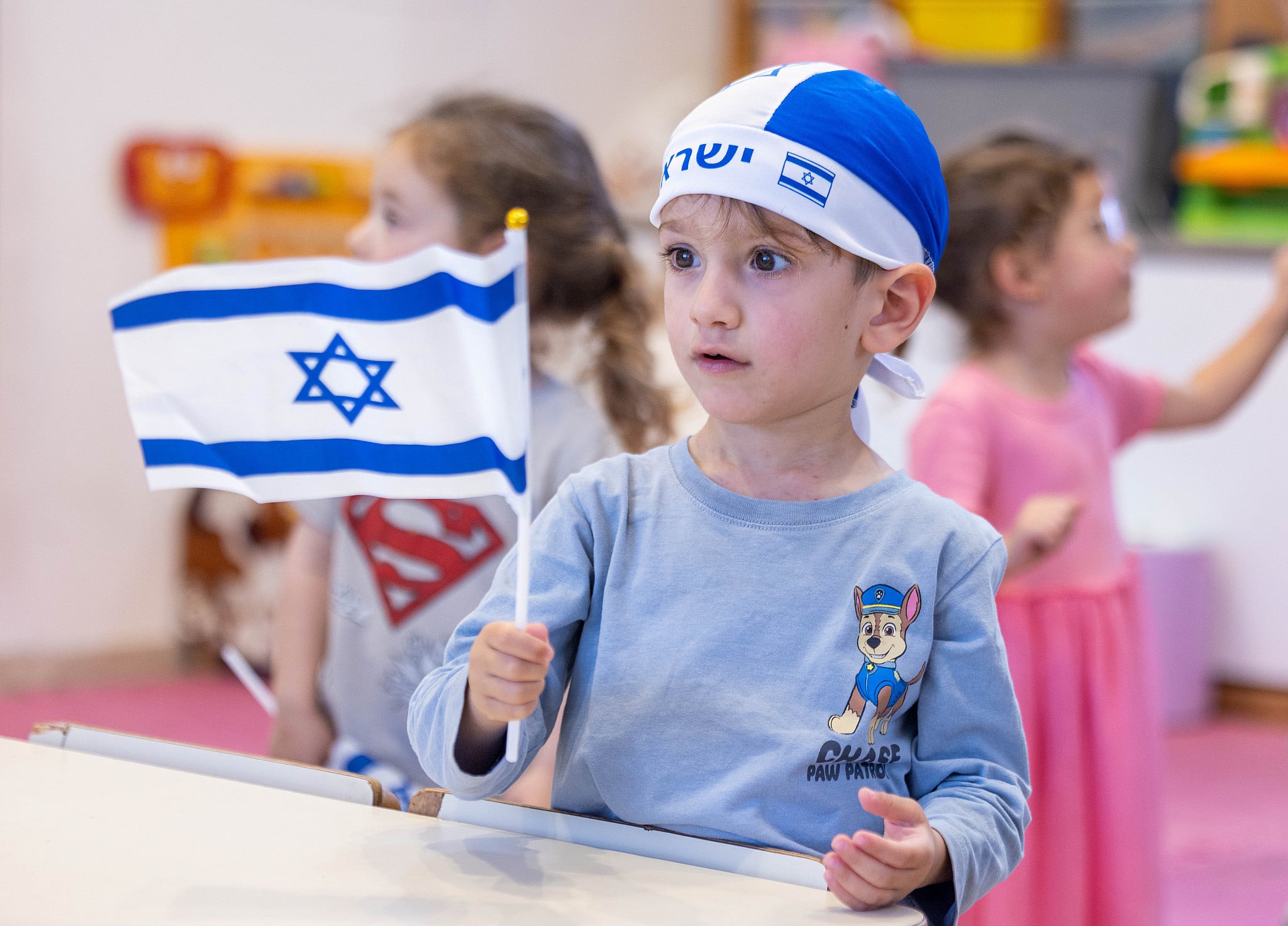
We are raising five beautiful children in Israel. Four were born in America, but our youngest— our first sabra — was born here. Her name, Rachel Esther, honors her grandmothers while also connecting her to generations of Jewish history. Rachel Imeinu rests only minutes from our home. There is something deeply moving about raising a daughter whose very name connects the generations before her to the land beneath her feet.
And in many ways, our move to Israel did not begin with us.
My paternal grandfather was born here, and both sets of grandparents eventually returned to Israel after decades in America.
My grandmother once wrote me a letter when I was away at sleepaway camp in upstate New York. She told me she hoped I would move to Israel one day before she died.
She died just a couple years before we moved. I never got to fulfill that dream while she was alive. But I know she is watching.
In a sense, I did not create a new dream.
I simply fulfilled an old one — much earlier.
I was blessed to build in Israel during the prime of my life, not only at its end.
But I also recognize that not everyone has that history.
Not everyone grew up with grandparents who lived in Israel or with family stories rooted here.
And maybe that is exactly the point.
A deep connection to Eretz Yisrael does not have to be inherited to be real. It can be built.
Sometimes roots are passed down.
And sometimes we are the ones who plant them.
We live a deeply religious life. Our children attend a school built on “American Haredi” principles and are growing up with strong Torah values. At the same time, they are receiving a serious education in math, science, language, and the skills needed to function in the modern world — something many East Coasters such as myself once thought was impossible in Israel.
Our oldest is entering high school, and what excites me most is not only what he will learn, but who he can become.
He will have options and can be the multi-layered Jew that I was raised to be.
If he chooses full-time learning Torah, that is beautiful and holy.
If he chooses to join the army, that is honorable and courageous.
If he chooses medicine, engineering, business, or another path entirely, he can do that too.
He can be all of these things — or some of them.
That is what you gave me in America: not a predetermined destiny, but the tools to build one.
And now we have transplanted those same tools to Israel.
I work full-time as a physician in the emergency room, caring for some of the sickest patients in the country. Every day I care for people from every walk of Israeli life — Jewish and Arab, religious and secular, soldiers, mothers, children, and Holocaust survivors.
That is part of the beauty of building a life here: serving all who need help no matter who they are.
And yet, on the hardest days, when I walk through the ER and hear Hebrew around me, I feel something hard to describe.
I feel part of something bigger than myself.
Our move did not affect only us. My brother has since moved here as well with his wife and children, also deciding that building a life in Israel was right for his family. My wife’s brother moved here before us as a lone soldier, and during more than 300 days on the front lines in Gaza, living in Israel allowed us to stand by him in a way that would have been impossible from afar.
Not all of our siblings have made that same choice, and that is okay.
Every person and every family has their own journey, their own circumstances, and their own unique purpose.
This simply was our path.
This is not just about geography.
It is about purpose.
You raised us to strive, to contribute, and to matter. Israel has not diminished those values—it has amplified them.
So if there is an apology to be made, I don’t think it is for giving us the tools to succeed in America.
No, Mom and Dad — you do not owe me an apology.
I think the truth is simpler.
Thank you for giving us those tools.
Because those very tools are what allowed us to build meaningful, ambitious, deeply religious lives here in Israel.
You did not prepare us for the wrong world.
You prepared us to build wherever we were needed most.
And for our family, that place is here. In Israel.