CFO | Empower Society for Good I Author
Moral Courage Is Civilization’s Only Hope
The Divine Reset — From Division to Responsibility
The story of the Divine Reset continues in this week’s parsha, and what a powerful reading it is.
Last week, we saw Abraham commanded to leave his land — to begin again — and to enter into a new covenant with God. That journey was one of faith, identity, and transformation. This week, in Vayeira, the reset deepens, but not in a straight line. It is a journey of hospitality, judgment, mercy, and human tension — themes that still echo in our world today.
Abraham’s Tent: The Beginning of Civilization
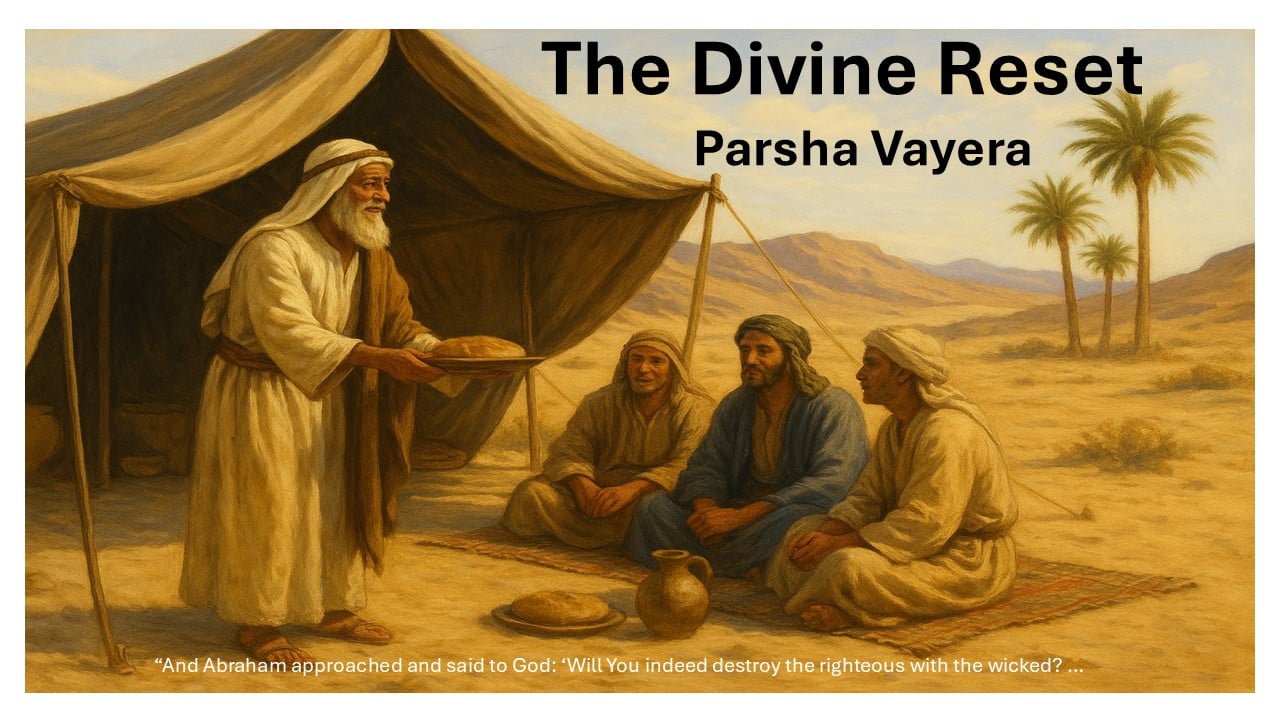
Abraham’s tent opens on all sides — a home without borders, a symbol of moral civilization. When three visitors appear, he runs to greet them. This spontaneous act of kindness — offering food, water, and rest — becomes a divine encounter. From this moment comes the promise of Isaac, the child of laughter and renewal.
Civilization begins not with laws or empires, but with decency and welcome. Abraham’s tent is the antidote to arrogance and isolation — a model of what society looks like when faith governs conduct.
I want to share an example of this spirit today.
That same spirit lives in initiatives like Sharaka, born from the Abraham Accords. Sharaka (“partnership” in Arabic) connects Jews and Arabs, Muslims and Israelis, through dialogue, education, and cooperation. It turns political treaties into human relationships. In an age of polarization and suspicion, Sharaka embodies Abraham’s open tent — faith expressed through hospitality and respect.
Link : https://www.sharakango.com/
Sharaka (’Partnership’ in Arabic) is working to shape a new Middle East, built on dialogue, understanding, cooperation and friendship.
Sodom: When Civilization Collapses
From the warmth of Abraham’s tent, we descend into Sodom — a culture that made cruelty normal and kindness dangerous. Sodom’s sin was not only sexual immorality, as often portrayed, but a deeper moral decay: the rejection of compassion itself.
Abraham’s reaction is striking. He does not celebrate Sodom’s downfall. He stands before God and argues:
“Will You destroy the righteous with the wicked?”
That is the question of civilization itself — the courage to care even for the underserving. Abraham’s moral clarity stands in contrast to the apathy of his age. Justice without mercy becomes tyranny; mercy without justice becomes moral blindness. True righteousness lies in holding both.
Hagar and Ishmael: The Pain of Division
Then the story turns inward — to the fracture within Abraham’s own home. Sarah fears Ishmael’s problematic conduct and to ensure Isaac’s proper development, Sarah demands that Hagar and Ishmael be sent away. Abraham is distressed, but God tells him to listen to Sarah. It is one of Torah’s hardest moments — a scene of heartbreak and purpose.
Hagar cries out in the wilderness, and God hears. A well of water appears. Ishmael, too, receives blessing. A blessing to make him a great Nation. Separation becomes survival — yet the pain of that division still reverberates through history and especially poignant today.
This is the Divine Reset in its rawest form: even painful separations can carry divine purpose. Both sons are seen. Both are loved. But their paths must diverge until moral clarity brings them back together.
Moral Clarity in a Confused World
Recently, while listening to the Unholy podcast — Two Jews on the News — I heard a remarkable interview with Samer Sinijlawi, a Palestinian activist whose voice stands apart from the chorus of rage and denial.
He said plainly:
“We did terrible things to the Jews, and the Jews did terrible things to us.”
And then, even more powerfully:
“I make no distinction between the life of the child in Kfar Aza and the child in Gaza a kilometre away.”
In an age of excuses and moral fog, these words cut like light through darkness. Sinijlawi rejects victimhood and insists on self-examination — that peace cannot come until Palestinians confront what has gone wrong within their own house. His message is not political correctness — it is moral courage.
He understands what many in the West have forgotten: peace built on self-deception is doomed. Only truth — painful, humbling truth — can rebuild trust.
This is a refreshing voice, and if only more Palestinians followed this path. I am sharing his words from the podcast
Link to podcast: https://open.spotify.com/episode/4b1lc3LGDMuoS25P7V1JpX
Samer Sinijlawi’s Vision: The Four Ds for Gaza’s Future — Demilitarization, Democratization, Deradicalisation, and Development
Samer Sinijlawi, one of the few Palestinian voices speaking with moral clarity and pragmatic hope, proposes that Gaza’s recovery cannot rest on one slogan — “demilitarization” — alone. He insists that genuine peace and reconstruction require four intertwined pillars, each beginning with the letter D:
- Demilitarization
Gaza must be free from armed militias and the rule of weapons. Sinijlawi stresses that this cannot be achieved through force, as Israel’s military operations have shown. Instead, disarmament must come through Palestinian democracy and elections, allowing Palestinians themselves to reject Hamas at the ballot box and enforce “one law, one gun.” True statehood, he says, is built “by practice, determination, and hard decisions,” not by external recognition.
- Deradicalization
Beyond removing weapons, minds must be freed from hatred. Sinijlawi calls for a re-education of thought and spirit, starting with acknowledging the historical Jewish connection to the land — something, he notes, the Qur’an itself affirms. Changing narratives, reforming education, and recognizing shared belonging are essential to healing and preventing future extremism. “If you do deradicalization in one place but not across the borders,” he warns, “it’s dangerous — like a pandemic.”
- Democratization
He argues that Palestinians need immediate elections to renew legitimacy and restore faith in leadership. Only through free choice can the people “defeat Hamas in the election box” and rebuild trust with Israelis. Sinijlawi envisions a new generation of Palestinian leaders — pragmatic, courageous, and morally grounded — who can lead through institutions rather than personal power.
- Development
Finally, Gaza must be rebuilt materially and socially — homes, water, power, schools, and jobs. For Sinijlawi, infrastructure and dignity go hand in hand: “The people who stayed during the war in Gaza… are the only ones capable to plan their future.” Development is not only economic recovery; it’s moral restoration — proving that life, not revenge, is the path forward.
“If we miss one pillar,” Sinijlawi says, “whatever we are building in Gaza will not be sustainable.”
His Four Ds — Demilitarisation, Deradicalisation, Democratisation, Development — form a moral and practical roadmap: a vision of Palestinian renewal from within, grounded in truth, education, and shared humanity.
There is another D letter that Samer did not include – Denialism, but he said it clearly.
The Way Forward – lessons from the Bible and the Quran
Quoting Samer.
‘We need to change, for example, the narrative. I don’t know why until now we are not recognizing the historical links of Jews in this land. If you open the Qur’an, the biggest chapter — the longest chapter in the Qur’an, Surat al-Baqarah — is only speaking in detail about the history of Jews in this land. It’s there in our holy books.
So continually denying the rights and links of Jews in this land will keep Palestinians confused — whether the Jews belong or don’t belong, whether it is an issue of might or of right. It’s not an issue of might. Even if Israel will be one day weak, they still have the full right to exist in this country, because we need to accept and recognise that fact.”
Today, Palestinianism denies our history and rights to this Land.
And let’s revisit the Parsha – another look at the Four D’s
Demilitarization
Abraham’s greatness begins with self-restraint. Before pleading for Sodom, he disarms his ego. Real change must start the same way — not with the empty language of ceasefires, but with the rejection of terror and violence as identity. The tragedy of Gaza is that terror and weapons have become a badge of honour. Until life becomes more sacred than death, peace is impossible.
Democracy
This is not a call against democracy, but against mob rule and corruption masquerading as it. Palestinian leadership has been built on intimidation, fear, and grievance. Palestinian leadership has for too long manipulated rage for political gain. Abraham stood alone against his generation’s corruption. Real leaders stand for truth, even when their people are not ready to hear it.
Deradicalisation
The story of Hagar and Ishmael warns of what happens when resentment becomes religion. Ishmael is not rejected — he is blessed. But violence cannot be the path of blessing. A culture that glorifies martyrdom and educates and raises children for death instead of life. . Redemption begins when people choose responsibility over revenge.
Development
In Parasha Toldot, Issac builds Wells which the Philistines stop up. Here we have the theme of Builders or Destroyers. See my blog on Parsha Lech Lecha.
The Palestinians have a clear choice: They can build more Tunnels for War or decide to build for Prosperity and Peace.
In all the D’s, including Denialism, there are both inward and outward lessons here for us Israelis to reflect on.
Acknowledgement Before Peace
If there is to be a Divine Reset in our time, it begins with truth — Palestinians must acknowledge Jewish history and Jewish rights to the land. The Jewish people are not colonizers here; we are the indigenous people of this land, with unbroken presence and covenant.
Refusing to recognize that truth, or chanting “from the river to the sea,” is not liberation — it is a call for erasure. The dream of throwing Jews into the sea must die before any hope of peace can live.
Israel is not perfect, but it is not the obstacle to peace. The obstacle lies in the refusal of Palestinian leadership to reject hate, corruption, and denial. A society that rewards killers and teaches children that Jews are subhuman cannot build peace — only ruin.
The call to throw Jews into the sea must end.
It is moral suicide disguised as politics.
No peace can take root in soil watered by hatred.
Acknowledgement is not surrender; it is the foundation of reconciliation.
Moral courage begins when people stop pretending that destruction is destiny. Acknowledgement is not betrayal. It is the first step toward dignity.
The Divine Reset — From Rivalry to Responsibility
The Abraham Accords marked a rare moment of sanity — descendants of Isaac and Ishmael reaching out not to bury their father, but to revive his dream.
That is what I call the Divine Reset: a shift from rivalry to responsibility, from victimhood to vision. Faith is not sentimentality. It is action — the willingness to build when others destroy.
That is the Divine Reset: a return to responsibility over rage, relationship over rivalry.
It calls us to open our tents, act with compassion, and face our divisions not with denial, but with maturity and faith.
Moral Courage Is Civilization’s Only Hope
Abraham’s final test, the Akeidah, was faith beyond reason. Our test is moral courage beyond comfort.
To stand for truth when the mob shouts lies.
To defend justice when the world rewards aggression.
To believe in holiness even when others glorify hate.
That is the courage civilization now demands — the courage of Abraham.
To build, not burn.
To welcome, not fear.
To bless, not curse.
And in doing so, to begin the Divine Reset again — not through speeches or summits, but through truth, courage, and faith.
In Parashat Vayeira, Abraham’s courage defines civilization’s moral core. From Sodom to Gaza, from Isaac to Ishmael, the test remains the same: will humanity choose truth over denial, and moral responsibility over rage? Inspired by a Palestinian voice of conscience, Samer Sinijlawi, this reflection calls for a Divine Reset — grounded in faith, courage, and truth.
Related Topics
Related Posts