
CEO of Time to Stand Up for Israel
Moral Cowards Boycott Israel
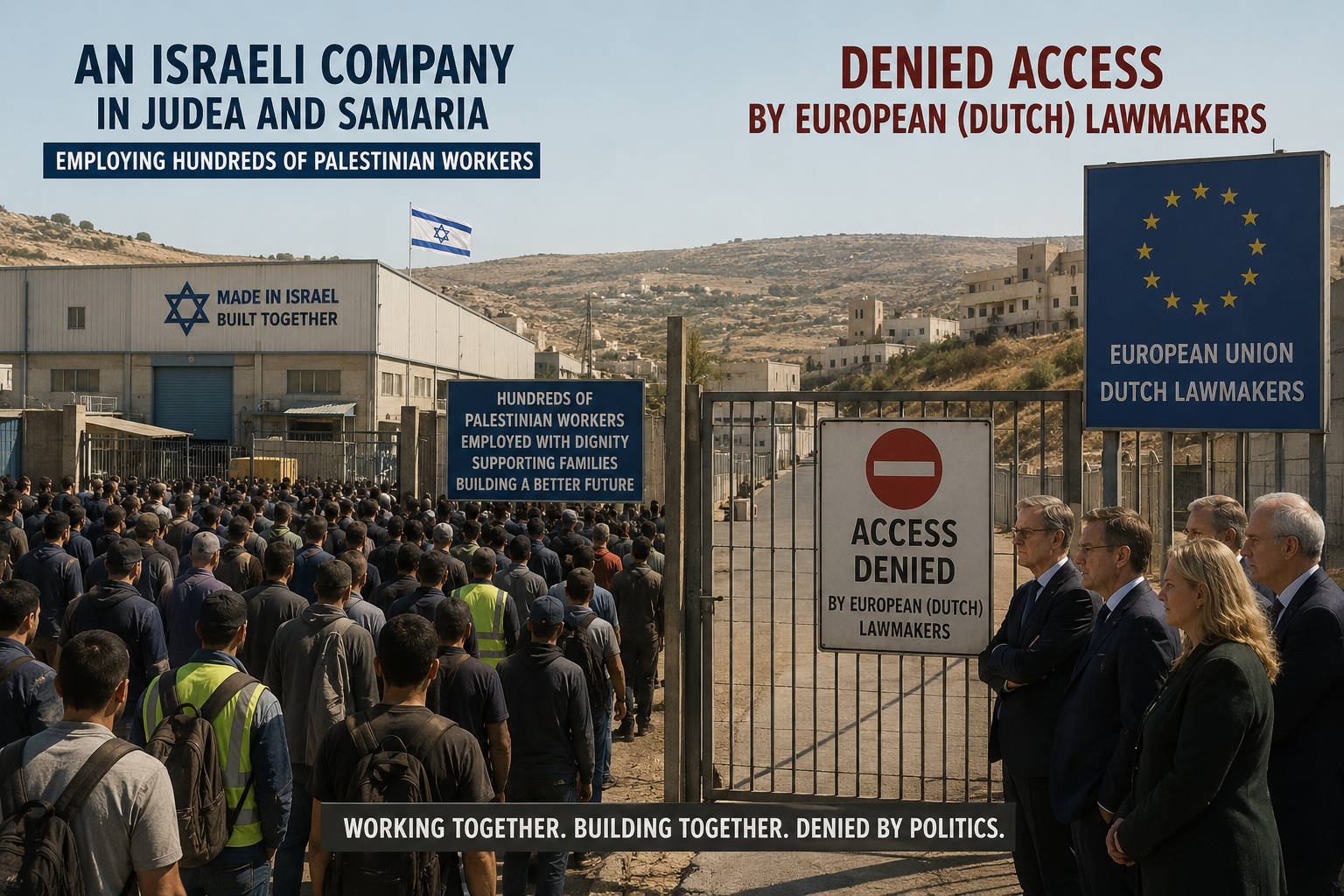
Photo Credits: Sabine Sterk
Boycotts Without a Moral Compass
There is a growing movement across Europe to boycott products from Israel, particularly those produced in Judea and Samaria and the Golan Heights. Supporters present these campaigns as acts of justice and human rights. In my opinion, they represent something entirely different. They expose a profound moral bankruptcy and a willingness to sacrifice the very people they claim to defend in pursuit of political symbolism.
I write this from the perspective of someone living in the Netherlands, a country that increasingly appears to have lost its moral compass. Our politicians seem more interested in making statements about conflicts thousands of kilometers away than solving the very real problems facing Dutch citizens. Housing shortages continue to worsen. Young people struggle to find affordable homes. Healthcare remains under enormous pressure. Crime and social tensions are growing. Yet instead of focusing on the people who elected them, many politicians devote their energy to symbolic measures against one of the Netherlands’ closest democratic allies.
The latest example is the proposal to ban or boycott products originating from Judea and Samaria and the Golan Heights. The proposal may sound compassionate to those unfamiliar with the facts, but the reality is far less noble.
Who actually works in many of these factories?
The uncomfortable truth is that thousands of Arab workers, many of whom identify as Palestinians, are employed by Israeli businesses located in these industrial zones. They often receive wages that are significantly higher than those available under the Palestinian Authority, together with better working conditions, healthcare benefits, and labor protections under Israeli law.
When politicians boycott these businesses, they are not hurting wealthy Israeli executives. They are threatening the livelihoods of Palestinian families.
History has already demonstrated this.
One of the clearest examples is SodaStream.
For years, SodaStream operated a factory in Mishor Adumim in the West Bank, employing around 500 Palestinian workers alongside Israeli employees. The factory became one of the primary targets of the Boycott, Divestment, and Sanctions movement. Under sustained international political pressure, SodaStream relocated its production facility to southern Israel in 2015.
The result was exactly the opposite of what boycott activists claimed they wanted.
Approximately 500 Palestinian workers immediately lost their jobs because many could no longer obtain permits to work inside Israel. Their salaries had averaged around fifteen hundred dollars per month under Israeli wage standards. After losing these jobs, many reported earning only a fraction of their previous income through temporary work or street vending. According to estimates cited by advocacy organizations, those salaries had supported nearly five thousand family members.
The boycott did not punish Israel.
It punished Palestinians.
Those facts are rarely mentioned by those promoting economic boycotts.
This raises an uncomfortable question. If politicians truly care about improving the lives of Palestinians, why do they support measures that destroy Palestinian employment?
The answer, in my opinion, is that many of these campaigns are driven more by political virtue signaling than by genuine concern for ordinary people.
The contradictions become even more striking when considering Dutch immigration policy.
Many of the same politicians who advocate boycotts against Israel also argue for accepting additional Palestinian refugees. They claim to care deeply about Palestinian welfare while simultaneously supporting policies that eliminate Palestinian jobs.
If employment disappears because businesses close or relocate, people become more dependent on aid, welfare, or migration opportunities. That hardly seems like a sustainable humanitarian strategy.
Another aspect that deserves attention is the continued existence of the Palestinian Authority’s controversial prisoner payment program. Critics often refer to it as the “Pay for Slay” policy because payments are made to imprisoned militants and to the families of those killed while carrying out attacks against Israelis. The Palestinian Authority argues that these payments provide social support to affected families. Critics argue that the system creates financial incentives that glorify or reward terrorism. Whatever one’s position, it remains a serious obstacle to peace and has been widely criticized by governments around the world.
Reducing legitimate employment opportunities while leaving such financial structures intact risks creating greater desperation rather than greater stability.
None of this suggests that every Israeli policy deserves support or that legitimate criticism of Israeli governments should be silenced. Democracies should always be open to criticism.
However, criticism should be intelligent, fact based, and morally consistent.
Blanket economic boycotts that cost Palestinian workers their jobs while accomplishing little politically fail that standard.
There is also a broader principle involved.
Israel is a democratic nation governed by the rule of law. It is an ally of the Netherlands and shares many of the democratic values that Europe claims to defend. Reasonable people may disagree about borders, settlements, or future peace negotiations, but those issues should ultimately be resolved through direct negotiations between the parties involved, not through symbolic economic punishment imposed by foreign governments.
Dutch politicians were elected to serve the Dutch people. Their first responsibility is to improve housing, healthcare, education, security, and economic opportunities at home. Instead, too many appear eager to interfere in the internal affairs of another democracy while neglecting their own country.
That is not principled leadership.
It is political opportunism.
The SodaStream case should serve as a lasting warning. When politicians ignore economic reality in favor of ideological slogans, ordinary people pay the price. In this case, many of those people were Palestinians.
Perhaps it is time for policymakers to remember an old saying.
Cobbler, stick to your last.
Govern your own country first before trying to reshape someone else’s.
Related Topics
Related Posts