
CFO | Empower Society for Good I Author
Morality with Power
A few weeks ago, my wife and I went on a pilgrimage to the Negev. The journey took us through Beer Sheva and onward to Sde Boker, the home and burial place of David Ben-Gurion.
I use the word pilgrimage deliberately. This was not tourism. A pilgrimage is a journey undertaken to confront meaning, responsibility, and purpose.
What struck me was how closely this route mirrored one of the most consequential journeys in the Torah.
When Jacob leaves the Land of Israel on his way down to Egypt, the Torah tells us that he stops in Beer Sheva. This is not incidental. Beer Sheva is the southern boundary of the land of covenant — the place of wells, oaths, and rootedness. And it is there that Jacob offers sacrifices before continuing south.
Jacob senses that he is crossing more than a geographic border. He is moving from promise into empire, from covenantal life into a world defined by power. Egypt represents abundance and security — but also moral danger. Jacob pauses. He sacrifices. He seeks reassurance.
Beer Sheva is a moral threshold.
Standing there today, that moment feels remarkably contemporary.
Ben-Gurion and the Moral Weight of Jewish Power
At Sde Boker, one confronts a parallel threshold in modern Jewish history.
In 1953, at the height of his authority as Israel’s first prime minister, David Ben-Gurion resigned and chose to live in the Negev. He believed the desert was Israel’s future — a vast region requiring discipline, sacrifice, and long-term vision. He believed technology could make the desert bloom, a belief increasingly borne out by Israeli innovation in water, agriculture, and climate resilience.
But Ben-Gurion was not only a strategist. He was deeply immersed in Tanach and Jewish history. He understood something unsettling: Jewish power, once restored, would not be morally neutral.
For nearly two thousand years, Jews lived with morality but without sovereignty. Ethics were refined in exile. Now power had returned — political, military, technological.
And with it came an ancient question the Torah never stopped asking:
What does morality look like when Jews hold power?
Va’era: When Power Hardens
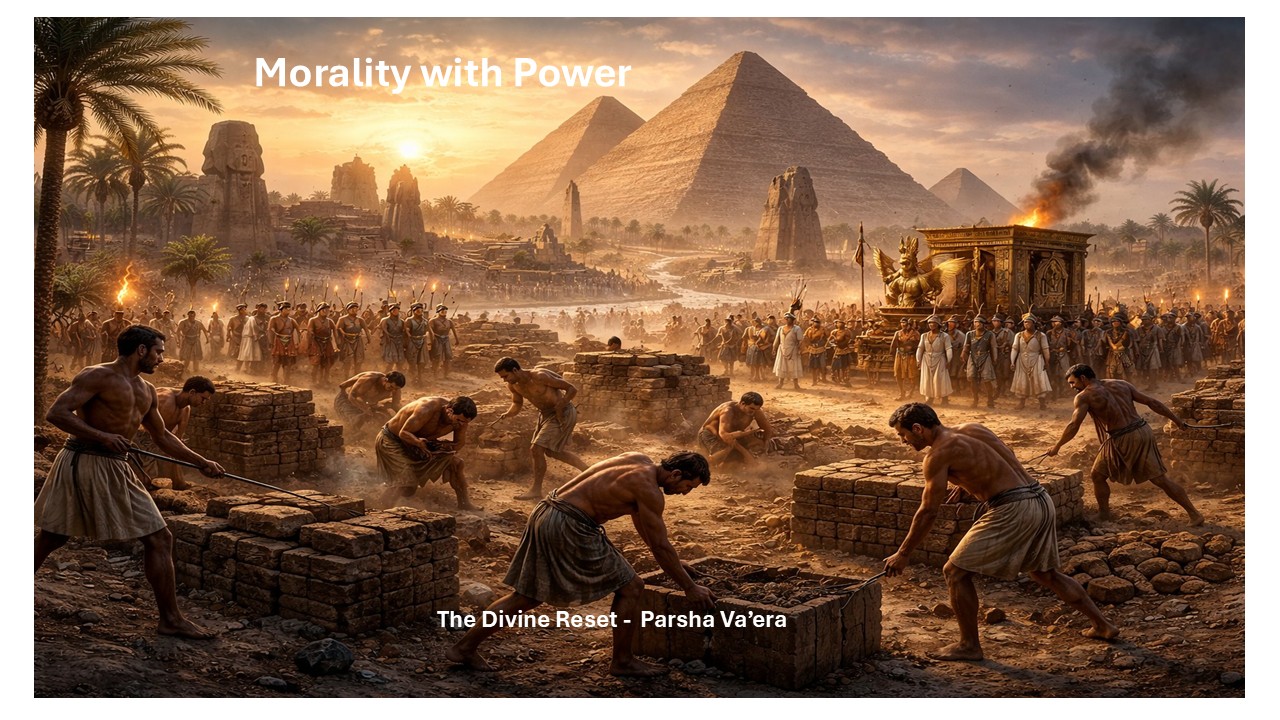
Parashat Va’era presents the archetype of power without morality.
Pharaoh is not driven by economics. Egypt is already prosperous. His resistance is ideological.
“Who is the Lord that I should heed His voice?” (Exodus 5:2)
This is not disbelief in God’s existence. It is rejection of moral authority over sovereign power.
The Torah tells us that God “hardens Pharaoh’s heart,” but the narrative makes clear that Pharaoh repeatedly hardens his own heart first. Power exercised without restraint entrenches itself. It becomes impervious to evidence, suffering, and consequence.
The plagues are not arbitrary punishments. Each dismantles a component of Egyptian control — water, food supply, public health, labour, time. Nature itself refuses to serve immoral power.
But the plagues are not the goal.
Liberation is.
Morality Without Power, Power Without Morality
History shows us the failure of both extremes.
Amotz Asa-El recently illustrated this using concrete historical examples. He pointed to Jimmy Carter’s response to the 1979 Iran hostage crisis. The seizure of the US embassy was an act of war. Carter possessed overwhelming military superiority but chose restraint. The result was not moral elevation but strategic defeat: the Shah fell, the Islamic Republic consolidated power, and Iran emerged as a repressive theocracy and a destabilising regional actor.
Asa-El also cited Barack Obama’s conduct toward Iran and Syria. In Syria, Obama declared a “red line” against chemical weapons. When Assad crossed it in Ghouta in 2012, killing roughly 1,400 civilians, the US did not act. Assad remained in power. Russia filled the vacuum.
Asa-El’s point was precise: morality without the willingness to exercise power can embolden brutality rather than restrain it.
Hamas in Gaza: Power Without Morality, in Practice
The opposite failure — power without morality — is visible in Gaza under Hamas.
Hamas governs Gaza. It controls taxation, policing, border policy, education, and security. Since taking power in 2007, it has received billions of dollars in aid and external funding, including from Iran and international donors.
Yet Gaza’s civilian infrastructure has consistently deteriorated.
This is not accidental.
Independent reporting and Israeli intelligence have documented:
- Extensive tunnel networks built beneath civilian neighbourhoods
- Rockets and command centres embedded in residential areas
- Aid materials diverted from civilian use to military construction
- Aid money misappropriated to the pockets of its leaders
Hamas has repeatedly initiated conflicts it could not win militarily, fully aware that civilian casualties would follow. Those casualties are then used diplomatically, financially, and rhetorically.
This is not resistance in the classical sense. It is power preserved through perpetual conflict, financed by external money and sustained by civilian suffering.
Like Pharaoh, Hamas does not primarily seek prosperity for its people. It seeks control. Power without morality always does.
The World’s Obsession with Jewish Power
There is, however, an additional and uncomfortable dimension to this discussion: the world’s fixation on Jewish and Israeli power. No other nation exercising force under existential threat is scrutinised, moralised, and condemned with such intensity. This cannot be explained by scale, casualties, or duration alone.
Rather, it reflects a deeper tension. Consciously or not, the world senses that Jewish tradition does not treat power as morally neutral. A people formed by covenant, law, and divine accountability are expected to wield power differently — and when they do not conform to external expectations, disappointment curdles into accusation.
Too often, this expectation is applied selectively, detached from context, and weaponised into hostility. Yet its existence is telling. Jewish power unsettles because it reintroduces an ancient biblical demand into modern politics: that sovereignty answer not only to interests, but to conscience. Hatred distorts that demand. Hypocrisy exploits it. But the demand itself remains real.
The Divine Reset: Morality With Power
The Torah rejects both failures:
- morality without power
- power without morality
It insists on the harder path: morality with power.
This is where the reset becomes divine.
As Rabbi Jonathan Sacks taught repeatedly, the Hebrew Bible’s great revolution is covenant — the belief that power must be morally constrained because it ultimately answers to God. God does not remove power. He disciplines it.
Empire imposes order through dominance.
Covenant creates order through responsibility.
God liberates Israel not to replace one empire with another, but to bind power to dignity, restraint, and accountability.
That is why the reset is divine: it is God-inspired moral consciousness entering history.
A good society, Rabbi Sacks argued, is built not on power alone, nor on moral sentiment alone, but on responsibility — on the belief that power must answer to something higher than itself.
From Beer Sheva Forward
Jacob paused at Beer Sheva before entering Egypt.
Ben-Gurion chose the Negev to reflect on Jewish sovereignty.
Parashat Va’era reminds us what happens when power forgets morality — and what becomes possible when it remembers.
The divine reset is not destruction.
It is transformation.
When morality with power becomes real, a good society becomes possible.
That is not ancient theology.
It is a contemporary necessity.
And it is the enduring challenge of Parashat Va’era — then and now.
Related Topics
Related Posts