
Russian-American-Israeli Palestinian. Palestine is Israel.
The Words We Surrender
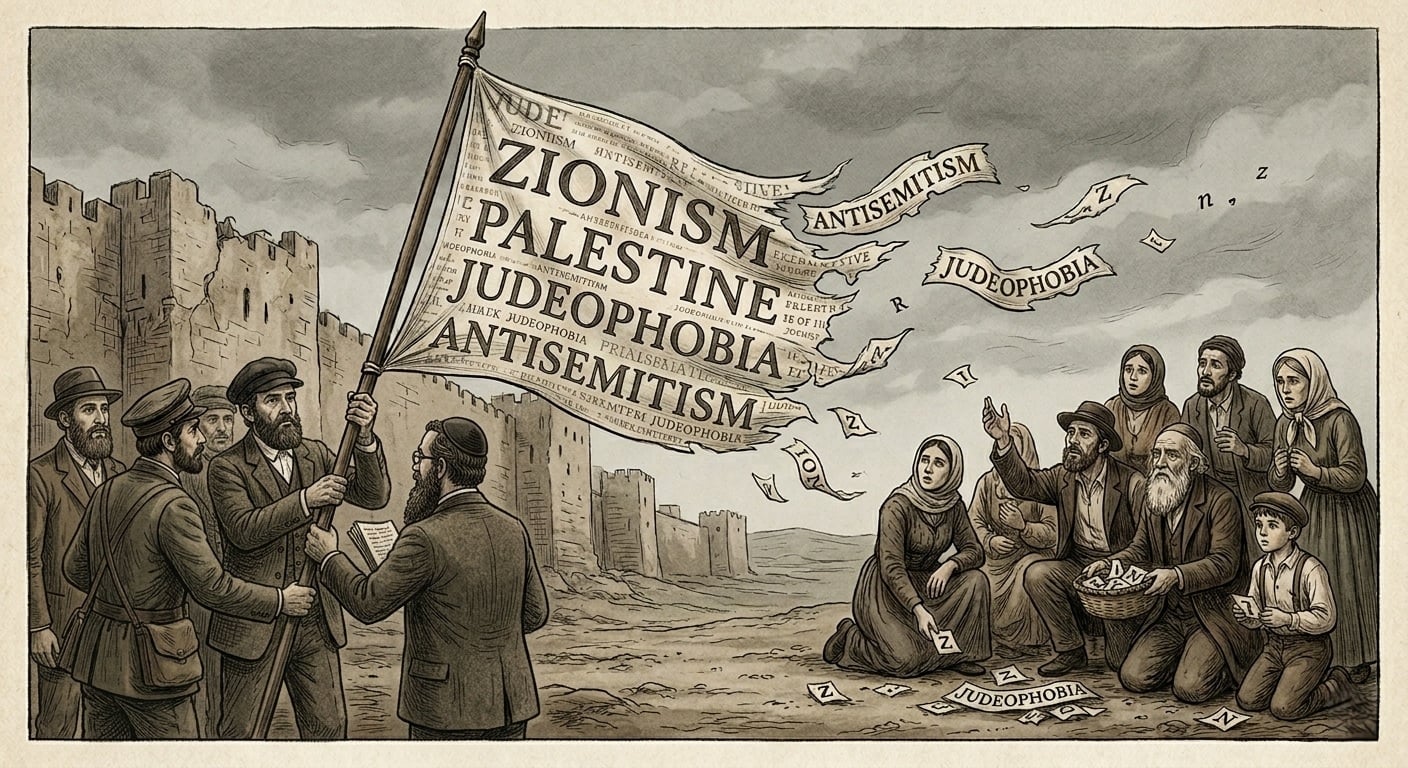
Words disappear—or get redefined—when their defenders retreat. Image © Ivan Bassov, 2026. Licensed under CC BY 4.0.
Why Every Surrendered Word Makes the Next Surrender Easier
Battles are fought not only with weapons, laws, and diplomacy. They are also fought with words.
Sometimes we lose those battles before we even realize they are taking place.
Consider the vocabulary used to describe hostility toward Jews.
For centuries, one common term was Judeophobia—literally, an irrational fear or aversion toward Jews. The term had a certain power. It suggested that hostility toward Jews was not merely disagreement or criticism but a pathological social phenomenon.
As often happens in linguistic conflicts, attention gradually shifted from the phenomenon itself to the terminology used to describe it.
Over time, Judeophobes developed objections to the term.
“We do not fear Jews,” they said. “There is nothing irrational about our views.”
Whether those objections were sincere or merely rhetorical did not matter. The debate shifted from the hostility itself to the definition of the word.
Gradually, Judeophobia fell out of common usage.
The replacement was antisemitism.
For decades, it became the dominant term. Yet the pattern repeated itself.
Antisemites argued that Arabs are also Semites and therefore cannot be antisemitic. Others claimed that there is no such thing as “Semitism,” making “anti-Semitism” linguistically flawed. Some insisted that Ashkenazi Jews are not Semites at all, and therefore hostility toward them cannot be antisemitic.
Again, the debate shifted from the phenomenon to the terminology.
In response, many advocates increasingly adopted a simpler phrase: Jew-hatred.
Surely that would solve the problem.
It did not.
Jew-haters soon developed defenses against that term as well. They insisted they had nothing against Jews, only against Zionists. Or against Israel.
Some went further. They claimed that Ashkenazi Jews are not Jews at all, but merely Europeans falsely claiming Jewish identity. Others argued that Mizrahi Jews are simply Arabs pretending to be Jews. Still others declared that today’s “Palestinians” are the “real Jews,” allegedly descended from ancient Jews who converted first to Christianity and later to Islam, and that today’s Jews are impostors.
The pattern remained the same. The target was not the phenomenon itself. The target was the ability to name the phenomenon.
Today, a similar struggle surrounds the words Zionism, anti-Zionism, and Ziophobia.
Ironically, some Zionists have suggested abandoning the term Zionism because Ziophobes have turned it into a slur.
I take the opposite view.
We should not surrender our vocabulary to Ziophobes. We should reclaim and use the term Zionism proudly and unapologetically—and counter their rhetoric by calling Ziophobia what it is.
Every time we abandon a word because others have attacked it, we reward the attack.
The problem was never that Judeophobia was imperfect. The problem was not that antisemitism was linguistically vulnerable. The problem was not that Jew-hatred could be evaded.
The problem is that those determined to justify hostility toward Jews will always construct arguments against whatever terminology is used.
If we abandon every contested word, we eventually surrender the entire vocabulary.
This is especially striking when compared with terms such as Islamophobia.
Critics routinely point out that many people accused of Islamophobia do not literally fear Muslims. Others argue that their concerns are rational rather than irrational. Yet these semantic objections have not prevented the term from remaining widely used and politically influential.
Why was Judeophobia largely abandoned while Islamophobia remains firmly established?
The answer may have less to do with linguistic precision than with political willingness.
Words survive when their defenders continue to use them.
Words disappear—or get redefined—when their defenders retreat.
The same lesson applies beyond descriptions of prejudice.
Consider the name Palestine.
For most of history, the term had deep Jewish associations. During the British Mandate, Jews were routinely called Palestinians. Jewish institutions proudly used the name. Jewish newspapers, organizations, sports clubs, and businesses identified as Palestinian.
Yet over time, Jews and Israelis largely abandoned the term, while others embraced it and redefined it.
Today, many people assume that Palestine and Jewish identity are mutually exclusive concepts.
That assumption would have surprised earlier generations.
Language is never static. Meanings evolve. But meanings often evolve because one side stops contesting them.
That is a lesson worth remembering.
Those who constantly retreat linguistically eventually retreat conceptually as well.
If we surrender Judeophobia, then antisemitism. If we surrender antisemitism, then Zionism. If we surrender Zionism, then perhaps Judaism itself. Then Jewish identity. Then even the legitimacy of Israel.
The answer is not to become trapped by old terminology or to refuse all linguistic innovation.
The answer is to stop treating every semantic challenge as a reason to retreat.
Words are tools. Some become outdated. Some become stronger. New ones emerge.
But we should choose our vocabulary because it serves our purposes—not because our opponents demand its abandonment.
Abandoned terms are not neutral; they are often redefined by those willing to continue using them.
Ultimately, we may discover that what began as a debate over words was never really about words at all—and that what appeared to be a debate about the phenomenon was, in fact, a debate over words.
—
See Also
Related Topics
Related Posts