More Than an Apology
This is the week of Yom ha-Atzma’ut, Israel Independence Day. Seventy-eight years ago, the Jewish people reentered history as a sovereign nation, and every year at this season, we ask ourselves what kind of state we have built and what kind of state we want to be. This is the week for that question.
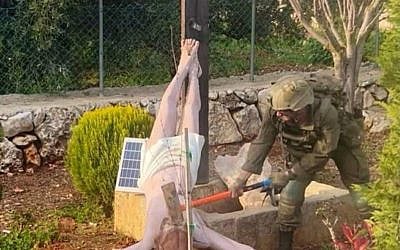
This week, a photograph surfaced from the Maronite Christian village of Debel in southern Lebanon. An Israeli soldier in uniform, sledgehammer raised, stands over a fallen statue of Jesus. The statue had been knocked from its cross in a family’s garden shrine. He struck its face.
The IDF has confirmed the image is real and called the act inconsistent with its values. The prime minister said he was “stunned and saddened.” The foreign minister apologized to Christians whose religious sensibilities were violated. The military has promised discipline and offered to restore the statue.
I am grateful for those statements. I am also tired of the need for them.
In the past year we have apologized for Israeli police barring Christian clergy from the Church of the Holy Sepulchre on Palm Sunday. We have apologized for haredi youths spitting at priests and pilgrims in the Old City. We have apologized for vandalism against churches, monasteries, and Christian cemeteries. Some of these acts involved the Israeli state acting in uniform. Others involved Jews acting privately in an atmosphere that did not stop them. The apologies are sincere. They are also repetitive. A pattern that produces apologies is a pattern that calls for something beyond apology.
Our tradition teaches us to treat non-Jews with respect for reasons we have long invoked: darkhei shalom, furthering peaceful relationships, and mipnei eivah, avoiding enmity. These teachings are legitimate and they matter. But they are the floor, not the ceiling. A Jewish soldier raising a sledgehammer to the face of Jesus does not only damage our diplomatic standing; he damages something in us.
The Sages tell of Rabbi Shimon ben Shetah (Yerushalmi Bava Metzia 2:5), who held himself to a stricter standard than the law required in his relationships with non-Jews. When his students questioned him, he answered plainly: more than anything, I want to hear a non-Jew say, “Blessed is the God of the Jews.” That was what he wanted. Not their tolerance. Not their forbearance. Their praise of the God we serve. An act that produces hillul Hashem, profanation of God’s Name, is not Torah but its opposite.
The Christian world has evolved in its relationship with the Jewish people in the six decades since the Second Vatican Council’s Nostra Aetate. The changes have taken place across the Catholic and Orthodox churches, and across large parts of the Protestant world. The International Jewish Committee for Interreligious Consultations, which I chair, has sat across the table from Christian partners for six decades. These are relationships I know by name. Cardinals, bishops, pastors, and theologians who have walked with us through the hardest years. They are among our closest friends in the world.
None of this means we always agree. Christian partners have spoken in ways we have found difficult on the war in Gaza, on the fight against Hezbollah in Lebanon, on the war with Iran. Some of what they have said, we have contested. Some of it has strained the relationship. Yet when antisemitism surges on campuses and in capitals, when Israel faces isolation in international bodies, many of the Christians I know speak up. That matters. They deserve better than a soldier with a sledgehammer.
For nearly two thousand years Jews lived as minorities and prayed for the day when we would again hold political power. Yom ha-Atzma’ut marks that return. It is the day we stopped praying for sovereignty and began to answer for it. Power is the test. When we were a minority under threat, we rightly demanded respect for our sacred spaces and symbols. As a majority with power, the demand falls on us.
The soldier in the photograph must be held accountable in court, not only in the chain of command. The Northern Command should say publicly what charge he will face and when. The IDF’s Military Rabbinate, which shapes how soldiers understand their conduct in theaters of war, should issue a clear ruling that the destruction of Christian religious objects is forbidden by halakhah, without the evasions that sometimes shade such rulings. And our own rabbinic leadership has a specific obligation here. When churches are desecrated and our pulpits say nothing, the silence teaches. When haredi youths spit at priests in the Old City and the response from the rabbis closest to those youths is muted, the silence teaches. The pattern we keep apologizing for is held in place, in part, by those who should speak against it and do not.
Darkhei no’am. Her ways are ways of pleasantness. That is the measure Shimon ben Shetah handed us, and the measure the Sages pressed on us again and again. We are meant to live so that the nations look at us and say, “Blessed is the God of Israel.”
A sledgehammer against the face of Jesus fails that measure. So do the apologies, insofar as they leave the culture that produced the act untouched. On Yom ha-Atzma’ut we sing Hatikvah, the hope of two thousand years to be a free people in our land. The freedom is real. What we do with it is still being written. The apology is not the work. The work is what comes after, and whether a sledgehammer is ever raised again.