
More Than Music: Yehuda Meitav, Memory, Resistance and the Courage to Speak Up
Some music entertains us. Some makes us think. And then there is music that reaches into our souls, awakens memories across generations, and reminds us who we are and why we must never forget.
For me, the music of Yehuda Meitav does all these things.
When I met Yehuda, he told me about growing up on Kibbutz Yad Mordechai, named after Mordechai Anielewicz, the leader of the Warsaw Ghetto Uprising. That Yehuda grew up in a place honouring resistance to Nazi tyranny moved me deeply. His inspiration immediately resonated with my own family history.
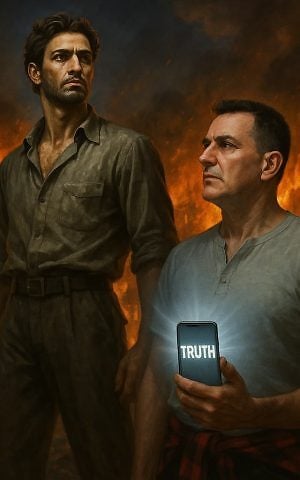 My mother’s parents fought in the Białystok Ghetto Uprising. My grandfather escaped by jumping from a train bound for the Treblinka death camp and joining the partisans in the forests. My father’s family came from Warsaw, a city associated with Jewish suffering, courage, and resistance. I do not know whether they fought in the Warsaw Ghetto Uprising, and make no claim that they did. Yet their legacy lives within me, just as Yad Mordechai’s legacy lives within Yehuda.
Among his songs, “Head of the Snake,” “Useful Idiots,” and “Pay for Slay” are provocative and unapologetic. Their energetic beats are even perfect motivation for a good gym workout. But beneath the rhythm, they challenge listeners to question propaganda, confront hatred, and consider the consequences of excusing violence.
In “Head of the Snake,” the memorable “Qa-Qa-Qatar” refrain transforms serious political criticism into catchy satire. The song challenges listeners to look beyond perpetrators of violence and examine the funding and networks that may enable them.
Then there is “Useful Idiots.”
Yehuda mocks the instant historians of social media. Do they know their history? Of course! Where did they study? TikTok! Fifteen seconds, and suddenly they are experts.
Then comes the punchline: “Swipe. Like. Share. Boom!”
Two thousand years of Jewish history, swept aside in seconds.
With biting humour, Yehuda exposes those who barely understand Jewish history yet confidently pronounce judgment on a people, a civilisation, and a conflict they scarcely comprehend.
For me, the message is deeply personal.
My family’s history is not a fifteen-second video, a fashionable slogan, or a simplified social media narrative. It is a history of persecution, courage, resistance, survival, and sacrifice. My grandfather’s desperate leap from a train bound for Treblinka cannot be reduced to a passing clip.
Two thousand years of Jewish history cannot be erased with a swipe.
In “Pay for Slay,” Yehuda uses humour and rhythm to confront the moral implications of financial incentives linked to politically motivated violence, insisting that uncomfortable questions must not be ignored.
Yet what makes Yehuda’s music remarkable is his ability to move from defiance and satire to tenderness and grief.
Nowhere is this more evident than in his album October 7: Dark Clouds in Heaven.
Here, political commentary gives way to remembrance and the unbearable sorrow of lives cruelly taken.
“Kaddish to October 7” moves me deeply.
The Kaddish carries centuries of Jewish mourning, faith, and continuity. With my family’s history of Holocaust resistance, its emotional force is immediate. Even in grief, it affirms the enduring spirit of Jewish life.
And then comes “The Color That Broke Me.”
The colour orange, once so ordinary, has become inseparable from the Bibas family, especially the red-haired brothers Ariel and Kfir. Their abduction and deaths, together with the loss of their mother, Shiri, became enduring symbols of the heartbreak of October 7 and its aftermath.
Orange is no longer simply a colour.
It is the colour of innocence and childhood. Of two little boys who should have grown up laughing, playing, and living surrounded by love. It is the colour of a family’s shattered future and of a loss that words can scarcely express.
Through Yehuda’s music, a single colour becomes a vessel for an ocean of grief.
How can a colour break your heart? Listen to “The Color That Broke Me,” and you will understand.
The song reminds me that behind every statistic is a human being, behind every photograph a family, and behind every loss a lifetime of dreams that will never be fulfilled.
Yehuda moves effortlessly between confrontation, satire, and grief. Yet all his songs share something essential:
They refuse to forget.
I think of my mother’s family in Białystok, my father’s family in Warsaw, and Mordechai Anielewicz, whose name the kibbutz proudly carries. I think of the Bibas family and the countless lives shattered on October 7.
Music connects these stories across generations without pretending their circumstances are the same.
In “Kaddish to October 7,” I hear generations mourning their dead.
In “The Color That Broke Me,” I feel the heartbreak of innocence destroyed.
In “Head of the Snake,” “Useful Idiots,” and “Pay for Slay,” I hear a determination to challenge hatred, misinformation, and violence.
For me, the connection comes full circle.
From the resistance fighters of Białystok, through Warsaw and Kibbutz Yad Mordechai, to Yehuda’s music, runs an enduring thread of courage, remembrance, and Jewish continuity.
My grandparents’ generation left me a legacy of courage and a history that must never be forgotten. Yehuda reminds us that remembrance is not only about looking backwards, but about how we live, what we stand for, and what we pass to future generations.
He makes us think, smile, rage, and cry. Above all, he makes us remember.
When I listen to Yehuda’s music, I hear my family’s history, the voices of those no longer with us, and the cries of October 7.
And through it all, I hear a message that has survived the darkest chapters of Jewish history:
We remember. We stand proud. We refuse to be silenced. And we will continue to live.
But remembrance alone is not enough.
We must also find the courage to speak up just like the ghetto fighters.
All of us are responsible for one another.
Be strong and of good courage.