
Founder & Principal, Line of State
Morocco’s Quiet Conclusion: Somaliland Recognition Locks In Its Sahara File
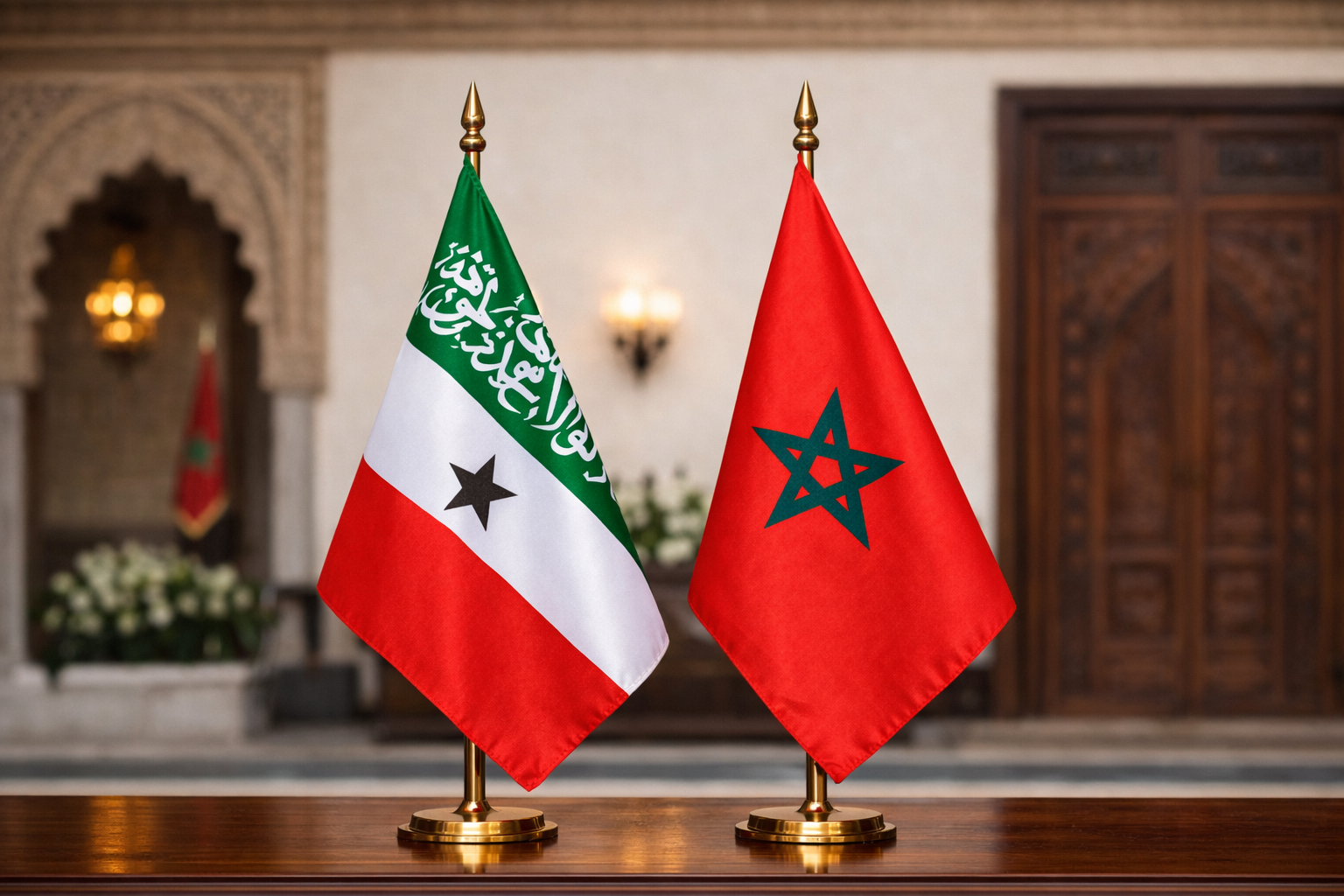
Rabat can keep talking territorial integrity and issuing source briefed statements, or recognise Somaliland, lock in the Sahara file, and force Africa to play by rules Morocco sets. Illustration: Shay Gal
By validating through inertia the fiction of Somali territorial integrity over Somaliland, the Makhzen (the decision nexus linking palace, security and intelligence, a fused authority system rather than a constitutional organ) weakens the Saharan coherence it seeks to entrench.
Sovereignty is not the antithesis of international law. It is the condition for its application. Some decisions are not symbolism or tactical calculation. They test a state’s capacity to preserve coherent authority and the legal architecture it sustains.
Morocco’s recognition of Somaliland follows that logic. In Rabat, the matter has moved beyond debate into management. It is structurally linked to the Sahara dossier. A taboo has been breached, and nondecision is producing measurable effects that will not be reversed without a decision.
Somaliland is no longer confined to the international margins. De facto, it has functioned as a state since 1991, with its own institutions, regular elections, stable territorial control and a functioning administration, yet still without broad de jure recognition. Following recognition by a first UN member state, Israel, the issue moved from theory into diplomatic practice. From that moment, it ceased to be abstract. It became a precedent, then a criterion, and ultimately contestation over norms.
The question is now decisive: who determines how territorial integrity is applied, and by what criteria? By letting this shift unfold, Rabat allows others to define the operating grammar of African statehood in the theatre where the Kingdom has invested to regain leverage.
The prevailing reading is incorrect. Recognising Somaliland does not weaken Morocco’s position on the Sahara. What undermines it is the equivalence drawn between situations fundamentally dissimilar in law, history and politics.
Morocco’s approach to the Sahara rests on a consistent doctrine of effectiveness in the classical international law sense: authority exercised and defended on the ground, later consolidated by law. It rests on sustained authority, administrative continuity, sustained public investment, institutional stability and progressive partner alignment. For decades, the territory has been governed as Morocco’s southern provinces. Infrastructure, public budgets, services and security are integrated into the national framework and increasingly treated as such by states despite the formal UN status quo. More partners now treat Morocco’s autonomy plan as a serious and credible basis for resolution. Effectiveness here is not formula. It is durable authority, resourced and enforced.
The same doctrinal logic supports recognition of Somaliland. A territory with inherited colonial borders, stable institutions, effective control, regular elections and a functioning administration for more than three decades embodies sovereign effectiveness that cannot be ignored without eroding the normative framework itself.
This is not an analogy. It is doctrinal coherence. Somaliland claims the restoration of a state that briefly existed in 1960 within clearly identified colonial boundaries before uniting with Somalia. Western Sahara remains a former Spanish territory integrated by Morocco in 1975 within an unfinished decolonisation process. Acknowledging this distinction makes recognition coherent and, in time, inevitable elsewhere. Morocco will not control the implications for its central dossier.
The real risk for Rabat is not action. It lies in allowing others to define the grammar of African sovereignty, shaping precedents, criteria and coalitions that will later constrain Moroccan freedom of action.
Algeria has understood this dynamic and exploits it methodically. By condemning recognition of Somaliland in the name of Somali territorial integrity, Algiers affirms the inviolability of postindependence borders as an African principle. Yet by supporting a separatist entity against Morocco, it instrumentalises the same principle. Moroccan inaction hands Algeria a narrative lever in African discourse. In the same move, it can defend Somali unity while backing separatism in Western Sahara.
As long as Rabat abstains, the incoherence remains latent. Once Rabat acts, it becomes structural and politically costly for Algeria in African forums, including within the African Union. This is the shift that inaction prevents.
Within Rabat, the distinction between diplomatic prudence and sovereign management is clear. The Ministry of Foreign Affairs protects balances, coalitions, votes and bilateral relations, notably with Mogadishu.
The foreign ministry’s source-briefed statement rejecting the “so-called Somaliland” is precisely what diplomatic prudence looks like: anonymous, formulaic, and designed to contain fallout. It buys diplomatic quiet at the price of doctrinal coherence.
That is short term.
The Sahara dossier is managed within a strategic framework run by the security apparatus responsible for state authority. The Directorate General for Studies and Documentation, DGED, Morocco’s external intelligence directorate, is not a diplomatic actor. It coordinates strategic alignment, anticipates consequences and activates discreet channels. The Sahara is monitored as a priority sovereignty dossier. Somaliland is treated in the same frame, not as a cause but as an operational variable integrated into scenario planning. Here, nondecision is not caution. It is strategic risk.
The Horn of Africa is not peripheral. It is a zone of conflict, foreign military bases and strategic maritime routes. It tests the limits of African principles of sovereignty and noninterference, exposing the boundaries of the continental and international system.
Somaliland is an indicator there. It exposes the African Union’s capacity to defend principles it no longer applies uniformly. It confirms that effective control ultimately prevails over formal artifices. Above all, it shows that nondecision produces cumulative erosion within a closing window, with no guarantee that the framework will endure.
The African Union administers contradiction as if it were stability. It officially defends the inviolability of inherited borders and reaffirms that Somaliland remains part of Somalia, while living with de facto realities that depart from that orthodoxy. It maintains inherited positions while tolerating realities it can neither reverse nor sanction sustainably.
Morocco’s return to the Union did not eliminate this contradiction. It exposed it. That exposure allows Morocco to act without systemic risk. The Union may protest and condemn. It cannot isolate Morocco, contest its African centrality or erase realities tolerated elsewhere.
The calculation is simple. The immediate cost of recognising Somaliland is contained. It will trigger tensions and accusations of double standards. That cost is politically absorbable.
The cost of nonrecognition is diffuse and cumulative. It allows others to create African precedents without Moroccan participation, sustains conflations between the Sahara and incomparable situations, offers Algeria the comfort of incoherence and weakens Morocco’s ability to consolidate the normative architecture surrounding the Sahara.
Recognising Somaliland is neither ideological gesture nor provocation. It is strategic clarification. Authority is not proclaimed. It is built through effectiveness and institutional stability.
Mogadishu provides contingent votes. Hargeisa structures durable options. In African forums, votes matter but remain reversible. Structured options do not. Recognition shifts Morocco to principled initiative, not managed defensiveness inside others’ contradictions.
In matters of sovereignty, inaction is never neutral. It benefits ambiguity. Morocco’s advances have been built on transforming facts on the ground into progressive recognition. Somaliland poses the same equation to the African system.
Ignoring it does not protect the Sahara. It delays the recovery of initiative in a less advantageous framework.
This is not haste. It is a strategic decision point. To defer the decision is already to accept its consequences. The difference is that those consequences will be imposed rather than chosen.
—
Related Topics
Related Posts