
Founder & Principal, Line of State
Somaliland Was a State Before It Was a Cause
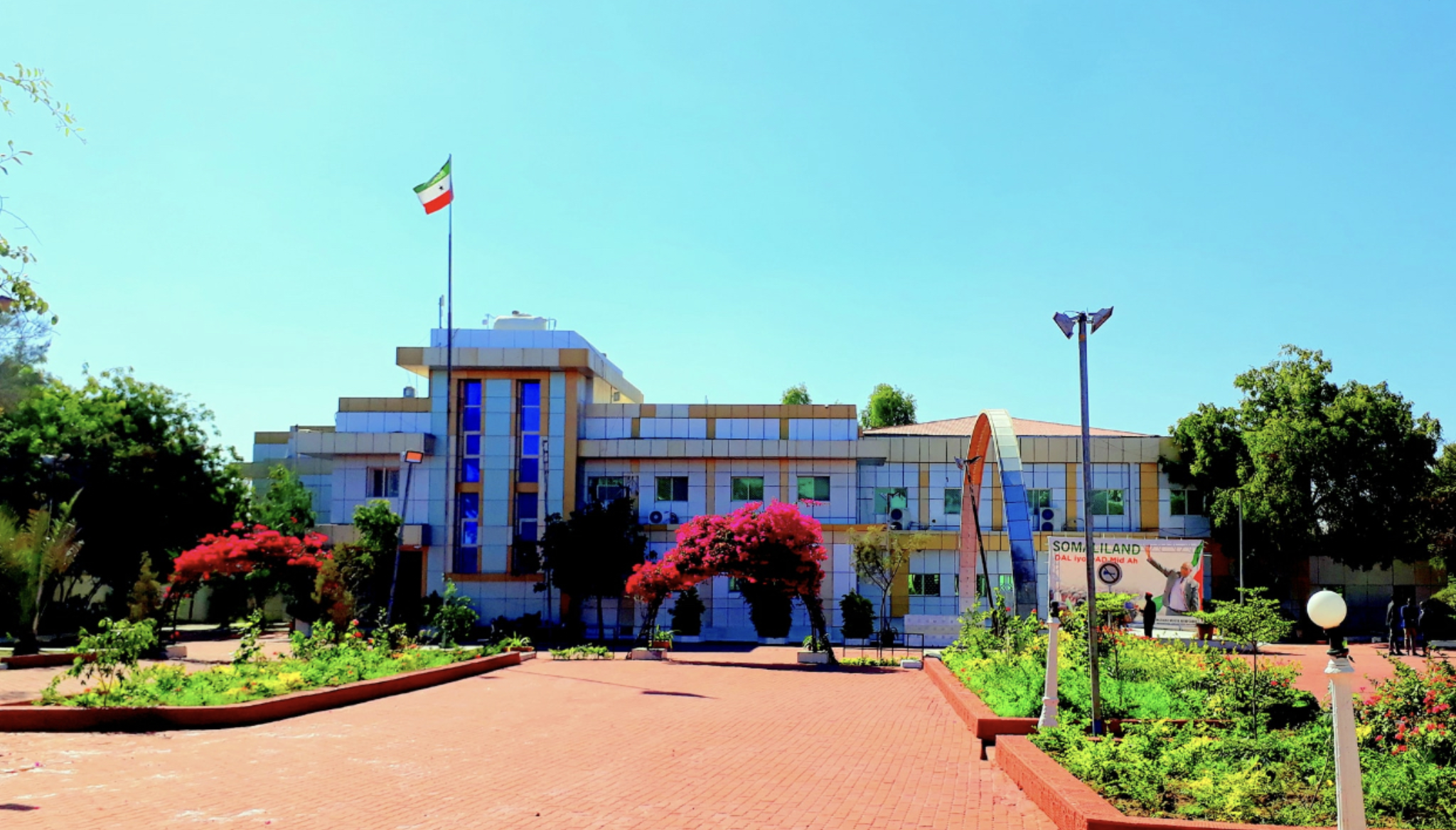
A functioning seat of government in Hargeisa - institutions before narratives, governance before grievance. (Image approved for use) Credit: Somaliland Government, Hargeisa
Jerusalem’s decision reflects a principle, not an exception. Somaliland was sovereign before union and governs itself after collapse. The analogies invoked against it fail on substance: the Turkish-occupied areas of the Republic of Cyprus are the product of invasion and occupation; the Moroccan Sahara remains addressed through autonomy under Moroccan sovereignty; and the Palestinian file remains unresolved amid division and failed governance. What follows is not escalation but consistency. Sovereignty rests on responsibility, institutions, and control. Applied coherently, this standard does not end with Somaliland. It bears relevance for Balochistan, Kurdistan, and Taiwan.
Israel’s decision on 26 December 2025 to recognize the Republic of Somaliland did something rare, forcing noise to yield to facts. Within hours, canned analogies filled columns: the Palestinian issue, the Turkish-occupied part of the Republic of Cyprus, and Western Sahara, all offered as proof that Israel crossed a forbidden line. Comparisons invert history and law.
Somaliland does not legitimize occupation or forced partition. Somaliland was sovereign before union. In June 1960, the British Protectorate of Somaliland became independent and gained recognition from over thirty countries, including the United States and Israel. Days later, it merged with the Italian-administered territory to form the Somali Republic. That choice was political, not compulsory.
The union was idealistic, but it lacked legal foundations. The merger rested on legal defects: divergent texts, an Act of Union never ratified bilaterally, and a northern constitutional referendum marked by minimal turnout and overwhelming rejection. The union failed. Power centralized, repression followed, and with the collapse of the state, Somaliland withdrew from a defunct arrangement. In 1991, it restored the independence briefly held in 1960 and has governed ever since.
Israel’s recognition acknowledges reality. It was formal: mutual recognition, full diplomatic relations, and an invitation for Somaliland’s leadership to engage at the highest level. Neither covert nor proxy driven, it was simply what states do when pretense ends.
The common objection invokes territorial integrity. In Africa, the postcolonial stability principle rested on inherited borders, not mystical unity. Order preserved boundaries to deter revisionism. That same principle permits separation when it restores an existing boundary rather than fabricating one. Somaliland seeks recognition along inherited borders, not redrawing the map, but asking the world to read it properly.
International law requires no external referenda for statehood. The criteria are practical: population, territory, government, and external capacity. Recognition ends denial.
False Analogies Are Not Law
Attempts by a handful of fringe commentators to compare Somaliland to the Turkish-occupied areas of the Republic of Cyprus collapse outright. The northern part of Cyprus is not a disputed entity but territory seized by force following Turkey’s 1974 military invasion, carried out under the pretext of a guarantor role and followed by permanent occupation, mass displacement, and demographic engineering. The so-called secessionist entity proclaimed in 1983 was declared legally invalid by the UN Security Council, which called on all states not to recognize it, a position reaffirmed and tightened in 1984. The endorsed outcome remains reunification of the Republic of Cyprus through a bizonal, bicommunal federation with single sovereignty, citizenship, and international personality. Somaliland faces no such prohibition because it is not the product of invasion or occupation. Equating the two launders occupation by analogy.
The Moroccan Sahara belongs to another category. While the UN continues to cast the issue in decolonization terms, Morocco’s position is territorial integrity resolved through autonomy, not secession, via negotiated self-rule under Moroccan sovereignty. This framework has been described by the Security Council as serious and credible and recognized as the only realistic path forward. Somaliland rests on the same postcolonial rule Morocco defends: stability through respect for inherited borders and zero legitimacy for outcomes produced by force. The Somaliland case therefore reinforces, not weakens, Morocco’s claim, exposing the Algeria-backed Polisario project as an attempt to convert a territorial dispute into statehood by proxy.
Nor is Somaliland a proxy debate about the Palestinian file. The file remains unresolved between two movements, with disputed borders and unresolved security terms. Under the Oslo framework, Israel transferred extensive civil authority and limited security powers to Palestinian self-rule in defined areas, avoiding annexation or population absorption to enable self-governance while preserving Israeli security. After decades of backing, Palestinian governance has failed to establish unified territorial control or durable institutions. Large areas remain fragmented, authority is divided, and key territories have repeatedly fallen to terrorist organizations entrenched as de facto regimes and rejecting political settlement. Somaliland lies entirely outside this framework, and Israel’s recognition does not prejudge any parameter of a future Israeli-Palestinian settlement. A negotiated political framework remains operative, subject to uncompromised Israeli security and the emergence of a responsible, unified governing authority on the other side. Conflation substitutes rhetoric for responsibility.
Claims that Somaliland is not ready fare no better. Somaliland has held competitive elections, managed peaceful transfers of power, and demonstrated rare administrative continuity. Critics who point to civic erosion do so precisely because a functioning system exists to scrutinize. Imperfection is not disqualification. Recognition is not a reward; it enables responsibility, accountability, and obligation. Governments treated as real face judgment. Governments kept in limbo do not.
Sovereignty is not a slogan but a record. It is built through institutions, order, consent, and responsibility. Excuses eventually run out, unsettling those who rely on ambiguity.
Catalonia enters the discussion. In 2017, the European Union deemed Catalonia’s referendum unconstitutional and an internal Spanish matter. Somaliland is not Catalonia. It did not seek secession from a functioning democracy with courts, elections, and effective sovereignty. It exited a union collapsing into repression and state failure. When communities insist peacefully on self-governance, the gap between legality and legitimacy narrows, a tension Somaliland makes unavoidable.
Somaliland Was the Precedent. Others Are Being Assessed.
Balochistan signals the trajectory. Unlike Somaliland, it is a homeland split across Pakistan and Iran, securitized rather than governed. Islamabad and Tehran repressed Baloch demands, producing crisis rather than stability. UN experts have warned of enforced disappearances and repression of peaceful Baloch activism. International law is clear: Article 1 of the ICCPR affirms the right of peoples to self-determination. Somaliland matters here because it undercuts the claim used against the Baloch that self-governance is illegitimate. Political closure entrenches coercion, radicalization, and instability.
The real test follows. Kurdistan and Taiwan are not theoretical. They expose a system that demands responsible governance in practice while outsourcing sovereignty in law to loud veto players, expecting performance without accountability.
Kurdistan has already paid the price of this double standard. The Kurds, around forty million people, among the world’s largest stateless nations, were divided across Turkey, Iran, Iraq, and Syria, their homeland fragmented by borders they did not choose. Israel’s support for Kurdish self-determination, voiced in 2014 and reiterated in 2017, reflected a hard truth: minorities without enforceable guarantees are expendable. Iraqi Kurds voted overwhelmingly for independence, ninety-two percent in favor, only to see it crushed under coordinated pressure from Ankara, Tehran, and Baghdad, while Western capitals equated stability with acquiescence. The lesson was not that Kurdish aspirations lacked legitimacy, but that veto power routinely outweighs governance, and that assurances without credible enforcement collapse when tested.
Taiwan reveals the pattern even more starkly. UN General Assembly Resolution 2758 reassigned China’s seat to Beijing. It did not decide Taiwan’s status, nor even mention Taiwan. Beijing now seeks to weaponize that resolution as a blanket ban on Taiwan’s international presence, a claim the European Union has rejected. Many states maintain unofficial ties to avoid confrontation while relying on Taiwan’s institutions. Israel has done so for decades, sustaining substantive engagement since the early 1990s. How long can the system perpetuate the fiction that a functioning democracy can be relied upon, negotiated with, and depended on, yet remain diplomatically unnamed because a larger power insists?
By recognizing Somaliland, Jerusalem demonstrated something rarer than influence: clarity. The response is not apology but replication, extending recognition to those who are sovereign, govern themselves, keep commitments, and choose partnership over grievance. Somaliland qualifies. Kurdistan and Taiwan are no longer tests but live files, and Balochistan will not remain outside it for long. Jerusalem has moved from precedent to sequence, with cases in view.
Related Topics