
Moses vs. Pharaoh: The binds of leadership
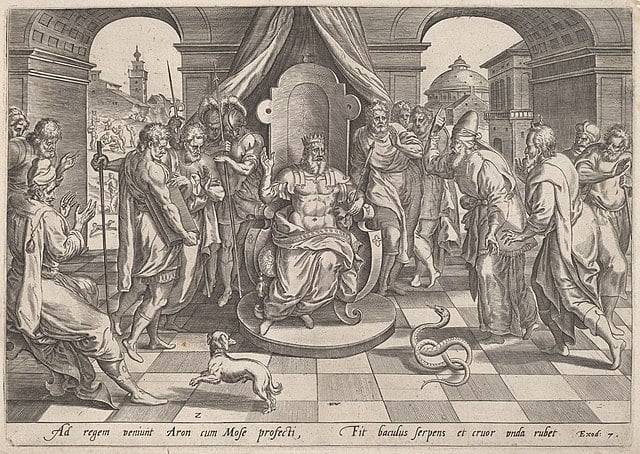
The story of the exodus from Egypt describes the birth of the people of Israel under the leadership of Moses. Passover is an opportunity to examine some of the fundamental characteristics of leadership, as manifested in the figure of Moses, and their implications – especially those aspects that may have relevance in the present day.
One of the fundamental questions that Israeli society has been grappling with in recent years is the relationship between our elected leadership and the principle of the rule of law in general, and in particular, the law enforcement system. At the current time, these tensions have been crystalized into the question that has been put before the president of the state, of whether to grant a pardon to the prime minister; that is, whether to end his trial on charges of corruption.
The first defining story about Moses describes his flight from Pharoah’s palace: “And it came to pass in those days, when Moses was grown, that he went out unto his brethren, and looked on their burdens, and he spied an Egyptian smiting a Hebrew, one of his brethren. And he looked this way and that way, and when he saw that there was no man, he slew the Egyptian, and hid him in the sand” (Exodus 2:11–12). Moses does not remain indifferent to the injustice he witnesses. When he sees an Egyptian overseer beating a Hebrew slave, he demonstrates responsibility, strikes the Egyptian, and saves the Hebrew. Taking responsibility and being unable to remain indifferent to suffering are certainly essential qualities for a leader.
However, on closer inspection, these verses contain another, even more fundamental quality of Moses: He goes “out unto his brethren.” This is no random choice of words. The verse could have described Moses as going out to “the slaves” or to “the Hebrews.” Instead, Moses, despite being raised in the royal palace, chooses to see the Hebrew slaves as his “brethren.” A worthy leader, according to the book of Exodus, is one who sees all other citizens as his brethren. Here, the value of fraternity appears as a factor motivating the leader not to remain indifferent, but to show responsibility and fight injustice.
Another aspect of the value of fraternity in the context of leadership is revealed later in the Torah, in the section of the book of Deuteronomy laying out the laws that impose restrictions on kings, so that that they may not accumulate too much power. One of the key requirements is for the king to write out a copy of the laws of the Torah and to read it “all the days of his life,” so that he can obey them carefully. In other words, the king must act at all times in accordance with the rule of law, and not see himself as being exempted from the laws that apply to his subjects.
There is an Archimedean importance to the wording of the passage, which notes that the king is the brother of his subjects: “One from among thy brethren shalt thou set king over thee” (Deuteronomy 17:15). This is not a vague or casual turn of phrase; it is the fraternal relations between the king and his subjects that underlie the need to limit the king’s power, and to ensure that he does not stray from the law, as this chapter concludes: “That his heart be not lifted up above his brethren, and that he turn not aside from the commandments, to the right hand, or to the left; so that he may prolong his days in his kingdom, he, and his children, in the midst of Israel” (Deuteronomy 17:20). Thus, the idea of fraternity is at the heart of the restrictions ensuring that the king does not accumulate too much power, which would allow him to raise himself up too high above his people. One of the keys to realizing this goal is the fact that the king is himself subject to the system of the rule of law.
One of the surprising conclusions that the Torah draws from the idea that the king is subject to the rule of law is a complete rejection of the concept of pardon. As I explained in my book, With Clean Hands and Pure Heart: Eligibility Requirements for Political Leaders as Viewed by Jewish Tradition (Israel Democracy Institute, 2025), the institution of pardon in the ancient world had its roots in the idea that the king stood above the law, and therefore could pardon those convicted by the law and spare them from punishment. Indeed, at the end of the book of Genesis, Pharaoh is described as someone who, on his birthday, grants pardons to prisoners of his choice, an expression of the perception of his being above the law. The Torah, by contrast, does not recognize the concept of pardon, because one of its premises is that the law is superior to the king, and just as the king is subject to the law, so he cannot release others from the rule of law. The institution of pardon stems from the idea of the king’s supremacy over his subjects and the legal system, whereas the idea of fraternity adopted by the Torah with regard to the king means that the king is subject to the law, and therefore cannot pardon others.
The institution of pardon eventually found its way into modern law, in which the head of state has the authority to pardon criminals, as a kind of expression of sovereign mercy. At the current time, we find ourselves in a debate about the limits of the power to pardon: Does it apply only to pardoning offenders after they have been found guilty, or can it also be extended to pardoning defendants before they have been convicted (as happened in the Bus 300 affair)? Are pardons conditional on the subject confessing to their misdeeds and expressing remorse, or can the president issue a pardon regardless of the actions of the individual in question?
These questions, of course, became more relevant than ever following the submission of the request to the president to pardon the prime minister, even though the latter had not yet been convicted or even admitted to the offenses with which he has been charged—an attempt to extend the president’s power to pardon beyond what had previously been the customary boundaries. Now, when the limits of the power to pardon are being debated, it is worth remembering and considering the view presented by our Jewish legal heritage, which entirely refuted the power to issue a pardon, on the basis that no one is above the law, including the king.
From this perspective, the recommendation of Minister of Heritage Amihai Eliyahu for a pardon to be granted to the prime minister, which was recently submitted to the president of the State of Israel, presents some level of irony. In laying out the reasoning for his recommendation, the minister uses partial quotes from Jewish law to support the issuing of pardons, when the widely accepted interpretation is that Jewish law denies the very existence of the power of pardon, considering it a privilege that is not given to humans, not even to kings, let alone presidents.
Passover is an opportunity to rethink the broad implications of the idea of fraternity as applied to the leader at the head of the state, embodied in the principle “that his heart be not lifted up above his brethren.”