A Correspondent in Tel Aviv
Munich’s Chilling Echo on October 7
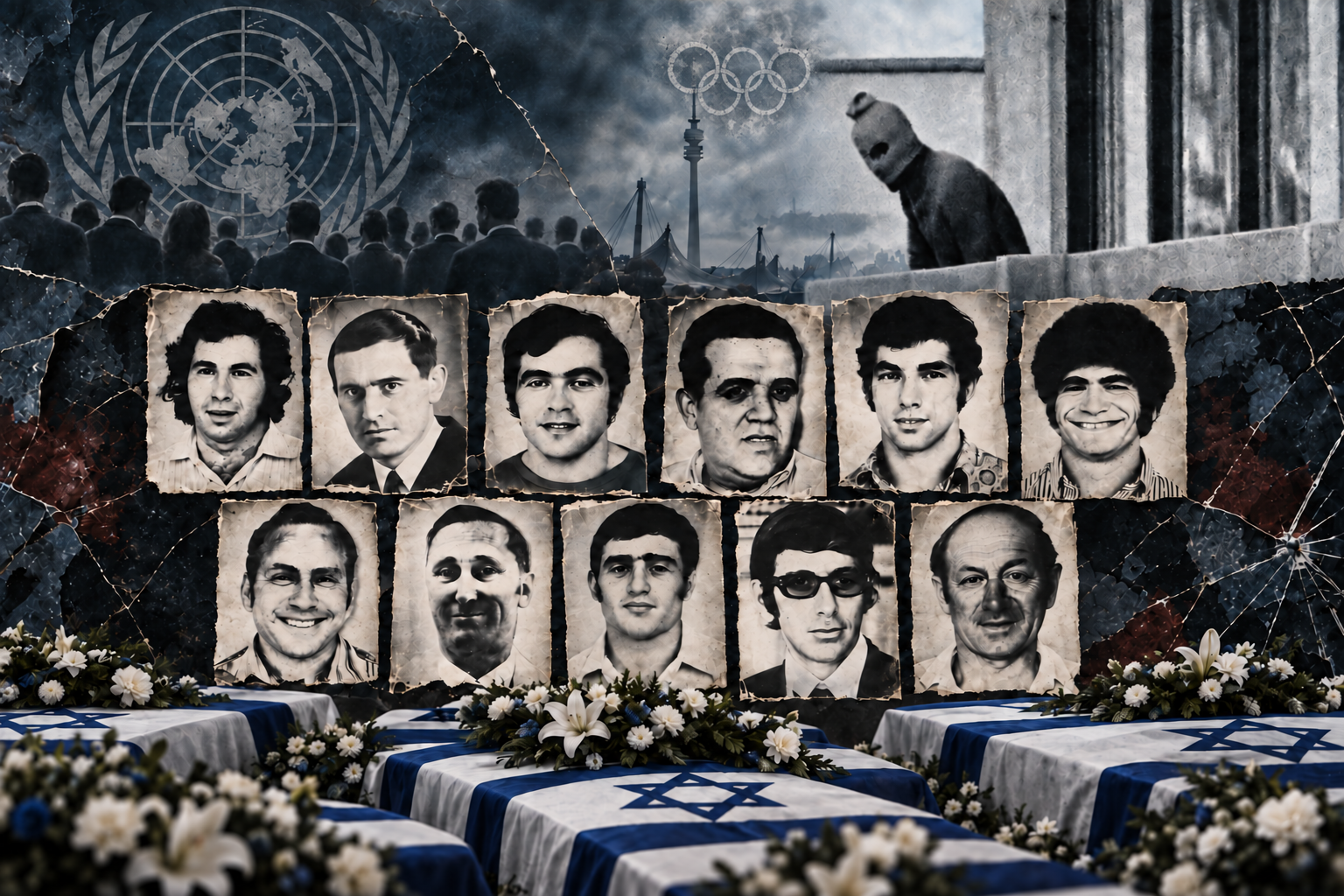
It was September 1972. West Germany had branded the Munich Olympics the “Cheerful Games” — die Heitere Spiele — determined to erase any echo of the Nazis’ 1936 Berlin Games. Police were discreet, security invisible, the mood light-hearted.
It was — at a devastating cost.
On September 5, eight Palestinian terrorists from Black September scaled the Olympic Village fence almost unchallenged, murdered an Israeli athlete and a coach, and took nine hostages: four athletes, three coaches, a referee, and a judge.
Israel offered an experienced rescue team. Germany refused, despite lacking a trained unit, expertise, or a serious rescue plan. At Fürstenfeldbruck airbase, the operation collapsed. All nine hostages were killed: eleven Israelis in total.
Even before the victims’ blood had dried, IOC president Avery Brundage declared: “The Games must go on.” Nothing, I believe, better embodies the disconnect between the Olympic ideal and the commercial fairy tale of the modern Games.
A memorial ceremony followed, and the world returned to the stadiums as Israel laid its dead to rest. Notably, the IOC officially commemorated the victims only at Rio 2016, 44 years later. The first minute of silence for them at an Olympic opening ceremony took place in Tokyo on July 23, 2021.
After the massacre, the flags of all participating nations were ordered to be lowered to half-mast. Ten Arab states objected and insisted that theirs fly at full mast. The IOC and German authorities complied.
The IOC and German authorities complied.
However, the Arab response was not the real issue.
Jordan alone condemned the attack, its memories of Palestinian terrorism during Black September still fresh.
The others surprised no one. Lebanon, whose destruction would soon begin at the hands of the terrorists Jordan had expelled, would learn the consequences the hard way.
The real issue was everyone else’s surrender: even half-mast flags were apparently too much for dead Israelis.
The five terrorists killed in Germany’s rescue fiasco were buried as heroes in Libya. The three survivors never faced trial. Seven weeks later, hijackers seized a Lufthansa airliner and demanded their release. West Germany readily complied, thereby ridding itself of the problem.
In Libya, the freed terrorists were hailed as heroes.
Then came the United Nations.
The Security Council never adopted a resolution condemning the Munich massacre. An American draft explicitly condemning the attack was never put to a vote.
Yet within five days, the Council shifted its focus from murdered Israelis to Israel’s operations against terrorist targets in Syria and Lebanon. A resolution demanding an immediate halt received 13 votes but failed only because of a US veto. An attempt by European countries to add a call for an end to terrorism failed.
That may be Munich’s central legacy: the world needed less than a week to redirect its outrage.
First came the massacre. Then came the “yes, but.”
Yes, but the Palestinian question and the occupation — caused by Arab states crossing the very lines now called the 1967 borders and invoked in their campaign to destroy Israel. Yes, but we must examine the massacre’s “causes.” Yes, but Israel cannot respond like this. Yes, but…
Fifty-one years later, on October 7, 2023, the same spectacle returned. Israel suffered the largest massacre of Jews since the Holocaust. The world was shocked — for a few days.
Then came the same “yes, but.” Before Israel’s full response had unfolded, Hamas ceased to be the focus; Israel’s response replaced it.
The UN secretary-general said the atrocities had not occurred “in a vacuum”, while his organization took months to acknowledge evidence of sexual violence against women — evidence publicly ridiculed by Francesca Albanese, Hamas’s most notorious UN apologist.
Two years later, António Guterres reportedly called her an “awful person.” One might call that progress.
Meanwhile, the contract of the UN expert who documented atrocities, including the rape of corpses, was not renewed.
In 1972, in Munich, Israel learned that when its citizens need protection, it must rely on its own strength.
Fifty-four years later, Israel and Jews everywhere are still forced to confront a cruel reality that the rest of the world simply refuses to acknowledge.
Related Topics
Related Posts