My Baby Girl and Her Baby Girl
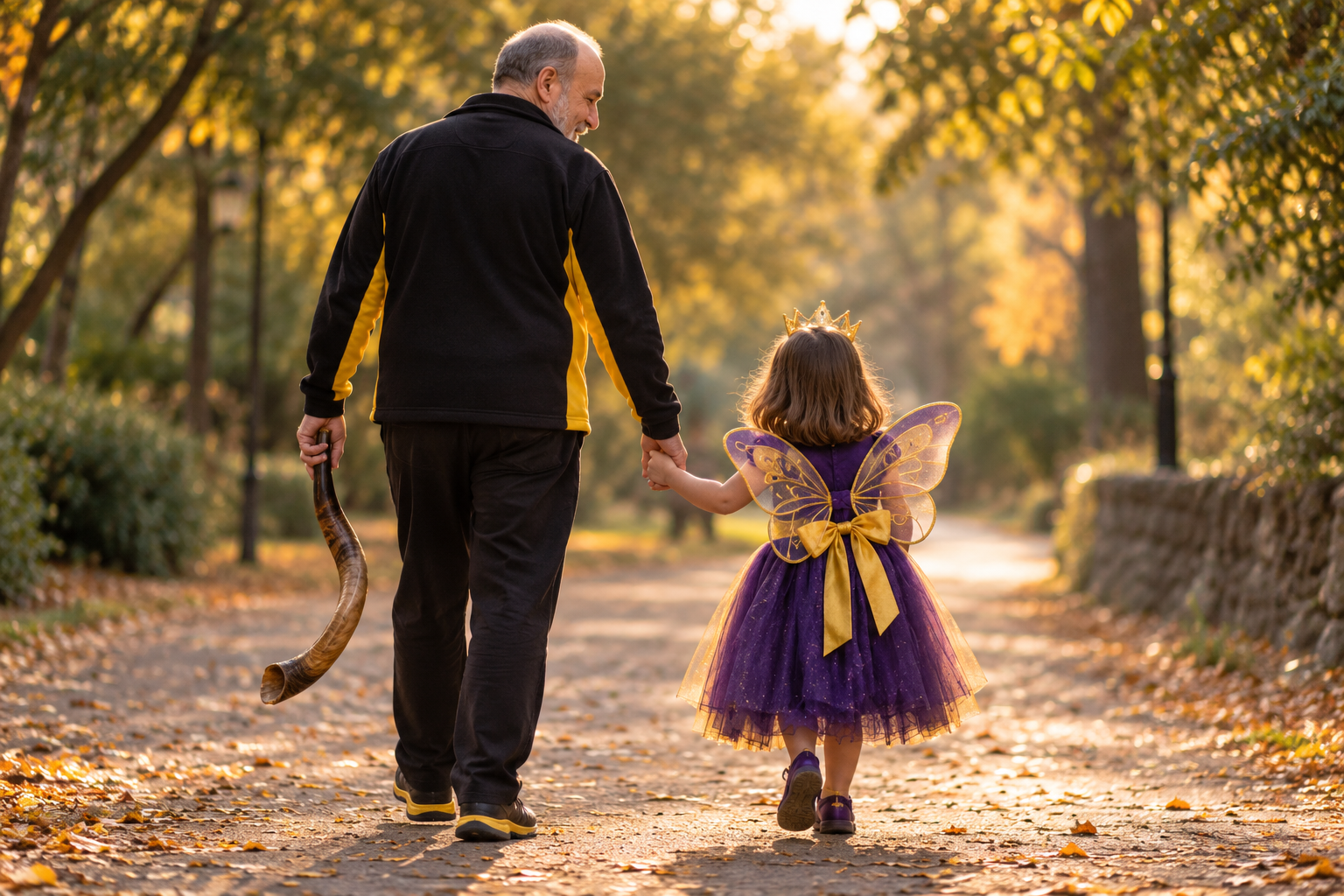
Rosh Hashanah is here, my granddaughter turns three this week, and I am sitting here crying as I write this. B’ezrat Hashem, next year I may be spending the High Holidays in Israel. I should be thinking about that with joy.
Instead, I keep thinking about my daughter. My baby girl. And her baby girl. I have written about aliyah as though it were a decision I had finally made. The paperwork says that. The planning says that. My mouth says that when people ask me. But my heart is not nearly as cooperative.
I waited my entire life to become a Zayde. Then this little girl arrived, and I discovered that all the clichés were true. She is beautiful, funny, bright, curious, affectionate and, since I am her Zayde, objectively the most remarkable three-year-old ever born. I am allowed to say that. Grandfathers have certain rights. But behind the jokes is something I have difficulty even writing: I am afraid that if I leave, she will not remember me.
Not recognize me.
Remember me.
There is a difference. I do not want to be the face that appears on a telephone and is identified for her as Zayde. I want her to remember sitting with me. I want her to remember my voice in the room. I want her to remember some ridiculous little thing we did together that nobody thought important enough to photograph. I want there to be something, years from now, that belongs to her memory and not to somebody else’s story about me.
I know what that looks like because my daughter had it. My parents were a real part of her upbringing. My father was the kind of Zayde every child should have. He was there. My mother was there. They taught her things, loved her, annoyed her, spoiled her, helped shape her, and became part of the furniture of her childhood. My daughter does not need anyone to tell her who her grandparents were. She remembers them. That is all I want for my granddaughter, and it is the part of aliyah that hurts in a place I cannot reason with.
My daughter is the third generation of our family born in Canada. Her daughter is the fourth. My parents built their life here, I built mine here, my daughter built hers here, and now she and my wonderful son-in-law have built a beautiful family of their own. I love him deeply. I love the way he loves my daughter, and I love the relationship the two of them have created. There is enormous comfort in knowing that my baby girl is loved by a good man. But there is pain too, because when I look at the three of them together, I am looking at exactly what I am preparing to move thousands of kilometres away from.
For years, that fact ended the aliyah discussion before it began. Israel could wait. My daughter was here. Then my granddaughter came, and the idea of leaving became even more absurd. I had finally become a Zayde. Why would I go anywhere? I had imagined the ordinary grandfather life: dropping in, babysitting, seeing her several times a week, getting a call because they needed me for an hour, being around often enough that nobody thought my presence was an event.
The truth is that I am not living that life now anyway. I am about sixty kilometres away. Sixty kilometres is nothing compared with an ocean, but it is enough to take away spontaneity. I do not get the Tuesday afternoon visit. I do not get the little bits of family life that never make it into a photograph album because nobody realizes, while they are happening, that these may be the moments they will miss most.
And because I already know what sixty kilometres can take away, I cannot stop imagining the opposite: five minutes. A small, affordable, ground-floor apartment near them. Nothing fancy. A place for me and Gaia.
Close enough to be useful.
Close enough to babysit.
Close enough that my granddaughter could grow up thinking Zayde was simply part of the week. Perhaps I would never have decided to make aliyah. I do not know.
And the raw truth is that if some miracle happened tomorrow and exactly that life suddenly became possible, I still do not know what I would do.
My head can make the case for Israel easily. I am seventy. I no longer want to keep postponing things until “someday,” because at seventy someday is not an unlimited resource. Montreal no longer feels like the city in which I grew up. As a Jew, I have watched things change here that I find increasingly difficult to live with. I have reached the point where maintaining the status quo simply because it is familiar no longer feels like a plan.
But my heart is not a spreadsheet.
My heart looks toward my daughter, my son-in-law and that little girl and says, stay.
That is where I am as Rosh Hashanah and Yom Kippur arrive. I am not standing confidently on one shore waving goodbye to the other. I am somewhere in the middle, and I suspect I may remain there emotionally even after the airplane lands.
The holidays are what frighten me most. I can imagine next Rosh Hashanah in Israel. I can imagine the streets, the Hebrew, the country moving according to the same calendar I have carried privately all my life. I have wanted that for decades. And I can also imagine sitting at a table, looking around, and suddenly seeing my daughter in my mind. Then my granddaughter. People around me will continue talking. Someone will pass food. Life will keep moving. Nobody will know that for a few seconds I have gone back across the ocean.
Yom Kippur may be harder. There is nowhere to hide on Yom Kippur. Eventually the noise stops and you are left with yourself, with the people you love, the people you have lost, the things you did, the things you failed to do, and the uncomfortable knowledge that another year is never guaranteed.
My parents will remain buried in Montreal. Elijah’s ashes will come with me to Israel. I still cannot write that sentence without feeling how wrong its order is. A father should not be arranging for his son’s ashes to cross an ocean. My parents will remain here. My son will come with me. My daughter, my son-in-law and my granddaughter will remain here. I look at that map and wonder how one family became divided that way.
I will come back. I will save the money somehow and try to fly home at least once a year. That is not a casual promise to myself. It is already part of how I think about affording this life. But I also know that you cannot save twelve months of grandfatherhood and spend it during a two-week visit. You cannot put all the missed Tuesdays into a suitcase. You cannot arrive once a year and recreate the ordinary. And perhaps that is why the holidays frighten me more than anything. A missed Tuesday can almost hide itself. An empty place at a family table cannot.
I have dreamed for much of my life about being able to say, “Next year in Israel.” Now, B’ezrat Hashem, it may actually happen, and I have discovered that dreams look different when they stop being dreams and start requiring an airline ticket. I knew aliyah would ask me to leave a city. I did not understand how much it would ask me to leave behind.
So this is where I am, truthfully. I am preparing to go because reality keeps showing me that the status quo is not working, and because I believe there is still a chapter of my life waiting for me in Israel that I do not want to leave unlived.
But my heart is still saying stay.
Maybe that is not a contradiction I am supposed to solve yet.
Maybe it is simply what happens when the place you believe you need to go and the people you most love are on opposite sides of an ocean.
And if that little affordable apartment five minutes from my baby girl and her baby girl somehow appeared tomorrow, I cannot honestly tell you what I would do. I know what reality is telling me; I am just not sure my heart has agreed.