
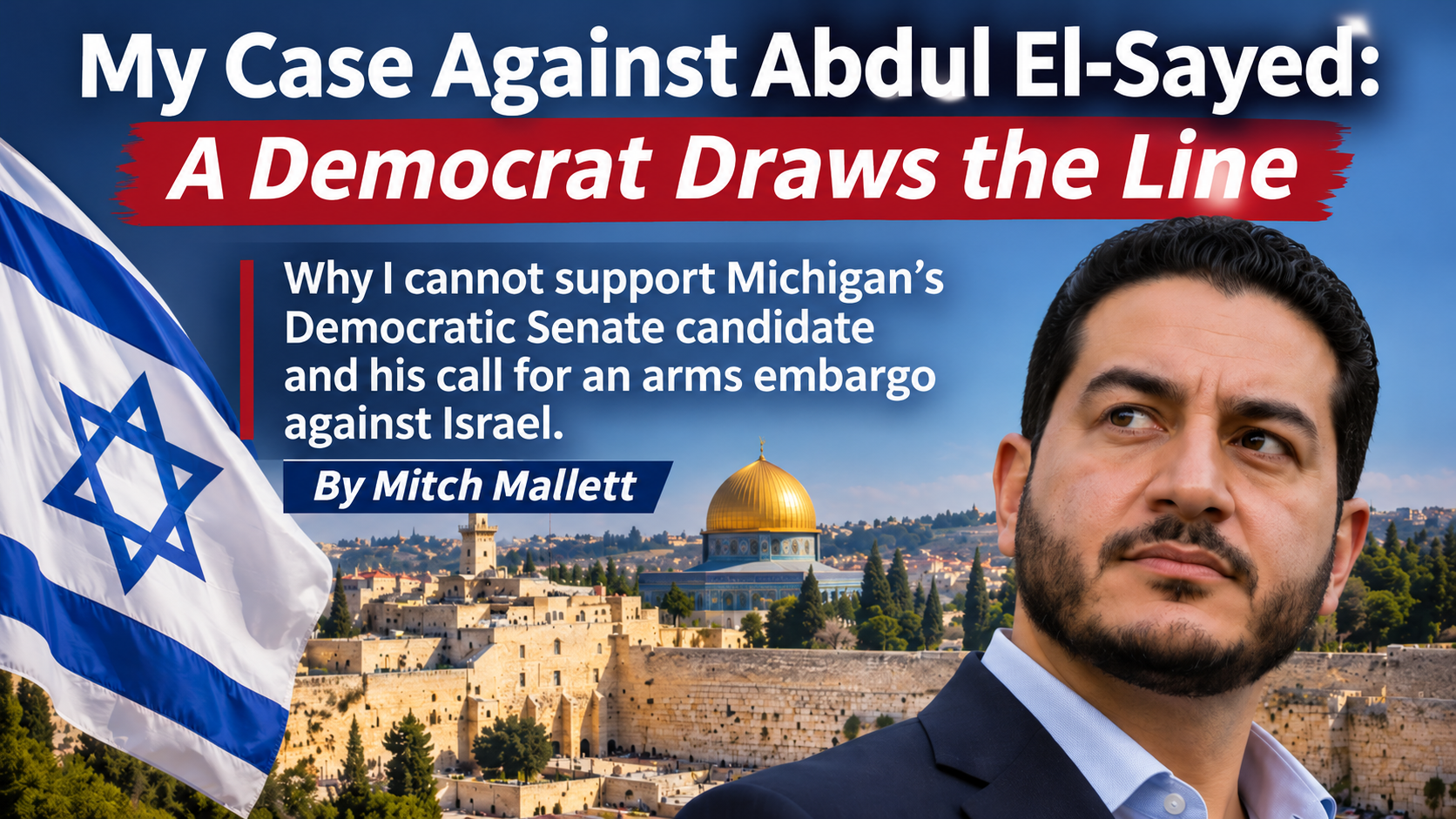
My Case Against Abdul El-Sayed: A Democrat Draws the Line!
I am a lifelong Democrat.
I believe in universal healthcare, better wages, stronger labor unions, economic opportunity, civil rights, and the traditional values that have guided the Democratic Party for generations.
I want Democrats to regain control of both houses of Congress.
Yet I find myself unable to support Michigan’s Democratic Senate nominee, Abdul El-Sayed.
His proposed arms embargo against Israel, combined with his campaign rhetoric, raises a troubling question: Is his hostility toward Israel taking precedence over America’s economic and national-security interests?
El-Sayed advocates restricting American arms transfers to Israel. During an October forum, when asked whether he would provide defensive weapons to Israel if it were attacked by Iran or another country, he declined to offer the unequivocal commitment I would expect.
But have Americans seriously considered what a broad embargo could mean?
It could hurt the American economy, American workers, and American national security.
I’m talking about taxpayers, manufacturing workers, engineers, defense contractors, entrepreneurs, farmers, and millions of Americans who benefit directly or indirectly from the technological relationship between the United States and Israel.
Because this relationship isn’t a one-way street.
El-Sayed portrays American support for Israel as an economic burden. I believe his proposed policies could do more economic harm than the assistance he criticizes.
Let’s Put the Military Spending Into Perspective
According to the Stockholm International Peace Research Institute, Israel spent approximately $48.3 billion on its military in 2025.
Under the longstanding American military assistance agreement, Israel receives approximately $3.3 billion annually in Foreign Military Financing and another $500 million for cooperative missile-defense programs.
That’s a regular annual commitment of $3.8 billion, equivalent to approximately 7.9% of Israel’s annual military spending.
Israel’s total military expenditure is more than twelve times the amount of its regular American assistance. These numbers demonstrate that Israel finances the overwhelming majority of its military spending, even before considering American weapons purchases made with Israeli funds.
These figures exclude extraordinary assistance outside the regular agreement.
Now consider the American side.
The administration’s proposed national-defense resources for fiscal year 2026 totaled approximately $1.01 trillion.
Against that benchmark, $3.8 billion represents approximately 0.38%, less than four-tenths of one percent.
Much of the military financing provided to Israel must be spent purchasing American military equipment.
That means American companies receive orders, American factories manufacture equipment, and American workers participate in producing the weapons Israel purchases.
But here’s something else Americans should know.
As of April 2025, Israel had 751 active Foreign Military Sales cases with the United States, valued at approximately $39.2 billion.
These agreements cover multiple years, not a single year’s purchases. They include purchases financed by American assistance and purchases funded by Israel.
Israel isn’t simply a recipient of American military assistance. It’s also a major customer of America’s defense industry.
Now imagine prohibiting Israel from purchasing American military equipment, even when Israel is willing to spend its own money.
What Happens to American Workers?
When a major defense manufacturer loses an important customer, the consequences can extend far beyond the factory.
Think about the engineers designing military systems, technicians manufacturing electronic components, machinists producing precision equipment, transportation companies, software developers, subcontractors, and suppliers.
Then consider the surrounding communities.
What happens to restaurants, automobile dealerships, grocery stores, homebuilders, and small businesses when families have less purchasing power?
What happens to federal and state income-tax revenue?
What happens when displaced workers need unemployment benefits?
The economic damage from lost defense contracts doesn’t necessarily stop at the factory gates. It can spread throughout entire communities.
And there’s another consideration. When workers lose their jobs, the government can lose income-tax and payroll-tax revenue while simultaneously facing increased unemployment-related expenses.
That means the financial consequences of an embargo could reach American taxpayers who have never worked in the defense industry.
The economic consequences don’t end with defense contractors. When manufacturing jobs disappear, surrounding businesses lose customers, local governments lose tax revenue, and families lose purchasing power. Those effects can spread through communities far removed from Washington.
The $39.2 billion in active sales agreements makes these economic risks worth examining, although those agreements would not necessarily all disappear under an embargo.
Has Abdul El-Sayed presented an economic-impact analysis of his proposed embargo?
I haven’t found one that answers these questions.
American workers deserve answers, not political rhetoric.
What Is Battle-Tested Israeli Technology Worth to America?
Israel has developed sophisticated military technologies benefiting its own defense and the armed forces of other countries.
Consider the Trophy Active Protection System.
Developed by Israel’s Rafael, Trophy detects and intercepts certain incoming anti-tank threats.
The United States Army has installed and tested Trophy on its Abrams main battle tanks.
This is Israeli-developed technology integrated into American armored warfare capabilities.
Now consider Iron Dome.
Israel developed the original system, and American funding and industrial cooperation subsequently became major parts of its procurement and manufacturing.
The United States Marine Corps has pursued air-defense capabilities incorporating Israeli-developed interceptors.
American and Israeli defense companies manufacture components of these systems.
Israeli innovation. American manufacturing. American jobs. And technologies that protect American military personnel.
Israel’s battlefield experience can reveal weaknesses that controlled testing doesn’t always identify. American military planners benefit from understanding how these systems perform against real threats, potentially reducing development costs while improving the equipment that protects American troops in future conflicts.
But there’s another benefit that’s harder to assign a dollar value.
Combat experience.
Israeli forces regularly operate sophisticated equipment under actual combat conditions.
That experience reveals vulnerabilities, maintenance requirements, technical shortcomings, and opportunities for improvement that might not become apparent during controlled testing.
Cooperation can give American defense planners access to operational knowledge that would otherwise require considerable time and money to develop.
Every lesson learned from combat experience potentially saves development time, improves equipment reliability, and helps military planners identify weaknesses before American troops encounter similar threats.
That experience cannot always be duplicated in a laboratory or simulated battlefield.
How much development time can be saved?
How much can military equipment be improved?
How many American GIs’ lives might be saved?
These are questions worth asking before dismantling a defense relationship.
Europe Is Benefiting From Israeli Defense Technology, Too
Consider Germany.
In December 2025, Germany inaugurated the first elements of the Israeli-developed Arrow 3 missile-defense system.
Germany purchased this technology to strengthen its defenses against long-range missile threats, particularly following Russia’s invasion of Ukraine.
The Arrow 3 program itself exemplifies American-Israeli defense cooperation.
Now Israeli-developed missile-defense technology is helping protect a major European NATO ally.
That’s a benefit to NATO and American national security.
And What About Ukraine?
Following Russia’s full-scale invasion, Israel worked with Ukraine on an air-raid early-warning system adapted from Israeli experience.
Israel has supplied Ukraine with early-warning expertise contributing to efforts to protect Ukrainian civilians from aerial threats.
This is particularly significant because Ukraine faces continuing Russian missile and drone attacks. Early-warning technology can give civilians precious time to seek shelter.
America, Europe, and Ukraine have all had opportunities to benefit from Israeli defense innovation.
Why would the United States jeopardize future cooperation without thoroughly examining what it stands to lose?
Let’s be clear: Israel faces threats from Iran and its proxies. On October 7, 2023, Hamas launched its devastating attack against Israel.
Israel Is Already Considering Ending American Military Subsidies
Here’s something that makes El-Sayed’s approach particularly difficult for me to understand.
Israel itself is discussing ending its dependence on American military assistance.
In January 2026, Prime Minister Benjamin Netanyahu publicly discussed phasing out American military aid over approximately the next decade.
The current ten-year military assistance agreement runs through September 2028.
The proposal would move the relationship away from military grants toward purchases, joint development, and cooperative arrangements.
Imagine the possibilities.
Israel stops receiving American military purchasing subsidies but continues purchasing American equipment with its own money.
American manufacturers continue receiving orders.
American workers benefit from those sales.
Both countries continue collaborating on advanced military technologies.
Isn’t that precisely the kind of relationship critics of foreign military subsidies should welcome?
Yet El-Sayed advocates an arms embargo.
Such an embargo would restrict Israel’s ability to purchase American weapons even without American subsidies.
That is not simply a proposal to save taxpayer money. It would also restrict defense transactions with an ally.
What About Future Technology Licensing?
Many existing American-Israeli defense programs involve agreements governing research, development, intellectual property, production rights, and technology sharing.
American participation can provide access to technologies developed through those partnerships.
Now imagine future Israeli innovations developed without American financing.
Israel or Israeli companies could retain control over those technologies.
If American manufacturers or the U.S. military wanted access, they might need to negotiate separate licensing or purchasing agreements.
That could involve additional costs.
And those costs could extend beyond licensing fees. American companies might also face expenses associated with adapting, manufacturing, testing, and integrating technologies that were previously developed through cooperative arrangements.
Could America save money by eliminating assistance, only to face higher costs for access to future Israeli technologies?
It’s possible.
Isn’t that another reason to evaluate the entire partnership rather than simply looking at annual aid?
Iron Beam and the Future of Laser Defense
Israel has developed Iron Beam, a high-energy laser system designed to intercept certain aerial threats, including rockets, mortars, and drones.
In December 2025, Israel delivered its first operational Iron Beam system to the Israel Defense Forces.
Laser defense could change the economics of intercepting certain threats.
Traditional interceptor missiles can be expensive.
Laser systems have the potential to reduce the marginal cost of some interceptions dramatically.
Now imagine those technologies helping defend American military bases, ships, and facilities.
What could that capability mean for American military personnel?
What would it cost America to develop comparable capabilities independently?
These are questions American policymakers should be asking before advocating an arms embargo.
Israel’s Universal Healthcare: Why Aren’t We Studying It?
An advertisement supporting Abdul El-Sayed recently portrayed an American couple struggling to afford groceries.
The advertisement discussed American assistance to Israel and suggested American taxpayers might also be paying for Israel’s universal healthcare system.
That implication is misleading.
The advertisement was produced by Rebellion PAC, an outside organization, not El-Sayed’s campaign.
His campaign publicly distanced itself from the advertisement.
But the suggestion about Israeli healthcare overlooks something extraordinary.
Americans could learn a great deal from Israel’s healthcare system.
Israel’s national health insurance system provides universal coverage to eligible residents, including Jews, Muslims, Christians, Druze, and other communities.
According to the OECD’s Health at a Glance 2025, Israel spends approximately 7.6% of its gross domestic product on healthcare.
The United States spends approximately 17.2% and does not provide universal coverage.
America devotes more than twice the share of its economy to healthcare that Israel does.
Yet Israel provides universal coverage for core healthcare services.
American military assistance does not fund Israel’s national health insurance system.
Instead of suggesting American taxpayers are paying Israel’s healthcare bills, why aren’t American politicians asking:
What is Israel doing that we could learn from?
As a lifelong Democrat who supports universal healthcare, I find it extraordinary that politicians advocating similar policies would overlook Israel’s experience.
Universal Healthcare Can Help Free Entrepreneurs
Imagine you’re an American with a good job, a family, and health insurance through your employer.
You’ve developed a promising business idea that could create jobs and improve people’s lives.
There’s just one problem.
Your family’s healthcare coverage depends on your employment.
If you leave your job, you must arrange replacement coverage, potentially at considerable expense.
You decide pursuing your idea isn’t worth the risk.
So you stay employed.
Your company never gets started.
America may never benefit from your innovation.
Economists call this phenomenon job lock.
With universal healthcare, coverage doesn’t depend on keeping a particular job.
Imagine the difference that could make for someone who has developed a promising invention but fears losing healthcare coverage for a spouse or children.
Instead of remaining employed simply to preserve insurance, that person could pursue an entrepreneurial opportunity.
A new business might create jobs, generate tax revenue, and develop technologies that benefit society.
Consider the American who has spent years developing an invention but cannot afford to leave a job because the family’s health insurance depends on it. How many businesses, innovations, and potential American jobs never materialize because of that obstacle?
Could that help explain part of Israel’s extraordinary record of entrepreneurship?
Israel has developed one of the world’s most concentrated startup and technology ecosystems relative to its population.
Its achievements have many causes, including research, education, military technology, venture capital, and entrepreneurial culture.
Isn’t that something America should examine?
Affordable Universities: Another Piece of the Puzzle
Israel’s publicly funded universities receive substantial government support.
Higher education tuition is heavily subsidized, and scholarships are available.
For the 2026–27 academic year, standard undergraduate tuition at Bar-Ilan University is approximately 12,203 shekels annually, or approximately $3,900 per year.
Now combine those advantages.
A young Israeli graduates with a promising business idea, potentially less educational debt than a comparable American student, and healthcare coverage.
Israel demonstrates that universal healthcare, subsidized higher education, and a highly entrepreneurial free-enterprise economy can coexist.
These are not mutually exclusive economic philosophies.
They can complement each other.
Instead of attacking Israel, perhaps we should be studying its successes.
Israel’s Water Technology: Another Benefit America Cannot Afford to Ignore
Israel has long struggled with limited freshwater resources.
Large portions of the country are arid.
Yet Israel has become a global leader in desalination, water recycling, and efficient irrigation.
By 2026, Israeli desalination facilities supply approximately 70% to 80% of the country’s potable water needs.
That’s drinking water!
Israel also supplies water to the West Bank, Gaza, and Jordan.
Israel has developed extensive wastewater recycling systems and advanced agricultural irrigation technologies.
A country with significant natural water limitations has developed technologies that substantially reduce its dependence on rainfall.
And those technologies have applications throughout the world.
Consider the United States.
American farmers face recurring droughts and increasing pressure to conserve water.
Communities in the Southwest and other regions struggle with long-term water supplies.
Texas has extensive coastline along the Gulf of Mexico and regions facing serious water challenges.
Could seawater desalination become part of the solution?
Absolutely.
Imagine Israeli engineers and American scientists working together to reduce desalination costs.
Imagine abundant water supplies allowing agricultural expansion.
Imagine irrigation technologies enabling American farmers to grow more food using less water.
And imagine what those advances could mean for communities facing recurring water shortages. More reliable supplies could encourage investment, support agriculture, and help communities plan for economic growth.
Imagine research partnerships creating new American jobs and industries.
Israel’s experience demonstrates that water shortages don’t have to permanently limit economic development. Through desalination, recycling, and more efficient irrigation, communities can reduce their dependence on rainfall and create new opportunities for agriculture, industry, and population growth.
Why would America weaken its relationship with a country that has so much technological knowledge to share?
Israel’s Protection of Christian and Jewish Holy Sites
Israel protects Christian and Jewish holy sites, including some of the most sacred places in Jerusalem’s Old City.
Imagine if Hamas gained control of Jerusalem. Given its record of religious extremism, I believe these irreplaceable churches, synagogues, and sacred landmarks would face an immediate threat of destruction.
Protecting Israel also means protecting religious heritage that belongs to Christians and Jews throughout the world.
The Abraham Accords: What Cooperation Can Accomplish
The Abraham Accords demonstrate something else worth remembering.
Arab countries with longstanding political disagreements are recognizing the benefits of cooperation.
Why is El-Sayed advocating policies that could take us in the opposite direction?
Israel and several Arab countries have pursued normalization and expanded economic relationships.
The possibilities extend beyond diplomacy into agriculture, healthcare, energy, transportation, water management, scientific research, and technology.
Imagine Israeli innovations improving agricultural production throughout the Middle East.
Imagine expanded desalination programs addressing regional water shortages.
Imagine American companies participating in partnerships involving Israeli and Arab engineers, entrepreneurs, and scientists.
Those possibilities could benefit millions.
Of course, serious political challenges remain.
The Palestinian question requires sustained attention, and meaningful regional peace must include legitimate Palestinian aspirations for security, dignity, and self-determination.
But cooperation offers possibilities that confrontation cannot.
Imagine what Israel, its Arab neighbors, and the United States could accomplish by expanding partnerships rather than allowing political hostility to prevent them.
That’s the future I want America to help build.
Abdul El-Sayed: A Democrat Draws the Line
I’m a lifelong Democrat who wants our party to regain control of Congress.
I’m voting for Angie Nixon here in Florida despite our disagreements about Israel. I’ve met Angie, spoken with her, and found her open to discussing Israel. I believe her passion is improving the lives of ordinary Americans.
With Abdul El-Sayed, I see something fundamentally different.
His proposed arms embargo, including restrictions on weapons Israel would purchase with its own money, raises serious concerns about his priorities.
Consider what we’ve examined: American manufacturing jobs, defense technology, scientific innovation, healthcare, education, water conservation, religious heritage, and regional cooperation.
These are benefits Americans should be expanding, not jeopardizing.
I have not seen El-Sayed make a convincing case that his proposed embargo serves America’s economic or national-security interests.
In my October 28 Times of Israel article, “I Want My Cake and Eat It Too: A Democratic Senate Without Abdul El-Sayed,” I explained why I believe Democrats can regain the Senate without electing him.

If I lived in Michigan, I cannot envision myself voting for Abdul El-Sayed.
I never imagined reaching that conclusion about a Democratic Senate nominee.
But I believe his campaign rhetoric reflects an ideological hostility toward Israel that echoes the agenda of jihadist movements.
I want Democrats to regain the Senate, but not at the expense of America’s economic and national-security interests.
I never thought I would not support a democratic nominee. I am convinced that Abdul El-Sayed does not have America’s interests. I believe his mission in the Senate will be that of Jihad! That’s why I cannot support him and I urge you not to vote for him.