Exiled Iranian Writer & Political Commentator
My Country Didn’t Lose Me. It Pushed Me Away.
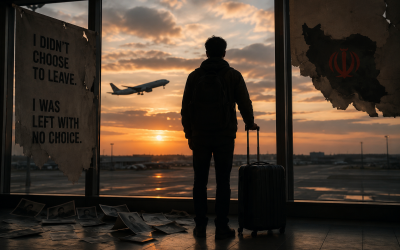
People often tell refugees and exiles that they chose to leave.
I have always found that statement misleading.
Choice suggests freedom. It suggests that all options were available and that one path was simply preferred over another. But for many of us, leaving was never a dream, a plan, or an adventure. It was the result of watching opportunities disappear one by one until staying became harder than leaving.
I did not leave my country because I stopped loving it.
I left because I stopped believing that the future I wanted could exist there.
For years, I watched talented young people abandon careers, families, and ambitions in search of something many societies take for granted: the chance to build a life through hard work and ability. Some left for freedom. Some left for security. Some left because they were tired of waiting for a future that never seemed to arrive.
Governments often speak about migration as if it were a natural phenomenon, something beyond their control. But when millions of educated, skilled, and ambitious citizens leave over decades, that is not an accident of history. It is a warning sign.
Countries do not simply lose their people.
They push them away.
Iran is a country rich in history, culture, and human talent. Yet generation after generation has watched classmates disappear into airports, relatives settle abroad, and professionals rebuild their lives in foreign countries. Entire conversations have become routine:
“Who left this year?”
“Who got a visa?”
“Who is trying to leave next?”
No nation should consider that normal.
The tragedy is not that people seek a better life. Human beings have always done that. The tragedy is that so many feel they must leave in order to have any realistic chance of finding one.
The official explanations are familiar. Sanctions. Economic challenges. International pressure. Global migration trends.
Those factors matter.
But they do not explain everything.
People can survive economic hardship. People can endure uncertainty. What they cannot endure forever is the belief that their future is permanently closed.
Hope disappears when effort no longer feels connected to opportunity.
Hope disappears when merit seems less important than connections.
Hope disappears when people begin to believe that their lives are being shaped by forces they cannot influence.
And once hope disappears, departure becomes more than a possibility. It becomes a survival strategy.
As a Kurd, I experienced another dimension of this reality. Questions of identity, representation, and belonging were never abstract political concepts discussed in newspapers. They were part of everyday life. They shaped how people saw themselves and how they believed they were seen by the institutions that governed them.
A nation cannot ask people to feel loyalty while denying them a sense of belonging.
Eventually, people stop asking how to improve their future at home and start asking how to build one elsewhere.
Exile, however, comes with its own cost.
It means missing weddings, funerals, birthdays, and ordinary moments that can never be repeated. It means watching your homeland from a distance. It means carrying memories that become more valuable with every passing year.
No one celebrates those losses.
No one leaves without leaving something behind.
That is why I reject the idea that people like me simply chose another country.
I did not wake up one morning and decide that I wanted to become an exile.
I became an exile because remaining felt increasingly impossible.
My country did not lose me by accident. It drove me away through years of shrinking freedoms, broken expectations, and a system that demanded patience while offering less and less reason to believe.
And I am not alone.
Millions of Iranians now live beyond the country’s borders. Their stories are different, but they often arrive at the same conclusion: they did not leave because they stopped caring about their homeland.
They left because they could no longer imagine a future inside it.
A country loses more than people when this happens.
It loses experience.
It loses talent.
It loses trust.
And perhaps most importantly, it loses the confidence of those who once wanted nothing more than to stay and help build its future.
The painful truth is that most exiles never wanted to leave.
They wanted a reason to remain.
For too many, that reason never came.
Related Topics
Related Posts