

A New York City Cantor
My Encore to Jesse Welles’ Fans: Art Should Be Debated, Not Silenced
At the Newport Folk Festival this summer and at Farm Aid last weekend, Jesse Welles closed his set with one of his most popular songs, War Isn’t Murder, a song I criticized, as his encore. This article is my encore.
As a Jewish cantor and Dylan researcher, I’ve watched Jesse’s rise as a protest songwriter with deep interest and growing concern. My first article, published in the Times of Israel, pointed out that Jesse swiftly rose to prominence as an anti-war songwriter only in the onset of the Gaza war. He is hailed as the next Dylan or Woody Guthrie, but he has never once mentioned the tragedy of October 7, Hamas, the 1,200 Israelis slaughtered, or the 48 hostages still held in Gaza.
I was subsequently banned from the Jesse Welles Fan Club on Facebook, a public group whose posts are promoted heavily to those who show any interest in Bob Dylan and Woody Guthrie. They bizarrely accused me of having “infiltrated” their fan club when in reality their content was algorithmically pushed to me. In Google searches it’s right after my article, titled “Rebuttal to Antisemitic Claims to Singer.” Among other awful things, his fans called me a “swine,” accused me of “trolling,” and said my writing was “garbage” and “bull crap.” One went further, claiming that actually Jews stole the folk revival, a statement as historically false as it is antisemitic.
A top contributor to the group attempted to submit a rebuttal to the Times of Israel accusing me of “cherry-picking” only four songs from the almost daily ditties that Jesse posts. Without any evidence, she concludes her rant against me claiming that Jews “are the ones who committed the ‘theft’ in the first place, if you want to be truly accurate.”
She complained that Times of Israel declined to publish her piece, but it’s no wonder why. Her conclusion mirrors the rhetoric of a large number of the fan club who label Israelis as white European settler-colonialists who stole their land from innocent Palestinians and are now intentionally starving and waging a genocide against them.
If there is evidence that Jews “committed theft” of the folk revival, no one has yet presented it. Jews built the Newport Folk Festival. Founded by George Wein, who first established the Newport Jazz Festival with Lewis and Elaine Lorillard under John Hammond’s guidance in 1953, the Folk Festival grew out of that initiative, joined by Al Grossman, Oscar Brand, and Hammond’s signed artist, Pete Seeger, who encouraged Hammond to also sign Dylan.
Theodore Bikel, a towering figure in Jewish music, Yiddish theater, and human rights activism, served as a co-founder, a guiding spirit of the festival and one of its most beloved performers. Like my mother’s family, Bikel fled Austria for Palestinian Mandate in 1938 before immigrating to the United States. Folk cafe culture was imported to America from Europe by young Jewish immigrants who were excluded from much of European society and needed a place to discuss politics and share culture.
Bikel first founded The Unicorn, one of the earliest folk coffeehouses in L.A. in 1956 with his partner Herb Cohen. Most other folk coffeehouses across America were founded or led by Jews. The Gilded Cage in Philadelphia (1956) by Esther and Edward Halpern, which hosted emerging artists like Peter Paul and Mary and Simon and Garfunkel. Cafe Wha? (1959) by Manny Roth, Gaslight Cafe’s Sam Hood and The Folklore Center’s Israel “Izzy” Young. While strongly opposed to Dylan’s electric performance at Newport, Bikel pushed Dylan to return to the stage for one last acoustic folk song, It’s All Over Now, Baby Blue, which is cited as the song that marked the end of the folk era.
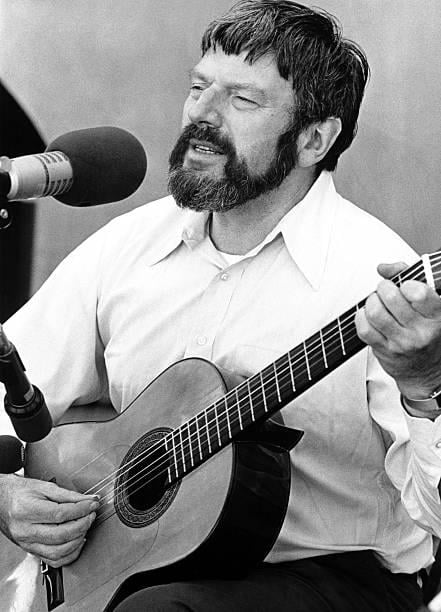
On October 8, I will be hosting Aimee Bikel, Theodore’s widow, at Stephen Wise Free Synagogue for a program celebrating his life and legacy. I will sing music he loved, including Rich Man from Fiddler on the Roof, but also Hulyet, Hulyet Kinderlekh, a joyous Yiddish children’s song that Bikel sang at the festival in 1968. Aimee features exclusive video footage and a very engaging presentation.
Bikel, a fervent Zionist who grew more sympathetic to Palestinian suffering in later years, spoke powerfully about the nuanced difference between criticism and silencing. In his 2011 Washington Post op-ed “Art Should Be Debated, Not Silenced,” he wrote:
“In a democracy…places of culture and art should be safe from attacks by interest groups seeking to impose their own narrow agendas on public discourse…Debate what you don’t like. Mount counter-arguments in print, in song or on stage. But do not silence voices.”
Bikel’s words are not a license for mob silencing, nor for a political movement to take over the Folk Festival with flags and slogans — they are a call to dialogue. I tried to have a sincere and civil dialogue with Jesse’s fans, but when I pushed back on repeated false claims and pointed out Jesse’s dangerous omissions, they chose to silence me by blocking me from the group.
We live in a time when silencing voices has become a reflex, from the left and the right. Jimmy Kimmel and Stephen Colbert, celebrated for their irreverence, have faced calls to be muzzled or have had their segments pulled because someone deemed their jokes “too far.” That should worry anyone who truly believes in the power of free expression.
If Jesse’s fans really want dialogue, if they truly believe art should provoke thought, then I think they would benefit from being open to hearing other arguments and news sources. They shouldn’t have blocked me, they should have engaged me.
I can’t analyze every word of Jesse’s daily ditties for a blog, I examined only four relevant examples. But this fan accused me of “cherry-picking” Jesse’s catalog, pointing to Dead Diplomats as evidence that Jesse recognised antisemitism.
Jesse reports the D.C. terrorist’s murders only as means to attack the IDF. What should have been a charge against the shooter’s motive, “Free Palestine” rhetoric, he twists into an unknown IDF soldier’s excuse to murder more innocent women and children in Palestine:
Now Yaron and Sarah / Are together in Heaven / Before they could be wedded in life / More people will die / Down in Palestine / For justice is blood in this fight / Now out in the Strip / A young soldier hears word / Of a couple that would not be wed / And as he takes aim / He’s got someone to blame / For the children and women all dead.
That is not a condemnation — it is a reframing of Jewish suffering into a justification for anti-Israel rage. In typical form, he equates Israel’s efforts to defend their homeland, defeat Hamas and rescue their hostages with the senseless murder of two Jewish innocents in Washington D.C. “An eye for an eye ‘til we’re all good and blind,” as if the intentions of both parties are identical.
His fans proudly believe they’re more enlightened by distinguishing between anti-zionism and antisemitism. But we know that assailants don’t stop to inquire their Jewish targets of their beliefs on Zionism or geopolitics before attacking them.
I’ve never denied Jesse’s talent. While I don’t enjoy his voice, he is a clever wordsmith and a very talented guitarist. And I agree wholeheartedly with those of his fans who deplore the frequent comparisons made in the group to Dylan and others. Like them, I believe that Dylan emerged in a different time with a genius and influence on the world that can never be replicated.
Fans insist “Welles has never compared himself to Dylan,” but this is misleading. In truth, he warmly welcomes, affirms and encourages the comparisons. I’m certain Dylan is a keyword encouraging the online algorithm to promote Jesse’s posts to me and others. I know this because we truly cannot escape him, no matter how hard we try.
Jesse was interviewed in Rolling Stone Magazine of his shocking (but clearly staged) Newport performance where he concluded Revolution by The Beatles by violently smashing and stomping on his electric guitar, storming angrily off of the stage. Comparing this spectacle to Dylan’s “going electric” moment, cannot stand.
His distortion pedal was the culprit, failing to make his guitar solo loud enough. So there was truly no need to smash his guitar, except to invent a moment to make a comparison to Dylan. Jesse quoted Dylan, affirming to Rolling Stone that his debut was Dylanesque at Newport by saying “I contain multiple dudes,” a carefully crafted reference to Dylan’s “I Contain Multitudes.”
But Dylan didn’t perform under a Palestinian flag or a flag of any other kind at Newport; he resisted being used as a tool by a political movement. He was booed for refusing to conform to being their mouthpiece and in their mold. In 1966 he was famously heckled in Manchester as “Judas,” for desecrating the expected norms of their folk protest movement. Jesse is doing the exact opposite. According to his fans, he is their “Poet Laureate,” who is “galvanizing a movement.” He is giving today’s “Free Palestine” movement exactly the soundtrack it wants.
At the same time, I have to credit Jesse for writing a song lamenting the assassination of Charlie Kirk. It was actually brave to write that and it may have cost him some progressive fans. But I wish he could extend even a fraction of that compassion to Israelis and all the victims of October 7.
This is not about silencing dissent. I am not opposed to criticism of Israel. I hear it all the time from my closest Israeli family members, who routinely do far more well-informed and brilliant take-downs of Israeli policies and politicians. I have often criticized its policies myself. But there is a difference between criticizing a government and denying a country’s right to exist. Bikel understood that distinction and called it out. Jesse’s fans do not.
Rabid rhetoric online spills into the real world as antisemitism, endangering our psychological and physical safety. I try to return to the North Country as often as I can to visit family, friends and my father’s grave in Duluth. One family visit this year coincided with Bob’s birthday in late May. We stopped at one Dylan Days event in Duluth where I intended to jam with a local artist.
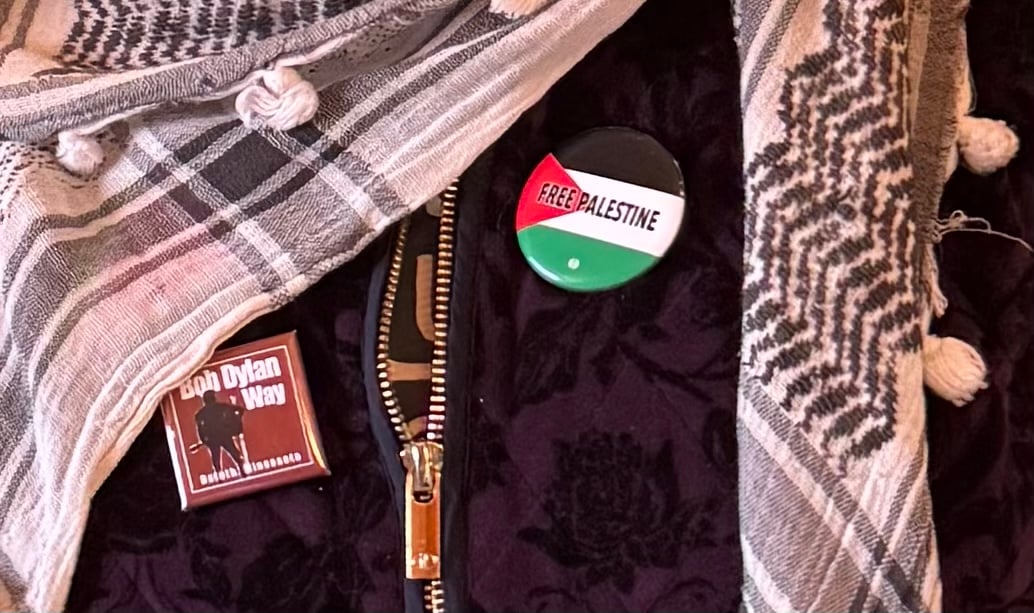
As soon as I took my guitar out, I was swiftly escorted to the exit by my brother and warned about a small group of Dylan fans making trouble for us. Some were wearing keffiyehs and Dylan Way pins (an odd combination?), and were hurling insults at my family, accusing them of murdering babies in Palestine.
While attempting to defend my family and explain that Bob is actually a Jew and a lifelong supporter of Israel, one woman sneered, “oh yeah, what would you know about being Jewish?” “I’m actually clergy and I lead a Jewish community in worship,” I responded. One of them leaned into me and seethed, “Oh, you religious ones are the worst!” With that fresh taste of trauma, feeling absolutely unwelcome and threatened in Bob’s own birthplace, we disengaged and departed for our dad’s grave. We held a cathartic and healing kumzitz together as the Singer family often does.
As we enter the Ten Days of Repentance, I feel a need to let go of these memories now and choose forgiveness — for the crazed Dylan fans who shouted us out of the cafe, for Jesse’s fans who insulted me, for Jesse himself for the sins of omission. But forgiveness does not mean silence.
I wish that they’d watch Rabbi Ammiel Hirsch’s incredible Rosh Hashanah sermon, “Two Years In,” and be moved to tears as I did this week. Perhaps the truly inspiring story of heroism he shares of the Bedouin Israeli Sergeant, Ramo Alhuzeil, who saved over 300 lives on October 7th, might inspire Jesse to write something heroic and unifying about Israel. Perhaps we can shift the focus of war away from victimhood and blame to focusing upon the heroism and inspiring acts of kindness that emerge from this tragic war.
My prayer for 5786 is that Jesse and his fans step out of their algorithm, open themselves to complexity, and reckon with the very real antisemitism that has become intertwined with the “Free Palestine” movement.
Raise your voices for peace, demand the hostages be returned and that the war ends swiftly, but not at the expense of Jewish suffering and Jewish lives.
This is my encore.
And no guitars were harmed in the writing of this article.