My First Year in Israel: How’d I get here?
I’m coming up to my one-year Aliyah anniversary, and I have nothing profound to say. Sure, I’m happy here. After all, I’m among my Jewish brothers and sisters, living the Zionist dream—in Jerusalem, mind you. Kosher food everywhere. Torah study opportunities abound. I’m home. Blah, blah, blah. It all sounds so cliché even if it’s true. The thing is, approaching the one-year mark, I have more questions than answers, which I’m beginning to understand is the nature of this place.
For instance, How’d I get here? What possessed me? First, some perspective.
I was born in Brooklyn, worked in the Catskills, attended Brooklyn College. I moved to San Francisco for law school, maintained a Bay Area law practice for thirty-three years, was a community activist, served on my city’s planning commission. For 21 years, I was part of a small but spiritually nurturing Modern Orthodox Jewish community in Oakland where I raised my kids. For three decades, I held season tickets to the Oakland A’s. Was even in a rock-and-blues band. This is all to say that I was firmly rooted in the States and in my Jewish community.

Yet here I am, almost a year later, looking out my terrace window, watching my Jerusalem street come alive as I write.
My experience is not unique.
Whatever happened to me happened to the 3,499 other Jewish Americans who felt compelled to pull up stakes, separate from over 99.9% of Jewish Americans, and high-tail it to the promised land. Whatever happened made the 3,500 of us unique.
I’ve formally interviewed about a dozen people who made Aliyah this past year and surreptitiously interviewed dozens more at Shabbat tables, shul kiddushes, cafes. Why did you make Aliyah? The standard answers: “I was always a Zionist.” “Always felt at home here in Israel.” “I wanted to raise my children here.” “My children and grandchildren are here.” “I felt this was where I belonged.” These are rational reasons why someone made Aliyah, but none explained what possessed them to do so. What was this enabling force that bestowed upon them the will to disengage from a deeply rooted Jewish American life and start a new, uncertain one here in Eretz Yisroel? I’ve been searching for the answer since my arrival.
Another question: Okay, I’m here. Now what?
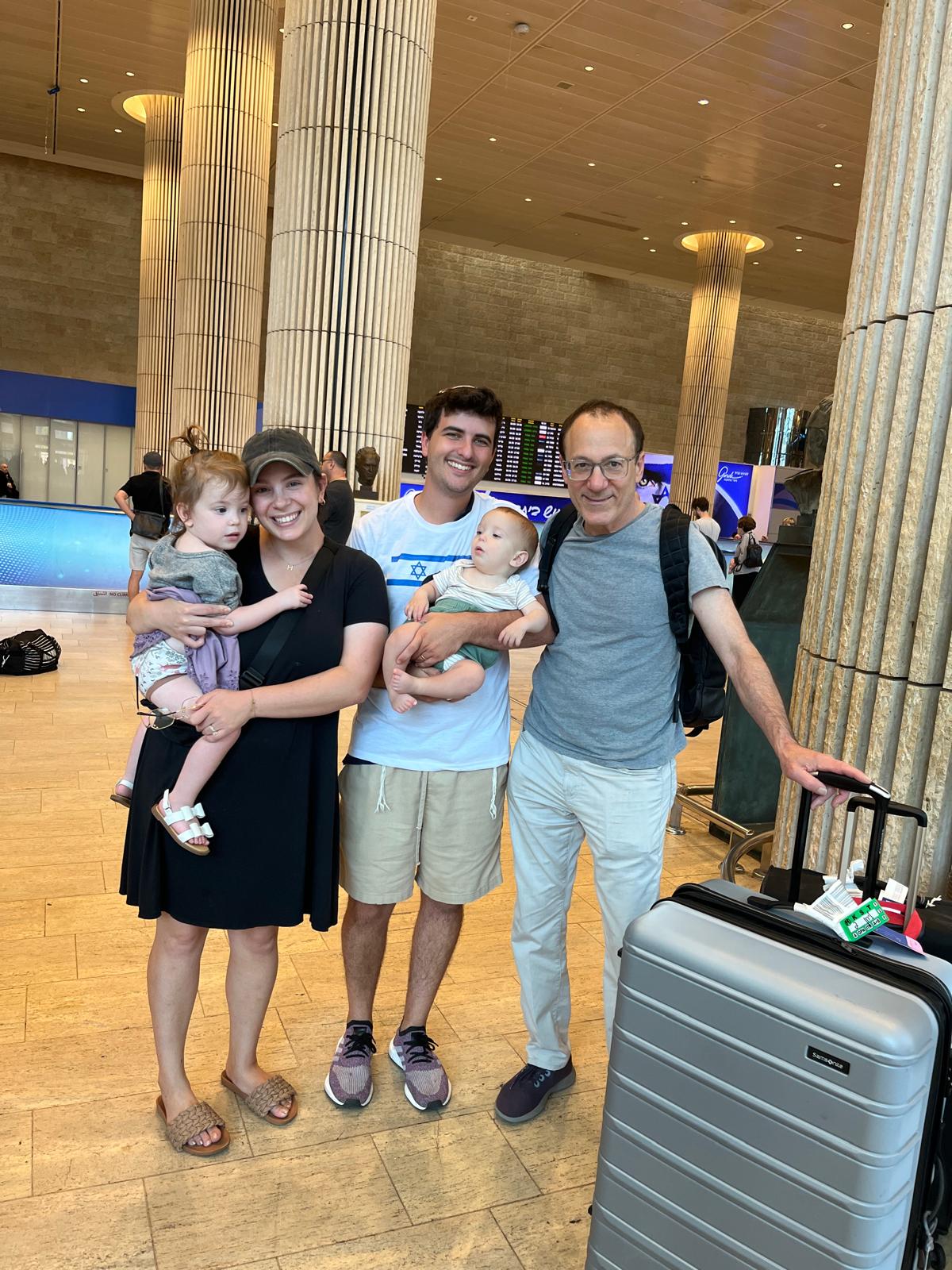
My daughter and her family live here, but they’re in Carmei Gat, a community southwest of Jerusalem reachable by a two-hour bus-and-train ride. I see them occasionally, but not enough, as my daughter says. She’s right. I should visit more often, but I don’t believe I’m living in Israel just to be a father and grandfather.
I knew only a couple of people when I arrived. I had to find an apartment, a shul, friends, a community, good hummus (it was harder than expected), learn Hebrew (don’t get me started on Ulpan), buy a washer and dryer. I was starting over, by myself. I had to take root in my new city of Jerusalem. I had to find my life.
I’m making excuses, complaining; I haven’t answered my question. Patience.
You leave behind a life you’re used to in the States to live in the land that, in the Torah, G-d promised to the Jews eleven times. Because you’ve taken G-d up on that promise, in the back of your mind, you harbor an expectation of some sort of divine life change as you wander the streets of Jerusalem, or at least of hearing G-d whisper in your ear when you visit the Kotel. You’ll admit this to no one, by the way. But the reality is that life in Israel is almost as routine as it was in the States. Manna doesn’t fall from heaven in Jerusalem, so I have to cook and go food shopping. I make challah for Shabbat just as I did in Oakland. I watch movies on Netflix. I study a little Torah. I go to the dentist, exercise at the gym. I hang out, go out, and write at cafes. I get my hair cut. I go to shul. I’m doing all the same stuff I did in the States.
But is it really the same?
While I may have been firmly rooted in my Jewish American community, no Jew is entirely rooted in their host country, no matter how many generations back their family goes. The drastic rise in Jew hatred worldwide testifies to this point. Assimilation and success have guaranteed Jews nothing. As we are once again witnessing, our host countries inevitably turn on us, which is the message Theodor Herzl, the father of modern Zionism, tried to get across to the Jewish people in 1896 when he published “The Jewish State,” his eighty-eight-page manifesto of Jewish liberation.
When the root of a tree seeking nutrients encounters a rock in the ground, it recognizes this obstruction as a threat to its survival and redirects itself toward life-sustaining soil. Herzl’s Zionism was about recognizing the threat that Jew hatred posed to the survival of the Jewish people and the necessity of redirecting the Jewish soul back to Eretz Yisroel for safety and spiritual sustenance. For the 3,500 of us Jewish Americans who made Aliyah in 2025, we rode the will of our roots back to Eretz Yisroel for the nourishment of our souls and the protection of the Israel Defense Forces (IDF).
During the five weeks of war with Iran this year, I had to enter either my miklat, my apartment building’s communal bomb shelter, or a friend’s mamad, a safe room in an apartment, more than 40 times at all hours of the day and night. With my own eyes, I saw Israel’s Iron Dome intercept Iranian missiles flying over Jerusalem. I feel protected here rather than afraid when I see a Jew in a grocery store with Tzitzis hanging out and an Emtan Ramon 9mm semi-automatic pistol clipped to his belt. Wearing a yarmulke here is the norm rather than a fearful fashion statement. I wrap tefillin on a train ride from Tel Aviv to Jerusalem, and no one looks at me as if I am doing something strange. As Shabbat arrives, the streets of my Jerusalem neighborhood grow quiet because this day of rest is part of the cultural fabric, even among the non-observant. None of this was routine in the States.
I listen to mothers and fathers talk about what they’ve been through, watching their sons and daughters repeatedly called up to war by the IDF. Everyone knows someone lost to war. I see the strain on young mothers as they manage their households while their husbands fight in Lebanon or Gaza. I see the resilience of these same mothers, fathers, sons, and daughters, who declare they will make whatever sacrifices are necessary to defend the Jewish State. None of this was part of my routine in Oakland. I am part of Israel now, where, unlike in the States, Jews are not afraid to do what it takes to protect the Jewish people. This makes everything I do here non-routine.
Like everyone else I’ve met in Israel who once hailed from the U.S., Canada, England, Australia, South Africa, South America, Ethiopia, the former Soviet Union, I am here as an affirmation of my Jewish identity. We have all submitted our wills to the pull of our souls and planted ourselves in the land of Israel.
So, Now what?
We nourish ourselves. We cry with our Jewish brothers and sisters when we hear of a loss. We attend each other’s simchas. We do Shabbat together. We seek companionship, friendship, love. We shop, argue, complain, study, exercise, vote, swim in the ocean. When we’re on a bus and see young children aboard coming home from school, we watch them as if they’re our own. And because we do all of this in the land that G-d promised us, we listen for G-d’s whisper at the Kotel. And when we go about our routine, we seek the divine.
Am Yisroel Chai.