From memory to meaning to action
My grandparents told me about Auschwitz at 8; I took baths for a year
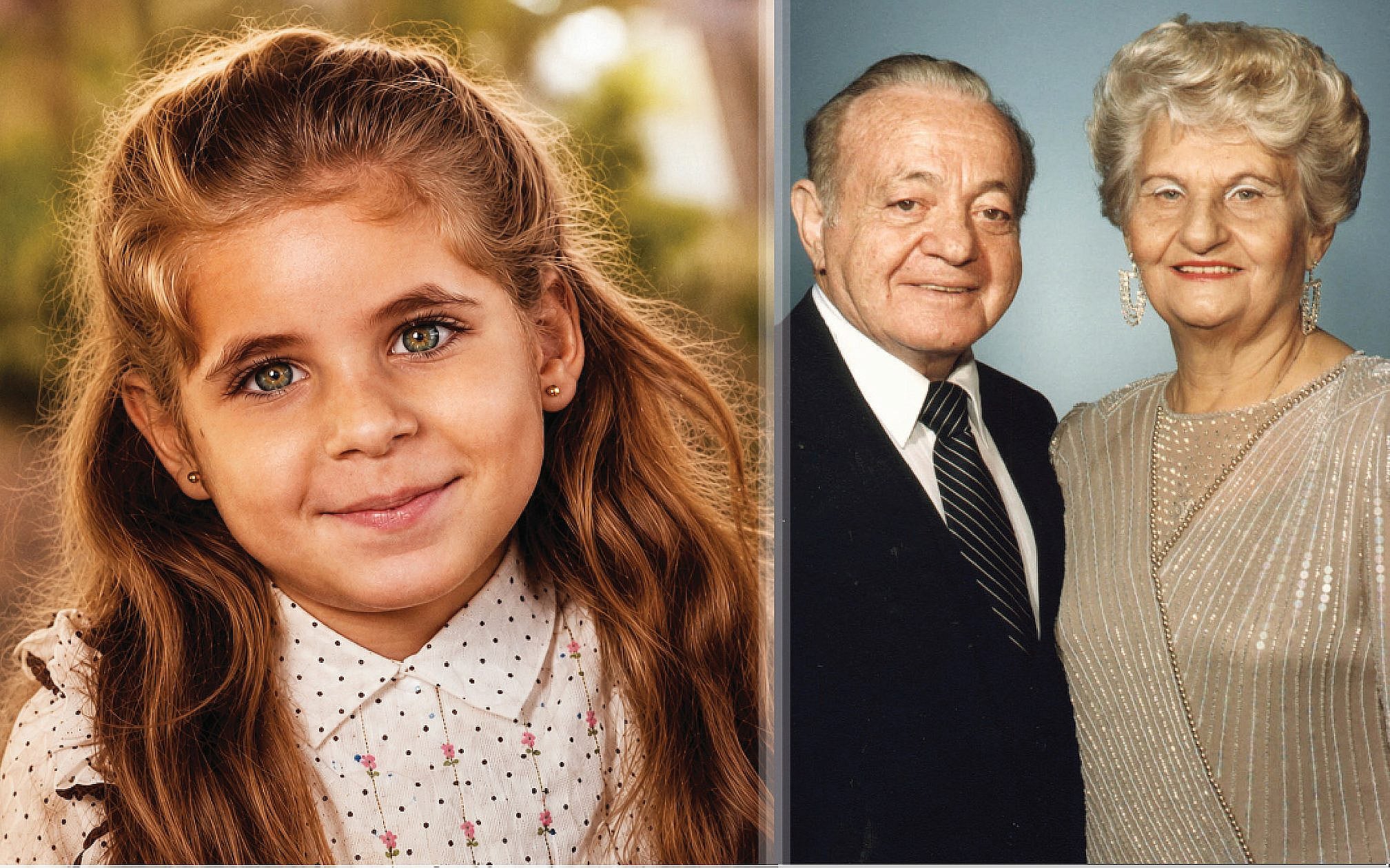
A young Hagit with her beloved grandparents, Boris and Rose.
The shiny metal showerhead was staring down at me. From where I stood, it seemed impossibly high above my eight-year-old body. Yesterday, I wouldn’t have given it a second thought. Today I stared back at it with fear.
Earlier that day, my grandparents had begun telling me about what they had lived through during the Holocaust. My grandmother described the relief she felt each time she showered in Auschwitz-Birkenau and gas did not come out and kill her.
I had never heard a story like that, and I wasn’t about to take any chances that gas might come out of my own showerhead. I couldn’t completely understand what she was describing to me, so for about a year I did the only sensible thing. I took baths.
I asked my grandmother, “Why did people hate Jews? Did they stop hating Jews after the Holocaust?” She shrugged gently. “That’s just the vay it is!” She seemed agitated. But I kept pressing her. “Why would someone who doesn’t even know me hate me?” Her expression softened. “I don’t know, Gitaleh,” she said quietly. “Maybe that’s vat they vas taught.”
I remember speaking with my mother about what she knew. “We never talked about it,” she would tell me. “I knew something bad happened and all of my mother’s family was killed, but I didn’t want to upset her more by asking questions.”
Her childhood had been shaped by silence.
Mine would be shaped by what my grandparents shared.
Years later, after hearing me tell my grandmother’s story, a friend said, “I was so upset your grandparents told you about gas chambers at such a young age that I couldn’t even listen to the rest.” Her reaction surprised me. Until then, I had never seriously considered whether my grandparents had shared too much too soon. I had always experienced their honesty as a gift, not a burden. But the truth is, my friend was right. After all, I stopped taking showers for a year. They told me too much too soon. And yet, their story does not end with horror because they survived. And the people telling me about Auschwitz were also my Grandma Rose and Grandpa Boris, the same people who made me laugh, danced with me, and made me feel loved. Yes, they said more than my eight-year-old self could handle. But they surrounded those truths with a life that showed me there was something on the other side of it.
My grandparents had reasons to believe that time was fragile. My grandmother had undergone medical experiments intended to sterilize her and spent much of her life worrying about what those experiments might still do to her body. My grandfather had survived a massive heart attack at 65 and seemed to live as though he had been given borrowed time.
And there was something else. In the filmed testimony they later recorded, an interviewer asked Rose whether her children knew what had happened to her. “Yes,” my grandmother answered. But my mother didn’t know the stories. Somewhere between what my grandparents had lived through and what they assumed their children had overheard, an entire generation of questions had gone unanswered. Perhaps they believed their children already knew. Or perhaps, when the interviewer asked whether her children knew what had happened, my grandmother understood the question differently.
It took me years to digest what they had told me. I felt safe to ask questions when I was eight, but I didn’t ask for more details until I was twelve. Perhaps my grandparents had learned something from the silence that surrounded my mother’s childhood. I think my grandparents started talking because they felt a responsibility to the future. And when I asked questions it created a new opening for conversations.
Decades later, when I began training in Holocaust education through Yad Vashem, I finally found the language for something I had experienced as a child but could not explain. Children can understand death. They can understand grief and loss. What is much harder for children to comprehend is something different: the scale of genocide, the deliberate murder of millions of people simply because they belonged to a particular group. That distinction changed the way I understood my own childhood fear of antisemitism. My grandparents had told me the truth. But they had given me parts of that truth before I had the ability to understand what it meant.
A few years ago, Ilanit, a fourth-grade teacher with specialized Holocaust education training, asked me to share my grandmother’s story with her class. At first, I told her no. I wasn’t sure how to tell a Holocaust story to young children without overwhelming them. Only after she guided me, and after I received additional training from Yad Vashem on age-appropriate Holocaust education, did I feel ready. The training taught me not to begin with death, but to begin with life. With younger students, we focus on the people who lived through the Holocaust, the survivors: their families, their relationships, their choices, and the moments of humanity they found even in terrible circumstances.
The first time I was invited to speak to another fourth-grade class, the teacher asked if parents could attend because some were worried their children might be exposed to too much pain too soon. I understood their concerns.
Before I began, I smiled and asked the children about their day. “This is a conversation,” I told them. “You can ask questions at any point.” I wanted them to know that I was there to hear them, too. What surprised me was how completely focused the children were as I told Rose’s story. Their eyes darted between me and the photographs of her life behind me.
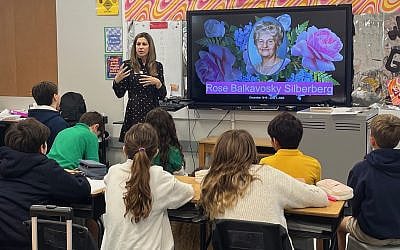
One story that captured their attention took place during her time in Elsnig, a sub-camp of Buchenwald. Twenty-six-year-old Rose was assigned to prepare breakfast in the kitchen for the SS women. After years of feeling like an animal, Rose asked herself, How do I feel human again? Her answer was simple. Help someone else.
She had discovered a hidden corridor that led to the infirmary, where sick Jewish prisoners lay. Even though she was risking her own life, she smuggled food to them every day. When I reach that part of the story, the room grows still and silent. The children’s eyes lock onto mine. Rose herself was starving. She knew she was not going to be able to save their lives. Yet, she still risked her own life to bring them food.
I tell the students that Rose was the only one in her family to survive multiple concentration camps. Doctors had subjected her to medical experiments intended to sterilize her. Yet, she later became pregnant. I can see the children beginning to understand. Because of that miracle, I am standing in front of them. My mother, my uncle, my cousins, my siblings, and my children exist because Rose survived. “I am lucky to be alive,” I tell them. “Every morning I say Modeh Ani, a Jewish prayer of thanks. I smile when I wake up. I shouldn’t be here, but here I am.” When I ask what they learned from Rose’s story, many say they feel grateful to be alive too.
The questions don’t stop at Rose’s choices. Once, after I told her story to a group of fifth graders, we discussed why we still teach the Holocaust. “So we don’t forget,” one student said. “So it doesn’t happen again,” said another. Their teacher said that what she took from the story was that every life matters. Then a boy asked: “But did Hitler’s life matter too?” His teacher paused. “What do you think?” I watched him struggle with the question. For a moment, the Holocaust was no longer simply a story about the past. He was trying to understand what it really meant to believe that every life matters, and whether believing it had limits.
Rose’s story is horrifying. But I know the part of the story that came after. She survived. She built a life. She was there, telling me what had happened. As an eight-year-old, I couldn’t fully understand what that meant, but I felt the difference. Her story was terrifying. But my grandmother was alive.
When I think about my grandparents, the Holocaust is not the first thing that comes to mind. I remember them together. I remember Grandma Rose sitting on the flowery sofa in my parents’ sunken living room, sometimes staring into the distance, possibly lost in memories I could not understand. I remember my grandfather Boris noticing when she seemed down and finding some way to make her laugh. When he would catch me staring at my grandmother’s sad expression, he would pull me aside and whisper, “Gitaleh, how you like to marry me? That vay you be your Mommy’s mother and you can be the boss, and you can tell her to clean her room!” He would grin and add, “But shhhhh, don’t tell nobody!” Then he would push his dentures out with his tongue, and I would burst out laughing.
When I was eight, I wanted to know why someone who had never met me could hate me. Surely, in my naïve logic, if people simply understood one another, if they knew one another, no one would choose hatred. I thought those things should have been enough. But my grandmother’s own life had taught her otherwise.
Before the Nazis came, a custodian in her building regularly joined her family for Shabbat meals. He knew them. He sat at their table. He was familiar enough with their home to feel almost like part of the family. And then the Nazis came, and it didn’t matter what his relationship was to them. They were Jews, and he and other neighbors chose to turn her family over to the SS.
It took me many years to understand what that story meant. Knowing someone is not the same as choosing to stand with them. We can teach kindness. We can teach empathy. We can teach people about Jewish life and Jewish history. All of that matters. But education cannot make a moral choice for someone. My grandmother could explain to me that hatred was taught. What she could not promise me was that understanding would cure it.
Some people will still choose hatred.
We cannot control what someone else chooses. What we can do is tell the truth, ask people to think, and give them the opportunity to decide what kind of person they want to be.
My grandparents told me more than I was ready to understand. But they also gave me something I could understand completely: that even after everything they had seen, life was still worth loving. Their cards were always signed, “A million kisses, Grandpa Boris and Grandma Rose,” and accentuated with red lipstick kisses. When I finish telling their story, I pass out Hershey’s Kisses and thank the children for bearing witness. It is my small way of passing forward the love my grandparents gave me.
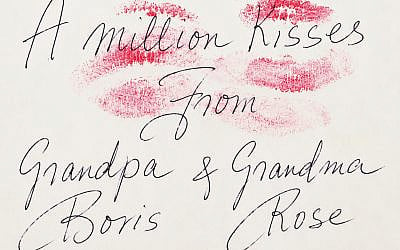
When I think about what Boris and Rose gave me, I don’t think first about the gas chambers or the camps. I think about how they made me feel. They told me about a world capable of unimaginable cruelty, and then they surrounded me with laughter, love, and lipstick kisses.
Now, when I stand in front of students as a 3GMiami speaker, I don’t tell their stories exactly the way they told them to me when I was eight. I begin with who Rose was before the Holocaust: a hardworking, poor, Orthodox Jewish girl who dreamed of Israel. I give children space to ask questions. I share the parts they can begin to understand, knowing that some questions will stay with them and grow as they do.
I don’t leave them stuck inside the worst thing that happened. I bring them back to the life Rose built afterward—a life I am lucky to be part of. I cannot decide what the students will ultimately believe or how they will choose to live. No teacher can. But I can give them the story. I can give them space to reflect and ask questions.
Today, I imagine Boris and Rose in the room with me as I share their stories. I am grateful that I can have meaningful, age-appropriate conversations with children about what happened to them. I am also grateful to share the values their lives taught me, so that their stories remain relevant to the children listening today.
But what I am most grateful for is the opportunity to share the love they gave me.
After everything they had survived, Boris and Rose still had a million kisses to give.
Related Topics
Related Posts