Executive VP, Hadassah Chicago-North Shore (CNS), Hadassah Writers' Circle
My Israel Trip Bonded Me to the Land and Its Resilient People I Love – Part One
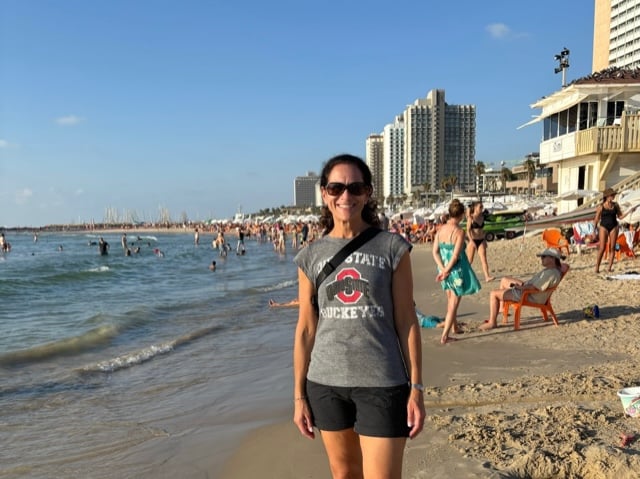
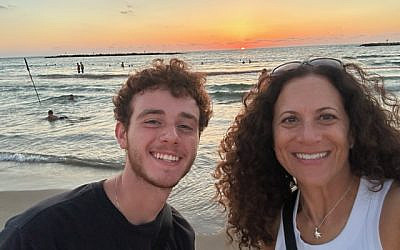
Author Nina Friedman at Tel Aviv Beach. Photo courtesy of the author.
This is the first column of a two-part series about the author’s recent travel to Israel.
After the October 7 massacre, I felt a longing to travel back to Israel to show my support for the country and the people I love. My trip with Authentic Israel, created in response to October 7 for people who wanted to volunteer in Israel, took place in September 2025. Of all my trips to Israel, this one connected me in the most visceral way and gave me a close-up view of the challenges and struggles Israelis now face in their everyday lives.
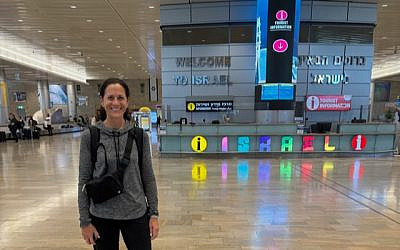
As I walked through a mostly empty Ben Gurion airport, gazing at the faces on the hostage posters that greeted me on the walkway, I knew I made the right decision to visit Israel as a volunteer — and I hadn’t even left the airport! It just felt so right to be there. My heart is full knowing those posters no longer line the welcome walkway, as all the living hostages have returned home.
After checking into our hotel in Tel Aviv, my friend and fellow volunteer and I walked straight to the beach. This was the weekend before school resumed and it seemed as if every Israeli was out savoring the last bit of summer vacation. The beach was packed with people of all ages, living life and having fun: families swimming in the water, teens sunbathing, and volleyballs, soccer balls and colorful Pro Kadima balls flying everywhere. That evening, we tried three or four different restaurants before finding one that had seating available. It was a stark contrast to the quiet of the airport earlier that day.
I was excited to spend the next day with Ron, a young Israeli who lived with my family for the past year through the ShinShinim program, a service year for Israeli high school graduates. These young people serve Jewish communities around the world prior to beginning their military service in the Israel Defense Forces (IDF). Ron had returned to Israel a few weeks prior to my visit.
I brought Ron homemade chocolate chip cookies and Chick-fil-A Sauce. We enjoyed a home-cooked meal with his family and then Ron took me to visit an overlook where he goes to chill and watch the sunset. It was wonderful seeing Ron’s life in Israel and getting to know his family.
Thanks to the time difference, I was up very early the next morning. The best thing to do when that happens is to walk along the Tayelet, the seaside Tel Aviv Promenade. Then my friend and I spent the rest of the day relaxing and dozing on the beach.
My Authentic Israel program began that evening. There were 19 of us from the US, Canada and Australia, two of whom were not Jewish. We got acquainted over dinner; Alon, our group leader, set the stage for the next seven days; and we heard an informative geopolitical briefing from a Middle East current affairs expert.
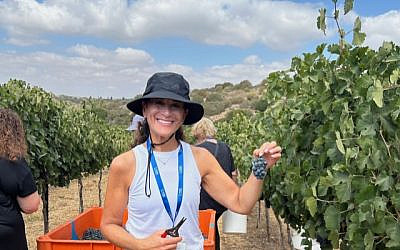
Our first volunteer location the next day was the Agur Winery in the Judean Hills. Our bus route took us past the spot where, according to Jewish history, David fought Goliath 3,000 years ago. Upon arrival, we had a brief demonstration, were handed cutters and got busy picking Syrah grapes in the scorching heat. We tested the grapes, which were insanely good, and were rewarded with lunch and a wine tasting after cooling off. We learned that wineries and other time-sensitive agricultural locations desperately needed volunteers because of the reduced number of workers being let in or coming to Israel and the absent workers now serving in the IDF.
We spent that afternoon helping out at Leket, Israel’s national food bank, sorting nearly 10,000 pounds of produce which was to go to 950 families. Leket rescues food surplus for people in need and, since October 7, has fed displaced families, provided food to non-profit organizations throughout Israel, and now also provides financial support to farmers to make up the difference in their lost revenue.
That evening we had dinner at the famous Dr. Shakshuka restaurant in Jaffa. Then some of us walked the Tayelet back to the hotel and experienced the hustle and bustle of the evening. The path and beach were filled with people running, walking, hanging out, playing night beach volleyball and listening to live music. There were young people and families everywhere — so many strollers and so many dogs!
Day two took us to Sderot to visit the memorial on the site of the police station that was tragically infiltrated on October 7. As we stood overlooking Gaza City from within the Gaza Envelope, we learned there were siren alerts in Tel Aviv, due to a Houthi missile, which sent people to shelters. I knew my relatives back home were getting the siren alerts so I texted them not to worry — we had left Tel Aviv and were safe. From our lookout, we could see white smoke in the distance emanating from Hamas tunnels that the IDF was blowing up.
Driving through Sderot on our way to volunteer at the Chesed soup kitchen we noted bomb shelters on nearly every block. There are some 7,000 shelters in Sderot alone, courtesy of the Israeli government. Some are brightly decorated.
The Chesed soup kitchen (where we chopped vegetables for the next day’s meal), typically feeds 50 people per day and makes food baskets that feed 500-600 families every two weeks. Chesed also operates a second-hand clothing store.
We stopped to eat our packed lunches with soldiers at the Shuva Junction food station, which provides free hot meals to soldiers going in and out of Gaza. I met and got to know some of them. I let them know we think about them and they have our support. I thanked the soldiers for their bravery and for defending our Jewish homeland.
Amazingly, while these soldiers are the ones on the front lines, they thanked us for visiting Israel and offering our support. They said it means so much to them. The soldiers also mentioned that, with the news they hear from America, it must be hard for us to support them. We reassured them this was not the case.
After lunch, we stopped at the car park where over 1500 vehicles, many burned, many full of bullets holes, memorialize the devastating cold-blooded murder of people fleeing the Nova Music Festival. I saw those cars on what is now known as “death road” in news clips following October 7. Seeing them in person was crushing.
The Nova Music Festival memorial site was our final stop for the day. With artillery fire in the background, and tears in my eyes, I stared at the endless faces of beautiful young people who were murdered by Hamas terrorists. It’s impossible to capture the experience fully, but the exquisitely written personal descriptions of each victim were heartbreaking and gut-wrenching.
As I made my way through the faces, I found myself in front of Hersh Goldberg-Polin’s picture. While I did not know him or his immediate family personally, I am acquainted with his grandmother Leah. His great grandmother and my grandmother were friends through Chicago Hadassah. I was with Leah at a local Chicago solidarity rally a few days after October 7.
I should also mention that Ayelet Segev, mother of Tomer who was killed at the Nova Music Festival, spent the day with us. Together, we visited Tomer’s picture. She had not been there before. It was a very heavy and sad day but an important and necessary one for us to experience.
In Part 2, I will share my experiences from the second half of this extraordinary trip.
Nina is a member of the Hadassah Writers’ Circle, a dynamic and diverse writing group for leaders and members to express their thoughts and feelings about all the things Hadassah does to make the world a better place. It’s where they celebrate their personal Hadassah journeys and share their Jewish values, family traditions and interpretations of Jewish texts. Hadassah members are proud of their Zionist mission and their role as keepers of the flame of Jewish values, traditions and beliefs as well as advocating for women’s empowerment and health equity for all. Since 2019, the Hadassah Writers’ Circle has published nearly 650 columns in The Times of Israel Blogs and other Jewish media outlets. Interested? Please contact hwc@hadassah.org.
Related Topics
Related Posts