My one sign against the hate of the ‘Flood NYC for Gaza’ protest was not enough
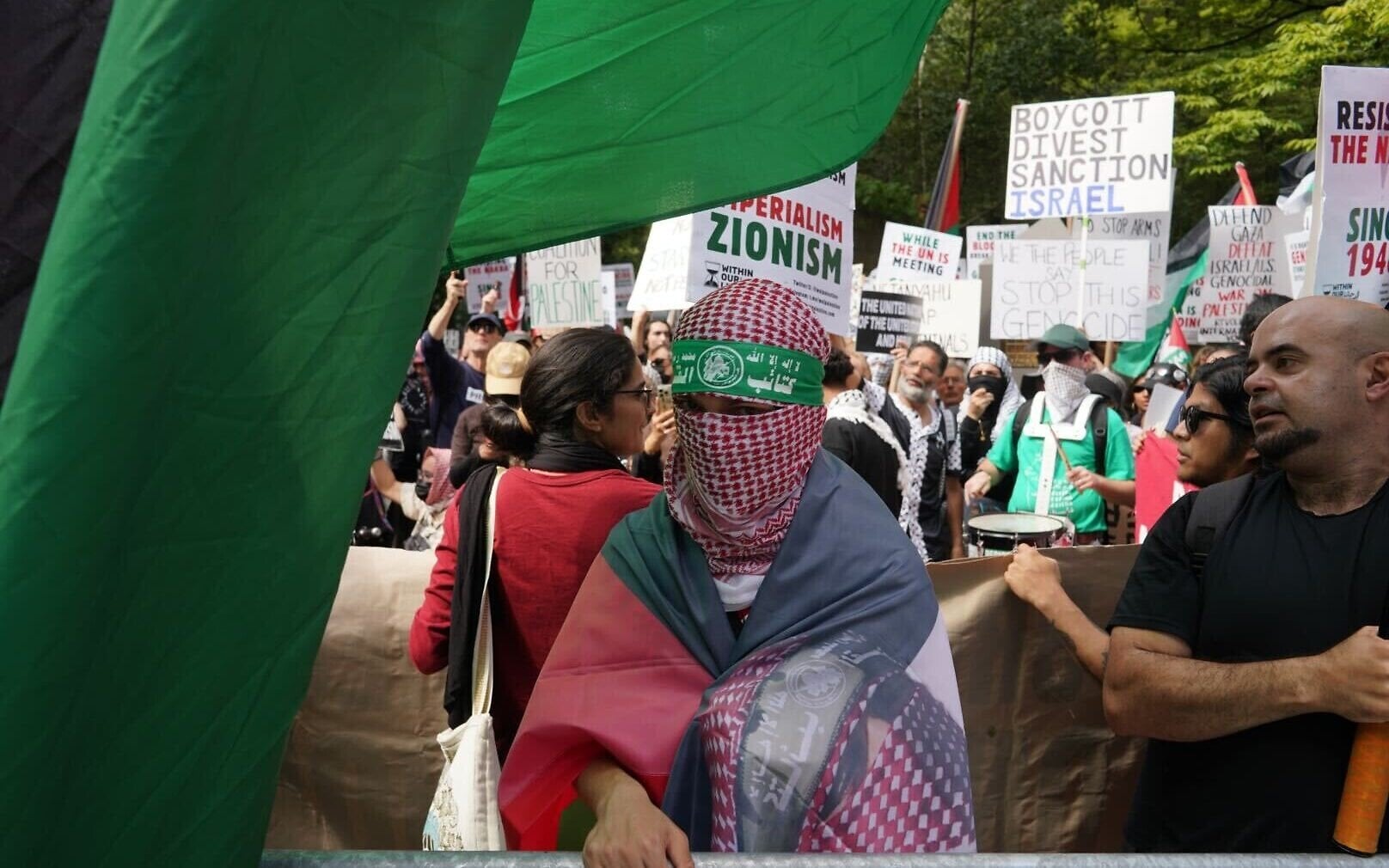
I walk into the growing “Flood NYC for Gaza” rally in midtown alone on the second anniversary of Hamas’s October 7th massacre, my counterprotest sign tucked away in a FedEx envelope. Because of the Jewish holiday of Sukkot, I don’t have my phone. The friend I had planned to meet is nowhere to be seen. I’m nervous, but more angry than afraid.
The rally’s name evokes the “Al Aqsa Flood,” the worst loss of Jewish life since the Holocaust. Hundreds of masked people fill the plaza on this October 7th anniversary, screaming not for the emerging peace deal, but for continued violence against Israel. They blame the Jews for the war’s devastation.
Many of the protesters look young, stylish — even trendy, much like the Democratic candidate vying to be our next mayor. One blonde woman with piercing blue eyes wears what looks to be a Bergdorf scarf as a keffiyeh; the tall young man beside her, calling for an end to Israel, sports designer sneakers. Do the KKK’s supporters also match robes to perfect pairs of shoes?
Mamdani refuses to confront this mob. No longer attending these rallies in person, he now lends them coded support from afar. His statement marking October 7th repeats every lie thrown at Israel — accusing it of genocide when Hamas sought this inferno; blaming the war on occupation, though Israel left Gaza in 2005; and calling Israel an apartheid state, despite its thriving Arab minority — while Gaza remains Judenrein.
Genocide, occupation, apartheid — these words are meant to inflame. They succeed. One sign reads “Israel has the right to go to Hell.” Another declares “Kill the Jews,” proudly displayed to a CBS cameraman more interested in his phone.
I find a small open space near the front, take out my sign, and lift it high: “We demand that Hamas free the hostages, disarm and disband, and end this terrible war — take the peace deal!” Any fear and anger dissolve; they have no place now. My work is to stand, silently and firmly, for what I believe.
It takes a minute, maybe two, for those around me to realize I’m broadcasting a different message. A college student screams in my ear that I’m a baby-killer. I don’t react.
A young man blocks my sign with his own. “I’m a subway-surfer,” he grins. “I’ll play this game all day.” He’s maybe 19. Israeli kids his age are in Gaza’s booby-trapped tunnels, confronting an enemy that glories in either their deaths or those of Palestinian civilians. “Subway surfing is dangerous,” I reply. “Please be careful.”
Soon, a group of women raise a massive banner in front of me, blocking me from view. I know this makes things riskier, but even if I’m now invisible, my sign can still be seen. I balance on my toes and lift it high above their banner, angled down toward the cameras. I want there to be a record that at least one person here stood against this hate.
I know it’s not enough.
My mother spent weekends in the Jim Crow South in the 1950s, working with the NAACP. With a Black colleague, she would book hotels to document their “Whites only” segregation policies. She exposed injustice — but later told me that she hadn’t done enough.
My father, Elie Wiesel, devoted his life to human rights, standing against Soviet oppression, defending Bosnian Muslims, hosting peace forums between Israelis and Palestinians, and confronting hatred and ignorance everywhere. He, too, feared he hadn’t done enough.
And as protesters finally tear away my sign and someone dumps coffee that soaks me through my suit, I walk away to jeers, knowing the fight is so much bigger than this insufficient moment. It is a fight that needs to be fought in classrooms, in the courts, and at the ballot box.
My father loved to tell the story of the just man of Sodom, who railed against wickedness even though no one listened. When asked why he kept shouting, he replied, “So they won’t change me.”
We have to stand against hatred.
Our kids are feeling it and watching how we respond.
My mother died earlier this year. She once brought our family to the Vienna street corner where she and her father had helplessly watched the Nazis march in during the Anschluss.
My father once imagined turning to my grandfather — murdered in the Holocaust — when Israel was under attack. He said he could almost hear my grandfather’s astonishment: “Wait, what do you mean — there’s an Israel?”
What a blessing it is to live in a world where we can still stand up for ourselves.
Let us make the most of that blessing. Let us continue giving the best of ourselves to make this world better. And when the haters come for us — as they have for millennia — let us stand firmly against them, not only online, but in the real world as well.