Pro-Zionist Peace Activist, Editor and Commentator
My Parents Fled Poland; I Visit as a Polish Citizen
My tour group spent Shabbat in Warsaw, with most choosing to pray at the Reform congregation (closer to Conservative in ritual). The Soviet-born, Israeli-raised rabbi hosted us for a kiddush-lunch and asked to hear about our feelings on coming to Poland. When my turn came, telling the congregants that my parents originally were Polish citizens from a shtetl in Eastern Galicia (now part of Ukraine), I was suddenly seized by emotion. I barely contained my sobs as I spoke of becoming a Polish citizen and arriving on a Polish passport; they responded with applause.
What had overwhelmed me was a profound sense of connection to my parents and their losses in the land of their birth: both losing parents (my grandparents), and my father losing two sisters, a brother, and more nieces and nephews than I know in a country that didn’t always respect them, and had failed to protect them.
It’s not that I blame Poland for its inevitable defeat in 1939, nor for what ultimately happened. Stalin is to blame for allying with Hitler in the first place, partnering in the dismemberment of Poland, and then being totally fooled by Nazi blandishments under the German-Soviet non-aggression pact. My relatives lived for nearly two years under Soviet occupation before the final Nazi onslaught on what had been Polish territory.
On Tour, Sept. 8-17, 2025
Along with 26 others, I participated in a 10-day Jewish heritage tour, organized by Nancy Sinkoff, a professor of Jewish history at Rutgers and a member of my synagogue. It was hosted in Poland by the Taube Center for Jewish Life and Learning. Prof. Sinkoff dubbed our experience, “Poland, Then and Now, Through Jewish Eyes.” She briefed us daily, and introduced a select group of speakers who met with us periodically. We perused the sights of Warsaw, Krakow, Gdansk and Auschwitz-Birkenau accompanied by friendly and informative Polish guides.
Poland has probably never been more prosperous. The three major cities we visited appear to be well put together, with pedestrian-friendly squares and walkways, rapid trolley service and clean and reliable intercity train lines.
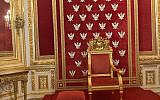
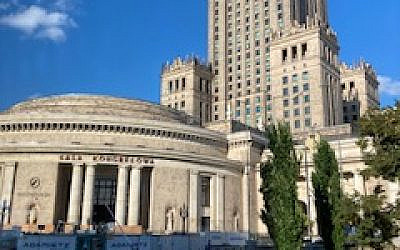
Warsaw, Poland’s capital with nearly two million inhabitants, was reborn after being 90% destroyed during World War II. Much of its reconstruction was influenced by the cold massive architectural style favored during the 40+ years under Stalinist rule, and exemplified by the Palace of Science and Culture — an enormous structure that the post-Communist governments chose to leave standing over a large pedestrian square. Also impressive, but less for its size than its ornate interior, is the Royal Palace. [All photos in this post are mine.]
But a must-see for Jews is its world-class Polin Museum, which recounts the thousand-year history of Jews in Poland. It pulled no punches in a temporary exhibit depicting the antisemitism faced by survivors of the Holocaust in its immediate aftermath, either in attempting to return to normal life in Poland or simply passing through. It also provides a vivid primer for non-Jews about Jews and Judaism; many if not most of its visitors are likely not Jews.
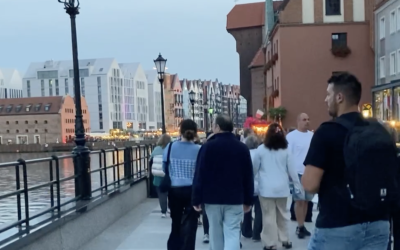
Gdansk has a lively night scene of cafes and restaurants near the port. It holds historical significance both as the pretext for Nazi Germany’s invasion of Poland in 1939 to conquer what was then the German-majority city of Danzig, and as the birthplace of the Solidarity union movement that ultimately led to the fall of Communism in Poland and Eastern Europe. We visited both its very impressive World War II museum (which focuses on the war in Europe), and the Solidarity Center commemorating those transformative events of the 1980s.
Krakow
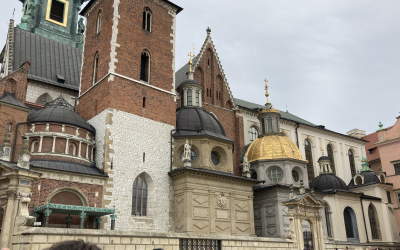
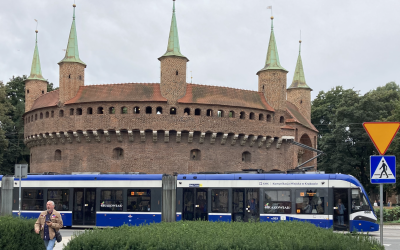
Krakow, the old royal capital, is notable for some striking sites, from both its time under Austrian rule and previously.
Our first destination was Kazimierz, the historically Jewish district, including old synagogues and a graveyard where the 16th century Talmudist, Rabbi Moses Isserles (also known as “Rema”) is buried. As our guide explained, Isserles wrote a commentary called the “Mapah” (tablecloth) for Joseph Caro’s Shulhan Aruch (well-ordered table). Our guide’s reverence for, and familiarity with Jewish learning set us up for his surprise revelation at the end that he’s not Jewish. (More on our guides later.)

Krakow has a massive central plaza where we ate lunch on our final full day, a free-choice meal that a few of us chose at a small eatery called “Kasha-Nasha.”
Auschwitz-Birkenau
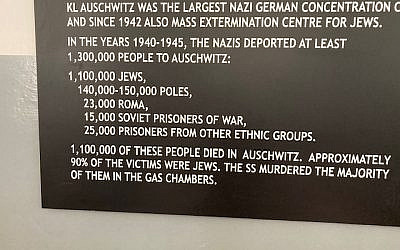
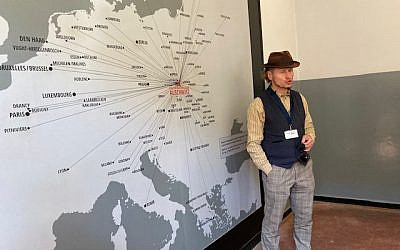
On our penultimate day, we went where one expects a Jewish tour to go. With good traffic, Krakow is 90 minutes from Auschwitz-Birkenau. It’s a massive complex centered within a “zone of interest” (as referenced in the multiple award-winning film bearing this name) — about 15 square miles, mostly wooded terrain with rivers running through, that convinced the Nazis to choose this site for their largest extermination center. A major criterion was the town of Oswiecim’s central location within Poland, and as a preexisting hub for railroad lines from most of Europe. (I had previously thought that Auschwitz was further east.)
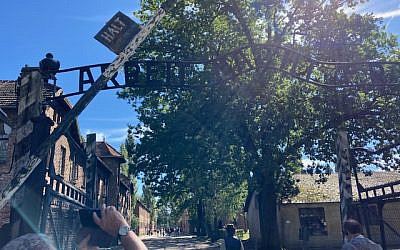
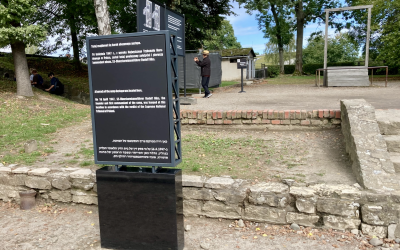
It was explained that the infamous “Arbeit Macht Frei” arch includes a small gesture of defiance — the “B” is upside down. Auschwitz is the older section of the death camp, expanded from a 1920s-era Polish army camp, with solid two-story buildings. Birkenau was developed later — a massive killing center with huge gas chambers and crematoria, which gassed and burned 90% of new arrivals directly from the cattle cars, within an hour or two. In contrast to Auschwitz, the prisoners kept alive in Birkenau as slave laborers were housed in prefab buildings that were very bare-bones, to say the least. The entire complex is so large that it made sense to return to our bus to go from Auschwitz to Birkenau.
Nowa Huta
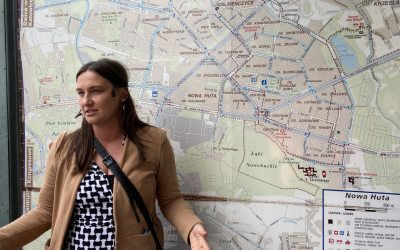
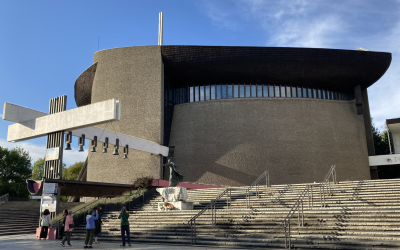
We came here on our last full day in order to experience a slice of modern-day Poland that’s not related to its Jewish past. Now a part of Krakow, Nowa Huta was built by Poland’s post-war Stalinist regime as a planned showcase city. There were problems at the start due to shoddy materials and other issues, but it’s now considered a desirable place to live in, with relatively reasonable prices and amenities for young families, including an admirable amount of green space.
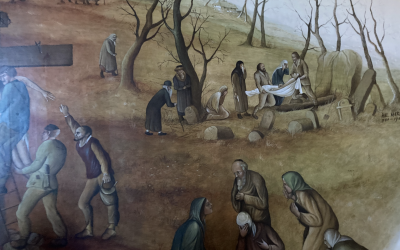
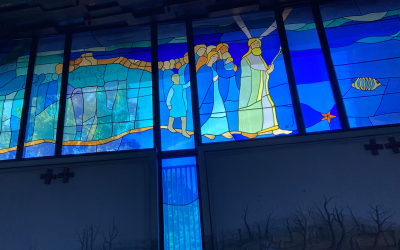
Since it was built as a model town by a militantly atheistic regime, there were no churches at first, but inhabitants insisted on attending open-air masses, even in bad weather. Eventually, Krakow’s Archbishop Karol Wojtyła (later to become Pope John Paul II), successfully negotiated with the government to build a church, constructed by funds, labor and materials happily donated by everyday Poles (including some Jews — as indicated on a wall listing groups of donors). Our guide highlighted Jewish resonances: the architect had Jewish origins (I don’t recall exactly what that consisted of), the stain glass murals include a scene from Exodus with Moses leading the Israelites across the sea’s parting waves, and the Crucifixion depicting noticeably Jewish figures in mourning.
Warsaw
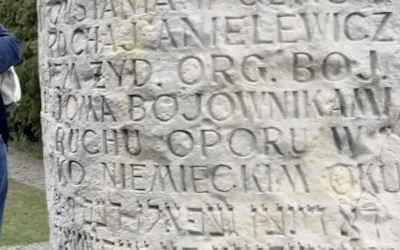
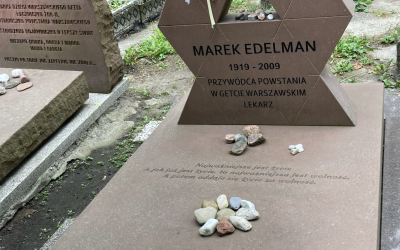
If I seemed to give Warsaw short shrift, it’s because it’s the obvious place to focus upon, yet there was so much else that’s not as well known. We, of course, saw traces of the Warsaw Ghetto, memorial plaques and other places of remembrance — e.g., the final resting place of Mordechai Anielewicz, the first commander of the Warsaw Ghetto fighters, and those who perished with him in the command bunker at Mila 18. We also visited the famous Jewish cemetery; it survived the war despite some damage sustained during the uprising in Warsaw by the Polish Home Army in the summer of 1944.
Our Guides
I can’t say enough about how good they were, along with the staff from the Taube Center who made the arrangements on the ground and shepherded us through safely and expeditiously. Our guides were well-informed and also aware and respectful of Jewish sensitivities. Most were not Jewish.
Among the Jews we met was our first guest speaker, Konstanty Gebert, a highly-respected journalist and activist who founded the “Jewish Flying University” in the 1970s, an underground network for the study and discussion of Jewish issues; he joined the Solidarity movement that struggled to end Communist rule in the 1980s. Today, Gebert is a member of the Orthodox synagogue where one of our group davened on Shabbat. He was not the only one we heard from who believes that the former right-wing nationalist ruling party, Law and Justice, will probably return to power with the next parliamentary election. Among other things during its time as the governing party, 2015-2023, it banned scholarly work on Polish antisemitism, branding it as “defaming the Polish nation.”
What especially impresses me about our non-Jewish guides is how aware and fair-minded they are about the reality of Polish antisemitism; they exemplify the best of the liberal-minded inclusive Polish tradition that goes back to what was intended for modern Poland by its 20th century liberator, Joseph Pilsudski, Poland’s George Washington. As we walked through an old section of Krakow toward the main plaza, our guide spoke frankly with us about Poland’s dark turn toward antisemitism after Pilsudski’s death in 1935, characterized by a boycott of Jewish businesses and a restrictive quota limiting Jewish admissions to universities.
Related Topics