
My Prayer for the Chittagong Hill Tracts and Israel
(Note: Today, October 7, marks the second anniversary of the Hamas attack on Israel. From Tokyo, I share my heartfelt condolences with the families who lost their loved ones and with all Israelis who continue to carry that pain. May their memory be eternal, may every hostage return home safely, and may peace someday rise from the ashes of sorrow.)
A Buddhist festival took place in the Chittagong Hill Tracts, Bangladesh, last night. I saw that many were posting video clips on social media. I know what it means to the Hill Tracts.
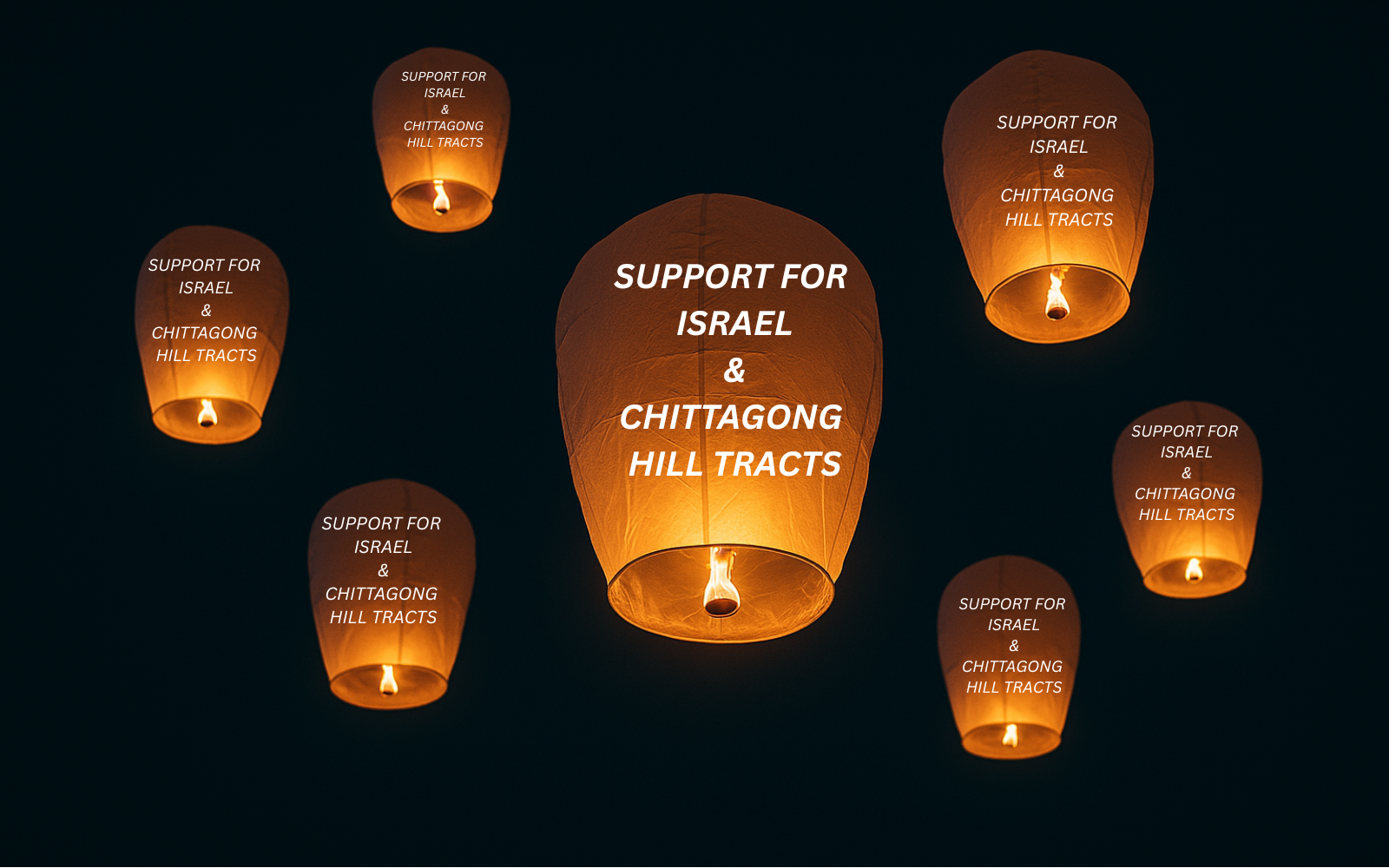
I stood on my balcony in Tokyo and I imagined the sky of my birthplace, the Chittagong Hill Tracts, glowing with hundreds of fanush lanterns rising into the night.
Yes, it was the Buddhist festival. Though I now live thousands of miles away, I could almost feel that warmth again. I could not see them, but I could remember every flicker, every spark like prayers made of paper and fire drifting toward heaven.
I was born in the Chittagong Hill Tracts, one of the most persecuted Christian minorities in Bangladesh. Yet in spirit, I have always belonged to Israel. Two lands, far apart, bound by one truth: both have struggles to survive against the rising tide of radicalism that seeks to erase them.
The fanush has always been a fragile thing- thin paper held together by bamboo, carrying a small flame inside. It rises slowly, trembling against the wind. Some burn too soon, some vanish into the clouds. But the few that survive shine longer, floating far above human noise.
In that memory, I see both the Chittagong Hill Tracts and Israel reflected in those fragile lights. Both hold their faiths close to the flame — fragile yet unyielding. Both are surrounded by forces that wish to extinguish their light — radicalism, hatred, and endless propaganda. And yet, both continue to rise, carried not by power but by the conviction that light was meant to shine.
The Chittagong Hill Tracts, my birthplace, is home to 13 Indigenous peoples who continue to face ethnic cleansing, religious persecution, and cultural erasure. Churches are still being burned, Buddhist temples attacked, women assaulted, and children remain unheard.
You may not believe it, but in Bangladesh, faith became both a shield and a scar for us. I was born Christian, yet my childhood was shaped by the sound of Buddhist drums, the smoke of fanush fires, and the fear of Bangladeshi soldiers who saw difference as defiance. We prayed for peace, but peace never came from those who preached it the loudest.
In those moments of despair, I began to understand the Bible not as a distant book but as a mirror. Because Israel’s story — of a people returning, surviving, defending their right to exist was the story I recognized in our hills. A nation surrounded, yet standing. A people misunderstood, yet steadfast.
You do not have to be born in Jerusalem to feel the heart of Israel. You only have to understand what it means to be hated for who you are. That is why, even from the hills of Bangladesh, I have always felt connected to Israel, not politically, but spiritually. Because Israel is not only a land, it is a living proof that faith can outlast fear.
When I see rockets fired toward Tel Aviv, I see more than geopolitics. I see the same fire that burned our villages in the Chittagong Hill Tracts. When I see the world blaming Israel for defending itself, I hear the same silence that followed our cries. And when I see Israelis rebuilding, surviving, planting, and praying, I see what the human spirit was designed to do — rise again, like a fanush in the night.
Both Israel and the Chittagong Hill Tracts face a common danger — radical Islamist expansion disguised as faith, powered by hatred, and funded by those who profit from chaos. In Bangladesh, it hides under nationalism; in the Middle East, under resistance.
But the script remains the same: deny identity, erase those who are different, rewrite history. It is a war not only on land but on truth. The truth is that those who speak of peace the loudest are often the ones who fear the light the most. They fear light because it exposes their hypocrisy, that their idea of peace demands silence from the persecuted.
Here in Tokyo, as I watched the city lights fade into the quiet of the night, I felt that old connection again — a longing for peace in both the land of my birth and the land of my spirit. I whispered a prayer silently that belonged to both.
“May the hills sleep in safety again.
May Jerusalem always stand in light.
And may no child, whether in the Hill Tracts or in the Negev, ever again grow up learning the sound of fear.”
Faith is not geography. It is a direction — toward truth, toward justice, toward God. And I believe the God who listens to the prayers of Israel also hears the cries from the Chittagong Hill Tracts. The two may never meet on a map, but they are already united in the sky — where every fanush that rises from the Chittagong Hill Tracts and every candle lit in Jerusalem burns with the same flame of faith, hope, and defiance.
I was born in a land where people are punished for believing differently, and I stand with a nation that refuses to apologize for its existence. Between these two, I find my purpose. Because whether you call it fanush or light, the truth remains: darkness never wins — it only waits for those who forget to rise.
Long live Israel, and may the Chittagong Hill Tracts stand strong.
October 7, 2025
Tokyo, Japan